Two open reservoir gravity equalization time calculator
Estimate the time for two large open reservoirs to approach a target water-level difference through a small connecting opening.
How to use this calculator
Estimate the time for two large open reservoirs to approach a target water-level difference through a small connecting opening.
- Enter First reservoir plan area (m²), Second reservoir plan area (m²), Initial water-level difference (m), Target water-level difference (m), then complete the remaining labeled fields. Match the units shown beside each field and review the result together with the assumptions below.
- Read the worked example below to check the expected input format and result.
- Compare another scenario by changing one input at a time. Use Reset to return to the starting values.
How the Two open reservoir gravity equalization time calculator works
Estimate the time for two large open reservoirs to approach a target water-level difference through a small connecting opening.
Inputs and units
- First reservoir plan area (m²): Plan area of reservoir 1, treated as constant over the level change.
- Second reservoir plan area (m²): Plan area of reservoir 2, treated as constant over the level change.
- Initial water-level difference (m): Initial positive water-level difference in metres.
- Target water-level difference (m): Target remaining level difference; must be between zero and the initial difference.
- Connecting opening area (m²): Area of the connecting opening in square metres.
- Effective connecting coefficient: Effective dimensionless discharge coefficient for that opening and flow arrangement.
Formula and method
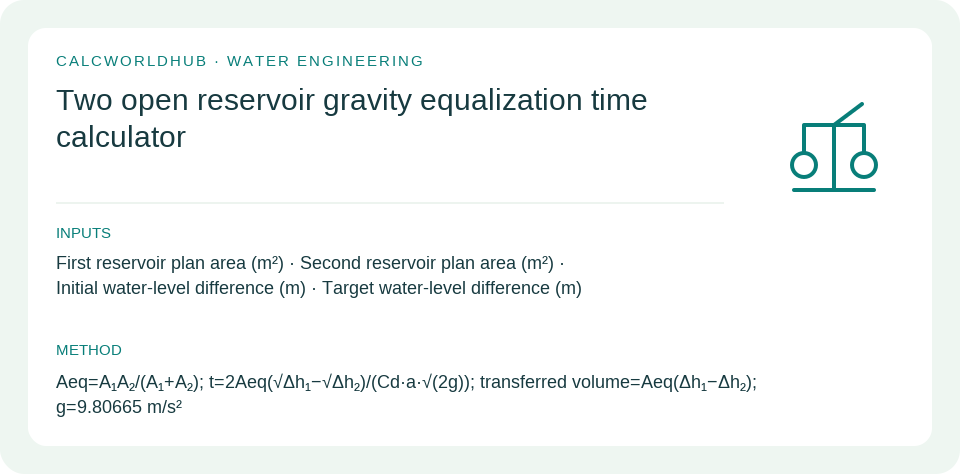
Aeq=A₁A₂/(A₁+A₂); t=2Aeq(√Δh₁−√Δh₂)/(Cd·a·√(2g)); transferred volume=Aeq(Δh₁−Δh₂); g=9.80665 m/s²
Worked example
With areas 20 and 30 m², head differences 2.0 and 0.1 m, opening 0.03 m², and Cd=0.6, Aeq=12 m², transferred volume=22.8 m³, and t≈330.6 s using standard g=9.80665 m/s².
Interpreting the result
The time is an idealized gravity-flow estimate to the specified residual head difference; it assumes the reservoirs' plan areas stay constant.
Assumptions and limits
Assumes open reservoirs, quasi-steady orifice discharge, negligible pipe losses and approach velocity, constant discharge coefficient, and no pump or external inflow. Real connecting-pipe friction can increase time substantially.
Sources and method
- Orifice discharge depends on head and an experimentally grounded coefficient; the reservoir model simplifies connecting losses. U.S. Bureau of Reclamation Water Measurement Manual: orifice relationships
- Lists standard gravity gₙ=9.80665 m/s²; this model uses that conventional value rather than a site-specific measured acceleration. NIST Guide to the SI: standard acceleration of free fall
Frequently asked questions
What does the target head difference mean?
It is the remaining water-level difference at which the idealized transfer is considered complete; it cannot exceed the initial difference.
Why may actual equalization take longer?
Pipe friction, entrance losses, changing discharge coefficient, reservoir geometry, and nonuniform flow are omitted from the simplified model.
How do I use the Two open reservoir gravity equalization time calculator?
Enter First reservoir plan area (m²), Second reservoir plan area (m²), Initial water-level difference (m), Target water-level difference (m), then complete the remaining labeled fields. Match the units shown beside each field and review the result together with the assumptions below.
What is a worked example of Two open reservoir gravity equalization time?
With areas 20 and 30 m², head differences 2.0 and 0.1 m, opening 0.03 m², and Cd=0.6, Aeq=12 m², transferred volume=22.8 m³, and t≈330.6 s using standard g=9.80665 m/s².
What does the Two open reservoir gravity equalization time calculator calculate?
Estimate the time for two large open reservoirs to approach a target water-level difference through a small connecting opening.
See the calculation methodology.