How to use this calculator
Approximate water volume between two reservoir elevations from the surface area measured at each level.
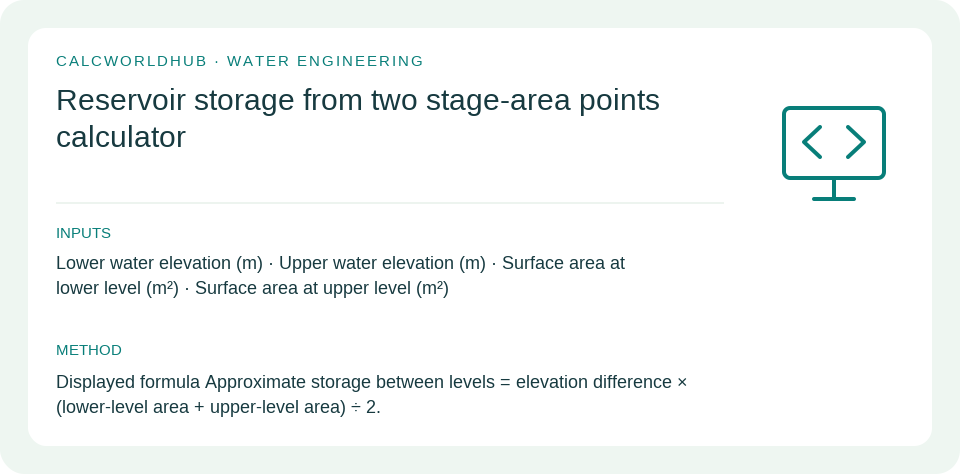
- Enter Lower water elevation (m), Upper water elevation (m), Surface area at lower level (m²), Surface area at upper level (m²). Match the units shown beside each field and review the result together with the assumptions below.
- Read the worked example below to check the expected input format and result.
- Compare another scenario by changing one input at a time. Use Reset to return to the starting values.
How this calculation works
When only two elevation-area observations are available, a trapezoidal approximation treats the water-surface area as changing linearly between the levels. This estimates the incremental storage in that band and is useful for a quick survey check, but it is not a complete stage-storage curve.
Inputs and units
lowerElevation— Lower water elevation (m)- Lower stage in the selected vertical datum.
upperElevation— Upper water elevation (m)- Upper stage in the same vertical datum; must exceed the lower stage.
lowerArea— Surface area at lower level (m²)- Horizontal water-surface area at the lower elevation.
upperArea— Surface area at upper level (m²)- Horizontal water-surface area at the upper elevation.
Formula
Approximate storage between levels = elevation difference × (lower-level area + upper-level area) ÷ 2.
Method
Enter the lower and upper water elevations and the corresponding horizontal water-surface areas. The elevations must be in the same datum, and the area units must be square units consistent with the elevation unit; for meters and square meters, the result is cubic meters.
Worked example
Between elevations 100 m and 105 m, with areas of 40,000 m² and 50,000 m², the approximate storage is 5 × (40,000 + 50,000) ÷ 2 = 225,000 m³.
Assumptions and limits
The trapezoidal rule assumes area changes linearly between the two measured elevations. Irregular basin shape, sparse survey points, sedimentation, and changing shorelines can make this approximation less accurate. Use a surveyed elevation-storage curve for design or operations.
Frequently asked questions
Is this the reservoir’s total capacity?
It estimates only the storage between the two entered elevations; storage below the lower level is not included.
Why is it an approximation?
The trapezoidal method assumes surface area changes linearly between the two survey points.
Can I use feet and acres?
The displayed result is in cubic meters; convert elevation to meters and area to square meters first, or use another consistent-unit method.
How do I use the Reservoir storage from two stage-area points calculator?
Enter Lower water elevation (m), Upper water elevation (m), Surface area at lower level (m²), Surface area at upper level (m²). Match the units shown beside each field and review the result together with the assumptions below.
What is a worked example of Reservoir storage from two stage-area points?
Between elevations 100 m and 105 m, with areas of 40,000 m² and 50,000 m², the approximate storage is 5 × (40,000 + 50,000) ÷ 2 = 225,000 m³.
Reference: USACE HEC-HMS reservoir storage methods. See our calculation methodology.