How to use this calculator
Estimate air vapor pressure deficit from temperature and relative humidity for crop and greenhouse monitoring.
- Enter Air temperature (°C), Relative humidity (%). Match the units shown beside each field and review the result together with the assumptions below.
- Read the worked example below to check the expected input format and result.
- Compare another scenario by changing one input at a time. Use Reset to return to the starting values.
How this calculation works
Vapor pressure deficit is the difference between saturation vapor pressure at an air temperature and the actual vapor pressure implied by relative humidity. It describes atmospheric drying demand, but does not by itself determine plant water stress or irrigation need.
Inputs and units
temperatureC— Air temperature (°C)- Use the air temperature measured near the crop canopy.
relativeHumidity— Relative humidity (%)- Enter relative humidity from 0 to 100 percent.
Formula
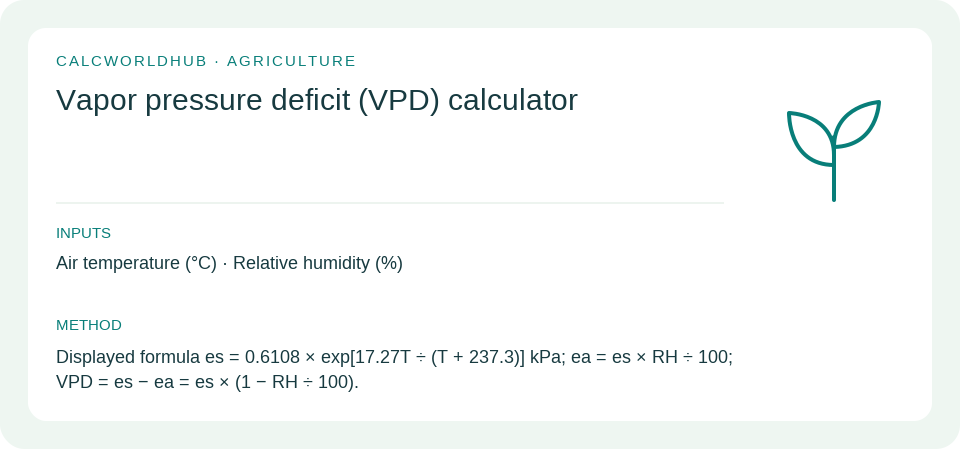
es = 0.6108 × exp[17.27T ÷ (T + 237.3)] kPa; ea = es × RH ÷ 100; VPD = es − ea = es × (1 − RH ÷ 100).
Method
Enter air temperature in °C and relative humidity in percent. The FAO Tetens saturation-vapor-pressure relation estimates es, and multiplying by relative humidity estimates actual vapor pressure ea.
Worked example
At 25°C and 60% relative humidity, saturation vapor pressure is about 3.168 kPa, actual vapor pressure about 1.901 kPa, and VPD about 1.267 kPa.
Assumptions and limits
This is an air-only estimate. Leaf temperature, crop species, stomatal response, airflow, substrate water, and sensor placement affect plant conditions; VPD should not be treated as a universal irrigation trigger.
Frequently asked questions
What does a higher VPD mean?
It means a larger gap between saturation and actual vapor pressure in the air, which generally increases evaporative demand.
Should I use leaf or air temperature?
This calculator uses air temperature. Leaf temperature can differ and may be needed for leaf-to-air VPD analysis.
Does VPD alone set an irrigation schedule?
No. Root-zone water, crop stage, radiation, airflow, and soil or substrate conditions also matter.
How do I use the Vapor pressure deficit (VPD) calculator?
Enter Air temperature (°C), Relative humidity (%). Match the units shown beside each field and review the result together with the assumptions below.
What is a worked example of Vapor pressure deficit (VPD)?
At 25°C and 60% relative humidity, saturation vapor pressure is about 3.168 kPa, actual vapor pressure about 1.901 kPa, and VPD about 1.267 kPa.
Reference: FAO meteorological calculation guidance. See our calculation methodology.