How to use this calculator
Estimate raw vector bytes and provisioned storage after metadata, index overhead, and replication assumptions.
- Enter Number of vectors, Dimensions per vector, Bytes per stored scalar, Metadata bytes per vector, then complete the remaining labeled fields. Match the units shown beside each field and review the result together with the assumptions below.
- Read the worked example below to check the expected input format and result.
- Compare another scenario by changing one input at a time. Use Reset to return to the starting values.
How this calculation works
Embedding dimensions and row counts give a reliable raw-vector baseline, but a vector service also stores metadata and an index and may keep replicas. Enter those allowances separately to see how much storage comes from the embeddings themselves and how much comes from the surrounding deployment.
Inputs and units
vectorCount— Number of vectors- Number of embedding records to store.
dimensions— Dimensions per vector- Number of scalar values in each embedding.
bytesPerValue— Bytes per stored scalar- For example, 4 for 32-bit float or 2 for 16-bit float, before any database encoding overhead.
metadataBytes— Metadata bytes per vector- Approximate serialized metadata allocated to each vector.
indexOverheadPct— Index overhead relative to raw vectors (%)- User-entered allowance for the vector index, calculated as a percentage of raw vector bytes.
replicas— Stored copies / replicas- Number of complete copies of the vector, metadata, and index footprint.
Formula
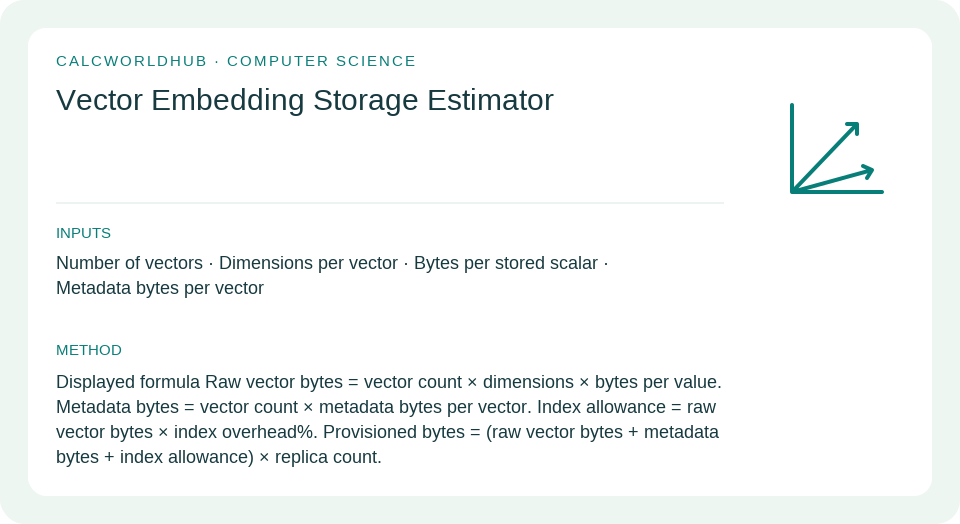
Raw vector bytes = vector count × dimensions × bytes per value. Metadata bytes = vector count × metadata bytes per vector. Index allowance = raw vector bytes × index overhead%. Provisioned bytes = (raw vector bytes + metadata bytes + index allowance) × replica count.
Method
The raw-vector term assumes a fixed number of bytes for every scalar. Metadata and index overhead are user-entered estimates; replicas multiply the combined per-copy footprint. Decimal GB uses 10⁹ bytes and GiB uses 2³⁰ bytes.
Worked example
Ten million 1,536-dimensional vectors stored as 4-byte values use 61.44 GB of raw vector data. With 200 metadata bytes per vector and 25% index overhead on raw vectors, one copy is 78.80 GB; two copies require about 157.60 GB before backups or service-specific overhead.
Assumptions and limits
Index structures, metadata serialization, compression, filtering structures, backups, and replication behavior vary by database and configuration. The entered overhead is a planning assumption, not a vendor guarantee or a quote for cloud storage.
Frequently asked questions
What is the difference between GB and GiB?
GB here means one billion bytes; GiB means 1,073,741,824 bytes. The page displays both for comparison.
Does the index overhead percentage come from a specific database?
No. Enter an estimate measured or documented for your selected index and configuration.
Should metadata include IDs and filters?
Include the serialized fields that your storage plan needs, based on the database's actual representation.
Does replication include backups?
No. Replica count multiplies the live per-copy estimate; backups and snapshots are not included.
How do I use the Vector Embedding Storage Estimator?
Enter Number of vectors, Dimensions per vector, Bytes per stored scalar, Metadata bytes per vector, then complete the remaining labeled fields. Match the units shown beside each field and review the result together with the assumptions below.
Read our calculation methodology.