How to use this calculator
Compare wastewater pollutant mass loads entering and leaving treatment, accounting for flow at both boundaries.
- Enter Influent concentration, Influent flow, Effluent concentration, Effluent flow. Match the units shown beside each field and review the result together with the assumptions below.
- Read the worked example below to check the expected input format and result.
- Compare another scenario by changing one input at a time. Use Reset to return to the starting values.
How this calculation works
Mass-load removal compares a pollutant’s influent and effluent loads for the same sampling interval. Calculate each load from concentration and its matching flow before comparing them; concentrations alone can misstate removal when flow changes.
Inputs and units
influentConcentrationMgL— Influent concentration- Influent concentration in milligrams per litre (mg/L).
influentFlowM3Day— Influent flow- Influent flow for the matching sampling interval, in cubic metres per day (m³/day).
effluentConcentrationMgL— Effluent concentration- Effluent concentration for the same pollutant and interval, in mg/L.
effluentFlowM3Day— Effluent flow- Effluent flow for the matching sampling interval, in m³/day.
Formula
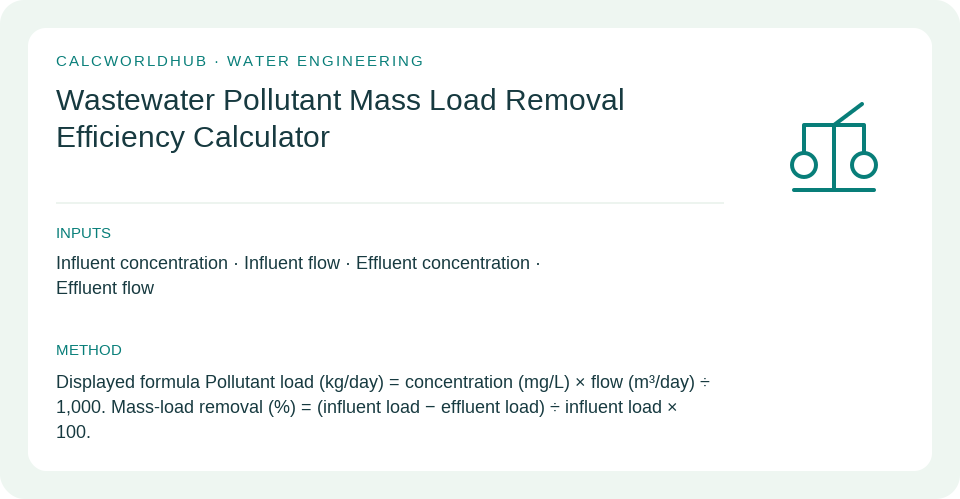
Pollutant load (kg/day) = concentration (mg/L) × flow (m³/day) ÷ 1,000. Mass-load removal (%) = (influent load − effluent load) ÷ influent load × 100.
Method
Use paired, representative influent and effluent measurements for the same pollutant and interval. Convert each concentration-flow product to the same mass-per-time unit before calculating the difference.
Worked example
Influent water at 50 mg/L and 1,000 m³/day carries 50 kg/day. Effluent at 10 mg/L and 900 m³/day carries 9 kg/day, so net mass-load removal is 41 kg/day or 82.00%.
Assumptions and limits
A negative removal result means the measured effluent load exceeds the influent load for the entered interval. Sampling alignment, pollutant transformation, and side streams can affect interpretation.
Frequently asked questions
Why include flow?
Pollutant mass load is concentration multiplied by the matching flow. Flow can change across treatment.
Can removal be negative?
Yes. A higher effluent load produces a negative result and may indicate a load increase or mismatched measurements.
Can I mix different sampling intervals?
No. Pair representative influent and effluent values from the same interval and pollutant basis.
How do I use the Wastewater Pollutant Mass Load Removal Efficiency Calculator?
Enter Influent concentration, Influent flow, Effluent concentration, Effluent flow. Match the units shown beside each field and review the result together with the assumptions below.
What is a worked example of Wastewater Pollutant Mass Load Removal Efficiency?
Influent water at 50 mg/L and 1,000 m³/day carries 50 kg/day. Effluent at 10 mg/L and 900 m³/day carries 9 kg/day, so net mass-load removal is 41 kg/day or 82.00%.
Reference: U.S. EPA Appendix L paired influent/effluent pollutant-load removal method. See our calculation methodology.