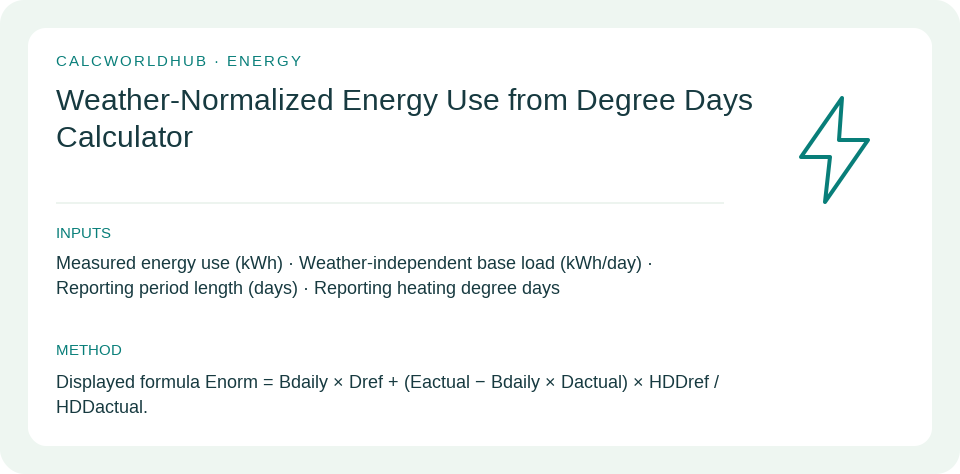
How to use this calculator
Estimate heating energy use at reference heating degree days using a base-load-plus-ratio method.
- Enter Measured energy use (kWh), Weather-independent base load (kWh/day), Reporting period length (days), Reporting heating degree days, then complete the remaining labeled fields. Match the units shown beside each field and review the result together with the assumptions below.
- Read the worked example below to check the expected input format and result.
- Compare another scenario by changing one input at a time. Use Reset to return to the starting values.
How this calculation works
A simple ratio method separates an estimated weather-independent base load from the weather-sensitive part of measured energy use. It scales only the latter in proportion to reference versus observed heating degree days.
Inputs and units
actualEnergy— Measured energy use (kWh)- Total energy use during the reporting billing period, in kilowatt-hours.
baseLoadDaily— Weather-independent base load (kWh/day)- Estimated daily energy use that does not vary with heating degree days.
reportingDays— Reporting period length (days)- Number of days covered by the measured energy and reporting degree days.
reportingHdd— Reporting heating degree days- HDD total for the same reporting period and selected base temperature.
referenceHdd— Reference heating degree days- HDD total for the reference period using the same base temperature and degree-day method.
referenceDays— Reference period length (days)- Number of days in the reference period for which normalized use is estimated.
Formula
Enorm = Bdaily × Dref + (Eactual − Bdaily × Dactual) × HDDref / HDDactual.
Method
Enter measured energy use and billing-period length, an estimate of non-weather base load per day, reporting-period heating degree days, reference-period heating degree days, and reference-period length. Use degree days with the same base temperature and method.
Worked example
For 1,200 kWh over 30 days, a 10 kWh/day base load, 300 reporting HDD, and 360 reference HDD over 30 days, weather-normalized use is 1,380 kWh, an upward adjustment of 180 kWh.
Assumptions and limits
This transparent ratio estimate is not a regression model or a standard whole-building normalization. It assumes all energy above the entered base load varies linearly with heating degree days. Use heating-dominated periods with comparable operations; it does not model cooling degree days, occupancy, production, solar gain, or equipment efficiency changes.
Frequently asked questions
Does this replace a building energy model?
No. It is a simple ratio estimate for a heating-dominated period and omits other explanatory factors.
Can I compare HDD in different units?
No. Use the same degree-day base temperature and method for reporting and reference periods; the ratio is meaningful only for consistent data.
What if measured use is below the base load estimate?
The inputs are inconsistent for this model. Revise the base-load estimate or use a method that fits your data.
How do I use the Weather-Normalized Energy Use from Degree Days Calculator?
Enter Measured energy use (kWh), Weather-independent base load (kWh/day), Reporting period length (days), Reporting heating degree days, then complete the remaining labeled fields. Match the units shown beside each field and review the result together with the assumptions below.
What is a worked example of Weather-Normalized Energy Use from Degree Days?
For 1,200 kWh over 30 days, a 10 kWh/day base load, 300 reporting HDD, and 360 reference HDD over 30 days, weather-normalized use is 1,380 kWh, an upward adjustment of 180 kWh.
Reference: U.S. DOE Building Energy Score review of degree-day normalization methods and base-load limitations. See our calculation methodology.