How to use this calculator
Estimate annual wind energy from a Weibull wind-speed distribution and a simplified turbine power curve.
- Enter Rated turbine power, Cut-in wind speed, Rated wind speed, Cut-out wind speed, then complete the remaining labeled fields. Match the units shown beside each field and review the result together with the assumptions below.
- Read the worked example below to check the expected input format and result.
- Compare another scenario by changing one input at a time. Use Reset to return to the starting values.
How this calculation works
Annual energy depends on how often the wind occurs at each speed, not only on its average. This estimate integrates a simple cut-in, cubic-ramp, rated-power, and cut-out curve across a two-parameter Weibull wind-speed distribution.
Inputs and units
ratedPowerKw— Rated turbine power- Electrical power at the rated portion of the entered curve, in kilowatts (kW).
cutInMps— Cut-in wind speed- Wind speed in metres per second (m/s) where production starts.
ratedMps— Rated wind speed- Speed in m/s at which the model reaches rated power; must exceed cut-in speed.
cutOutMps— Cut-out wind speed- Speed in m/s where the model stops production; must exceed rated speed.
weibullShape— Weibull shape k- Dimensionless Weibull shape parameter; this model accepts values from 1 to 10.
weibullScaleMps— Weibull scale c- Weibull scale parameter in metres per second (m/s), for the wind-speed distribution at the turbine hub.
availabilityPct— Availability- Share of the year the turbine is available to produce, as a percentage from 0 to 100.
Formula
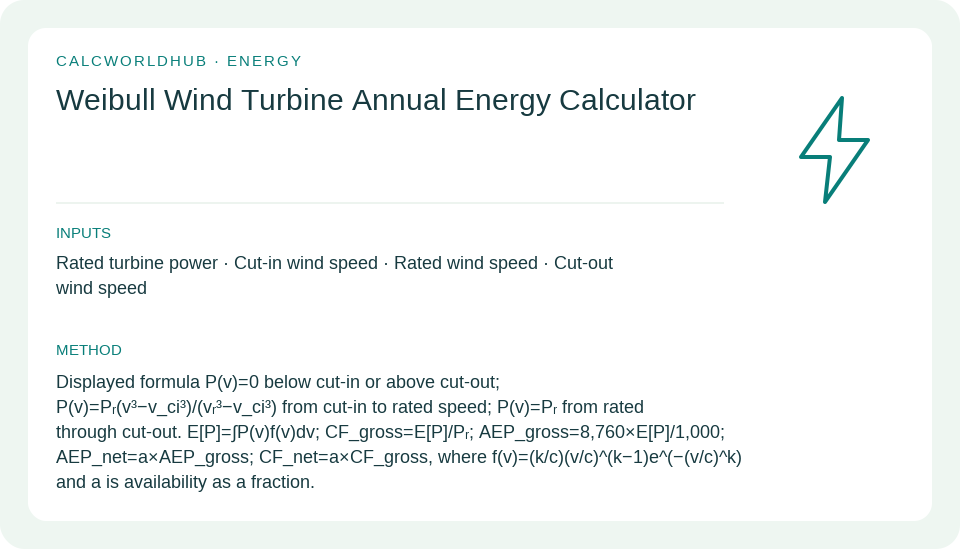
P(v)=0 below cut-in or above cut-out; P(v)=Pᵣ(v³−v_ci³)/(vᵣ³−v_ci³) from cut-in to rated speed; P(v)=Pᵣ from rated through cut-out. E[P]=∫P(v)f(v)dv; CF_gross=E[P]/Pᵣ; AEP_gross=8,760×E[P]/1,000; AEP_net=a×AEP_gross; CF_net=a×CF_gross, where f(v)=(k/c)(v/c)^(k−1)e^(−(v/c)^k) and a is availability as a fraction.
Method
The entered curve is zero below cut-in, interpolates cubically to rated power, remains at rated power until cut-out, then returns to zero above cut-out. The value assigned at the single cut-out boundary has no effect on the continuous integral. The Weibull density weights each wind speed. Simpson integration estimates average power; annual gross energy is average kW × 8,760 hours ÷ 1,000, then availability scales the net estimate.
Worked example
For a 2,000 kW turbine with 3 m/s cut-in, 12 m/s rated, 25 m/s cut-out, Weibull k = 2 and c = 8 m/s, the simplified curve gives about 5,265 MWh/year gross. At 90% availability, estimated annual energy is about 4,739 MWh and net capacity factor is 27.05%.
Assumptions and limits
This is a simplified screening estimate, not a bankable site assessment. Real power curves, turbulence, wind shear, air density, electrical and wake losses, terrain, curtailment, and time-varying availability are not modeled. A single Weibull distribution may not represent seasonal or directional wind conditions.
Frequently asked questions
What do the Weibull shape and scale describe?
Together they describe the distribution of wind speeds. The shape controls its form; the scale sets its characteristic speed.
Why is this different from multiplying rated power by hours?
Most wind speeds do not keep a turbine at rated power. The integration weights partial and zero output by how frequently each speed occurs.
What power curve does this use?
It uses zero output below cut-in, a cubic ramp to rated output, constant rated output until cut-out, and zero output above cut-out.
Can I use it for a project investment decision?
Use a measured or manufacturer power curve and site-specific resource and loss analysis for investment-grade estimates; this simplified model is only a screening calculation.
How do I use the Weibull Wind Turbine Annual Energy Calculator?
Enter Rated turbine power, Cut-in wind speed, Rated wind speed, Cut-out wind speed, then complete the remaining labeled fields. Match the units shown beside each field and review the result together with the assumptions below.
Reference: NREL Annual Technology Baseline land-based wind energy method. See our calculation methodology.