How to use this calculator
Compare solar electricity generated over a period with the energy a system would produce at rated power continuously.
- Enter Energy generated (kWh), Rated system capacity (kW), Period length (days). Match the units shown beside each field and review the result together with the assumptions below.
- Read the worked example below to check the expected input format and result.
- Compare another scenario by changing one input at a time. Use Reset to return to the starting values.
How this calculation works
Capacity factor divides energy generated during an interval by the energy the same rated system would produce at continuous full power during that interval. Keep the measured energy boundary, AC/DC rating basis, and calendar duration aligned; a result above 100% flags an input-basis mismatch.
Inputs and units
energyKwh— Energy generated (kWh)- Metered energy output over the reporting period.
ratedKw— Rated system capacity (kW)- Rated capacity using the same AC or DC convention as the comparison.
periodDays— Period length (days)- Number of calendar days in the generation interval.
Formula
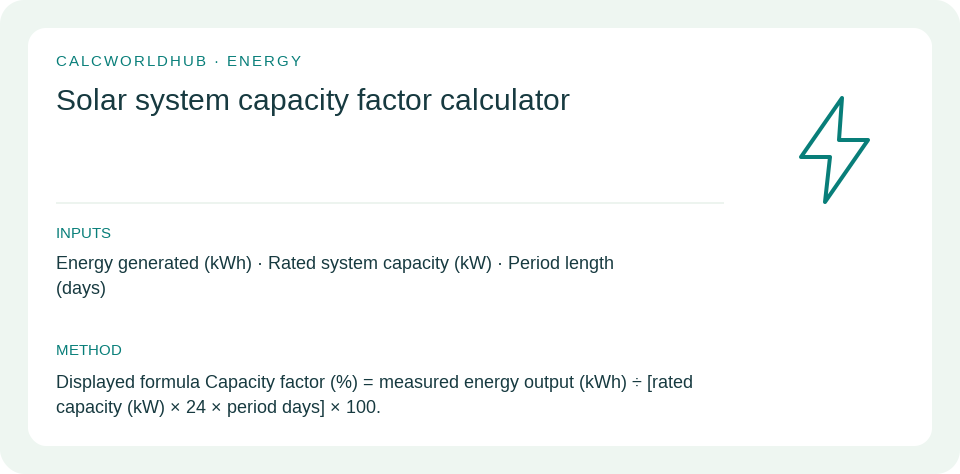
Capacity factor (%) = measured energy output (kWh) ÷ [rated capacity (kW) × 24 × period days] × 100.
Method
Enter metered AC energy for the period, the system’s rated capacity on the same AC or DC basis, and the number of days in that period. Use the same boundary for energy and capacity, and specify whether clipping, downtime, or behind-the-meter use is included in metered output.
Worked example
At 10 kW for 30 days, theoretical full-power output is 10×24×30=7,200 kWh. The corrected 1,200 kWh illustration is 1,200/7,200×100=16.67%.
Assumptions and limits
Location, season, orientation, shading, system losses and downtime affect the result. For the same measured boundary and rated-capacity convention, energy above continuous full-power output is not physically consistent; verify units, period and AC/DC rating before interpreting a result above 100%.
Frequently asked questions
Can a capacity factor exceed 100%?
For a fixed rated power and interval, measured energy normally cannot exceed continuous full-power output; a result above 100% usually signals mismatched units, interval, or capacity basis.
Is capacity factor the same as solar panel efficiency?
No. Capacity factor compares period energy with rated capacity over elapsed time; panel efficiency compares sunlight input with electrical output under defined conditions.
Should I use AC or DC system capacity?
Use the capacity basis intended by your comparison and state it consistently with the measured generation boundary.
How do I use the Solar system capacity factor calculator?
Enter Energy generated (kWh), Rated system capacity (kW), Period length (days). Match the units shown beside each field and review the result together with the assumptions below.
What is a worked example of Solar system capacity factor?
At 10 kW for 30 days, theoretical full-power output is 10×24×30=7,200 kWh. The corrected 1,200 kWh illustration is 1,200/7,200×100=16.67%.
Reference: U.S. Energy Information Administration capacity-factor glossary. See our calculation methodology.