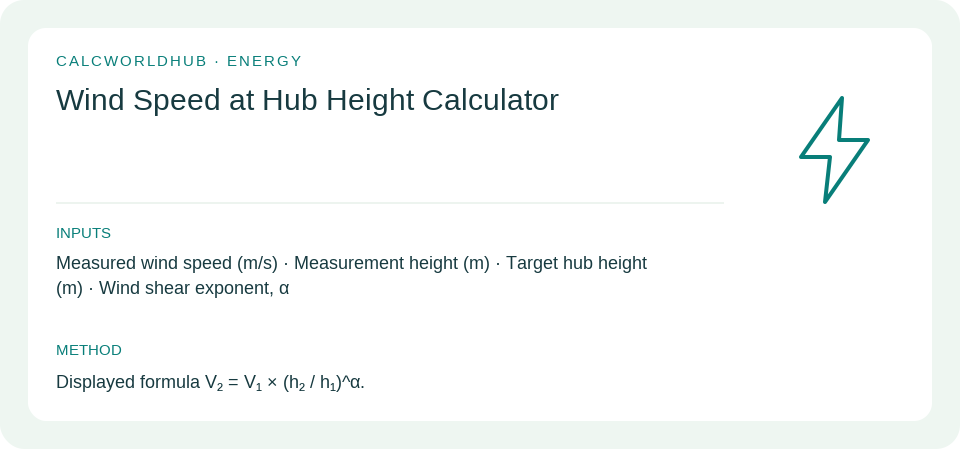
How to use this calculator
Extrapolate a measured wind speed to a turbine hub height with the empirical power-law shear profile.
- Enter Measured wind speed (m/s), Measurement height (m), Target hub height (m), Wind shear exponent, α. Match the units shown beside each field and review the result together with the assumptions below.
- Read the worked example below to check the expected input format and result.
- Compare another scenario by changing one input at a time. Use Reset to return to the starting values.
How this calculation works
Wind observations are often collected at a height different from a proposed turbine hub. The power-law profile scales the measured speed by the ratio of heights raised to an empirical shear exponent, making the assumed vertical profile visible in the estimate.
Inputs and units
measuredSpeedMs— Measured wind speed (m/s)- Wind speed measured at the stated reference height.
measurementHeightM— Measurement height (m)- Height above ground where the wind speed was measured.
targetHeightM— Target hub height (m)- Height above ground at which wind speed is estimated.
shearExponent— Wind shear exponent, α- Empirical exponent for the chosen terrain and atmospheric conditions.
Formula
V₂ = V₁ × (h₂ / h₁)^α.
Method
Enter wind speed V₁ measured at height h₁, target height h₂, and a shear exponent α. The output applies the selected exponent directly; it does not infer α from a second measurement height.
Worked example
With 8.00 m/s measured at 10 m, a target height of 80 m, and α = 0.14, the estimated speed is 8.00 × (80/10)^0.14 = 10.703 m/s.
Assumptions and limits
The power law is an empirical extrapolation that assumes one shear exponent across the selected height interval. Terrain, atmospheric stability, roughness, wakes, and time-varying conditions can make the real profile differ; use measured multi-height data when available.
Frequently asked questions
What does the shear exponent represent?
It summarizes how wind speed changes with height for the selected site and atmospheric conditions.
Is 0.14 correct for every site?
No. It is a commonly used example value, but surface roughness and atmospheric stability change the appropriate exponent.
Can I extrapolate below the measurement height?
Yes, the same equation works for a lower positive target height, but the empirical assumptions still apply.
How do I use the Wind Speed at Hub Height Calculator?
Enter Measured wind speed (m/s), Measurement height (m), Target hub height (m), Wind shear exponent, α. Match the units shown beside each field and review the result together with the assumptions below.
What is a worked example of Wind Speed at Hub Height?
With 8.00 m/s measured at 10 m, a target height of 80 m, and α = 0.14, the estimated speed is 8.00 × (80/10)^0.14 = 10.703 m/s.
Reference: NREL System Advisor Model power-law wind-height extrapolation documentation. See our calculation methodology.