
Why flour is the reference weight
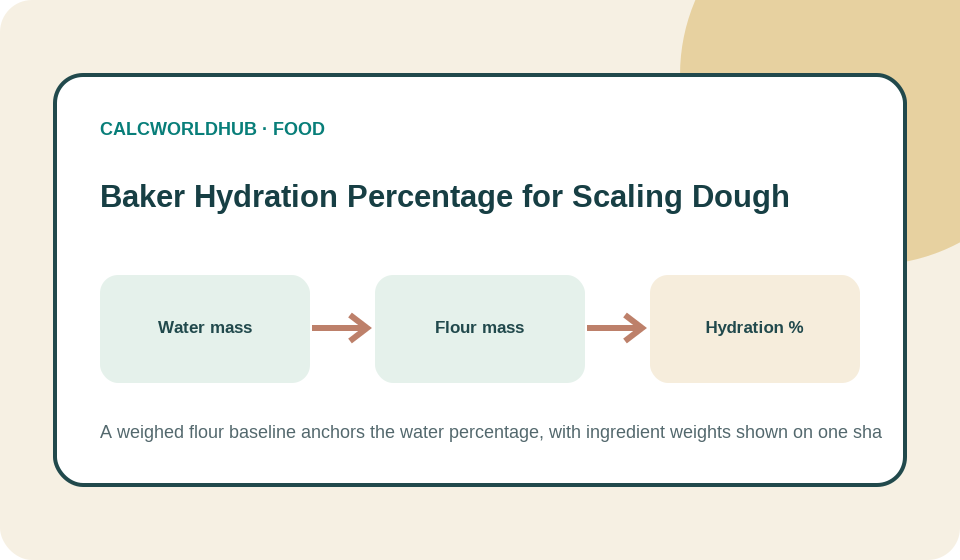
Baker’s percentage sets flour at 100% and expresses each other ingredient as a share of that flour weight. Hydration is the water part of this system: water grams divided by flour grams, multiplied by 100. The reference is flour, not the finished dough and not the sum of every ingredient, so a 70% hydration dough is not 70% water by total dough mass.
The method is useful when a formula changes from a home loaf to a larger batch. If the flour quantity doubles and the target hydration stays fixed, the required water doubles too. Salt, preferment, oil, eggs, and other ingredients have their own baker’s percentages; they do not change this calculator’s two-field hydration result unless you intentionally count a liquid ingredient as water in your recipe convention.
Weigh water and flour consistently
Enter Water (g) and Flour (g) as masses measured on the same scale. The calculator computes water ÷ flour × 100. Keep flour as the positive reference quantity and water nonnegative. A zero flour value cannot be a denominator, and volume measures such as cups cannot be compared directly without a measured mass conversion.
Decide what your formula calls water before using the number. Some bakers include water contributed by a liquid starter or other aqueous ingredients when they calculate overall hydration; others report the added mixing water alone. The calculator accepts only one water mass and one flour mass, so it cannot infer starter hydration or subtract water already present in a preferment. Record that convention alongside the result.
Interpret the percentage in dough
Hydration is a formulation ratio, not a universal softness score. Flour type, milling, bran content, protein, temperature, mixing, fermentation, and handling all affect how a dough feels. Two doughs at the same computed percentage can absorb water differently. Use the number to reproduce a formula, then make controlled adjustments in small increments while keeping a note of the actual weighed quantities.
A small change can matter at scale. Adding 20 g water to 1,000 g flour raises the ratio by 2 percentage points because 20 ÷ 1,000 × 100 = 2. That is a percentage-point change in the hydration reading, not a 2% relative increase in the prior hydration. Keeping those descriptions separate avoids muddling a recipe adjustment with a proportional change in the original value.
Scale ingredients from a target
To plan a new batch, multiply the flour mass by the target percentage written as a decimal. For 1,500 g flour at 68% hydration, water is 1,500 × 0.68 = 1,020 g. The calculator runs the reverse direction: it reports the hydration implied by the two weights you enter. If you already know the target, use this equation as a separate planning step and check the result by entering both masses.
When scaling a complete formula, apply each ingredient’s baker’s percentage to the same flour baseline. A formula with 68% water and 2% salt uses 680 g water and 20 g salt per 1,000 g flour. Those values describe ingredient weights relative to flour; they do not state a final dough moisture percentage or a salt concentration in the finished dough. Keep the baseline visible in a written formula.
Worked examples
These two batches use different flour quantities, so the percentage can be checked independently of batch size.
A lean dough at 68%
Inputs: Water = 680 g; Flour = 1,000 g.
Calculation: Hydration = 680 ÷ 1,000 × 100 = 68%.
The recipe uses 680 g water for every 1,000 g flour. The result is a baker’s percentage, not the fraction of the finished dough that is water.
A smaller dough at 70% hydration
Inputs: Water = 525 g; Flour = 750 g.
Calculation: Hydration = 525 ÷ 750 × 100 = 70%.
The batch is smaller, but the ratio is slightly higher. To make 750 g flour at 68%, the water target would instead be 510 g.

Where this estimate stops
This two-input result does not measure dough absorption, predict gluten development, or determine how much water a particular flour can hold. It also does not establish a food-safety or fermentation schedule. King Arthur’s baker’s-percentage reference describes the flour-based scaling convention; the baker still has to decide which ingredients belong in the formula and how the dough behaves under the chosen process.
Use a consistent flour and liquid convention when comparing batches. If a starter is included, state whether its flour and water are folded into the totals. If a recipe is expressed by volume, convert each ingredient to mass before comparing it with a weight-based formula. The percentage is most useful as a repeatable bookkeeping measure; the final dough should still be judged by the process and outcome you can observe.