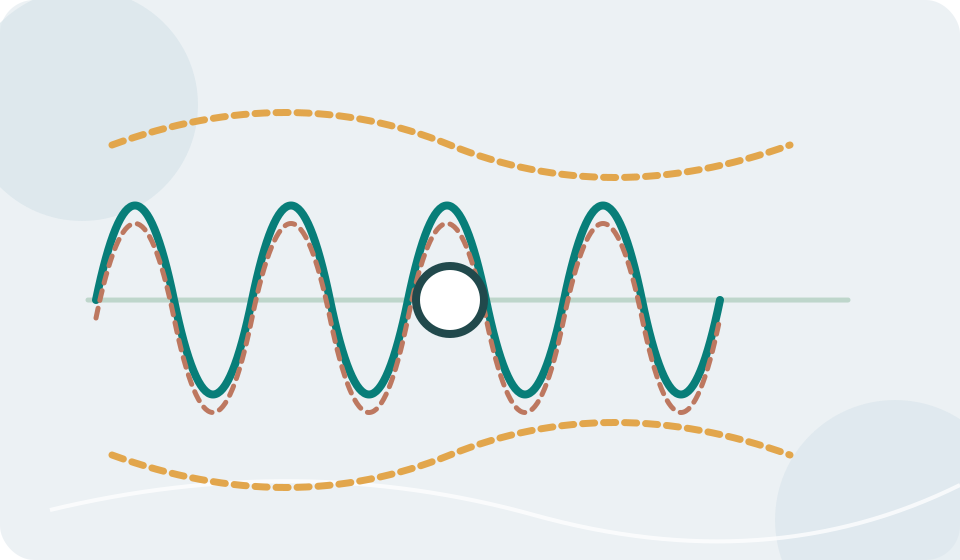

What a listener hears
A beat is a slow change in amplitude that appears when two sinusoidal waves of similar frequency overlap. At moments when the waves reinforce one another, the result is stronger; when they oppose one another, it is weaker. The ear perceives these recurring loud and soft regions as pulses. A piano tuner can use them by comparing a piano note with a reference tone: as the pitches approach one another, the beat rate slows.
The two input frequencies are the component tones, measured in hertz (cycles per second). The result is also measured in hertz, but it describes how often the amplitude pattern repeats, not the average pitch of the combined wave. For tones at 440 Hz and 443 Hz, the combined carrier is near their average, 441.5 Hz, while the loud-soft envelope repeats three times per second.
Use the difference formula
For two tones, calculate fᵦ = |f₂ − f₁|. The absolute-value bars make the answer nonnegative regardless of which input is larger. If the frequencies are expressed in hertz, fᵦ is in hertz as well. When the beat rate is positive, the envelope period is Tᵦ = 1/fᵦ seconds. Equal frequencies give 0 Hz and no finite period; the calculator reports “No finite beat cycle.”
A difference of 3 Hz means the envelope completes three cycles each second; its period is 1/3 s, or about 0.333 s. A difference of 0.5 Hz produces one beat cycle every two seconds. The reciprocal describes spacing between beats, not the oscillation period of either high-frequency sound wave.
Calculate the beat rate and its period
Enter both tone frequencies in hertz from the same measurement or reference. For a tuning task, use the measured fundamental frequencies rather than a note name alone, because an instrument can be slightly sharp or flat. Keep the order of the inputs consistent if recording a series of checks, although swapping them does not change the absolute difference.
Check the result by subtracting the smaller frequency from the larger. Then take the reciprocal only if the beat rate is above zero. The calculator’s period output is in seconds; it translates a small frequency difference into a time interval that can be heard or observed on a waveform display.
Worked examples
Two nearby tuning tones
Inputs: First frequency = 440 Hz; second frequency = 443 Hz
Calculation: |443 − 440| = 3 Hz; beat period = 1 ÷ 3 = 0.3333 s
Beat frequency = 3 Hz; beat period ≈ 0.3333 s.
A slightly wider frequency gap
Inputs: First frequency = 256 Hz; second frequency = 260 Hz
Calculation: |260 − 256| = 4 Hz; beat period = 1 ÷ 4 = 0.25 s
Beat frequency = 4 Hz; beat period = 0.25 s.

Worked examples and a measurement check
Example one uses two tuning tones at 440 Hz and 443 Hz. Their difference is |443 − 440| = 3 Hz, so the envelope repeats three times per second. The corresponding beat period is 1/3 = 0.3333 seconds. A listener should hear a fairly quick pulsing compared with a pair of tones only a fraction of a hertz apart.
Example two changes only the separation: increasing it from 4 Hz to 5 Hz shortens the period from 0.25 to 0.20 seconds.
For a recorded waveform, count several envelope peaks across a known duration rather than timing a single pulse. If ten peaks span roughly 3.0 seconds, the measured beat rate is about 3.3 Hz, consistent with frequencies separated by approximately that amount. A mismatch can arise from noisy peak detection, drifting tones, or a short sample window.
When the simple model is useful
The difference formula is useful for tuning, comparing two nearly steady oscillators, and explaining amplitude modulation from two close components. It is also a quick sanity check when a slow pulse appears in a signal containing two nearby spectral peaks. It answers a narrow question: how quickly does the ideal two-tone envelope repeat?
The beat pattern is easiest to interpret when the tones have similar frequencies, overlap in time and place, and remain stable long enough to observe several cycles. If the frequencies change during measurement, there is no single fixed beat rate; the calculation describes only the entered pair at that moment. Multiple tones can create more complex envelopes that are not summarized by one subtraction.
Common interpretation errors
A frequent mistake is calling fᵦ the pitch of the resulting sound. The two component tones remain near their original frequencies; the beat is the slower envelope pattern. Another error is adding the frequencies. The beat rate comes from their difference, while the average frequency describes the rapidly oscillating carrier in the simple equal-amplitude derivation.