
Use the driven wheel’s rolling circumference
Enter the circumference of the rear wheel in metres, then the front chainring and rear sprocket tooth counts. The circumference should represent the tire and wheel actually fitted. A nominal wheel size is only a starting point: tire width, casing, pressure, rim, and load can change the measured rollout.
The tooth fields represent counts, so enter the whole positive numbers printed on the chosen drivetrain. The entry form does not limit them to whole numbers, but a fractional tooth count has no physical sprocket interpretation. Use integer teeth for a real gear comparison; the input limitation is documented separately.
Connect the tooth ratio to wheel turns
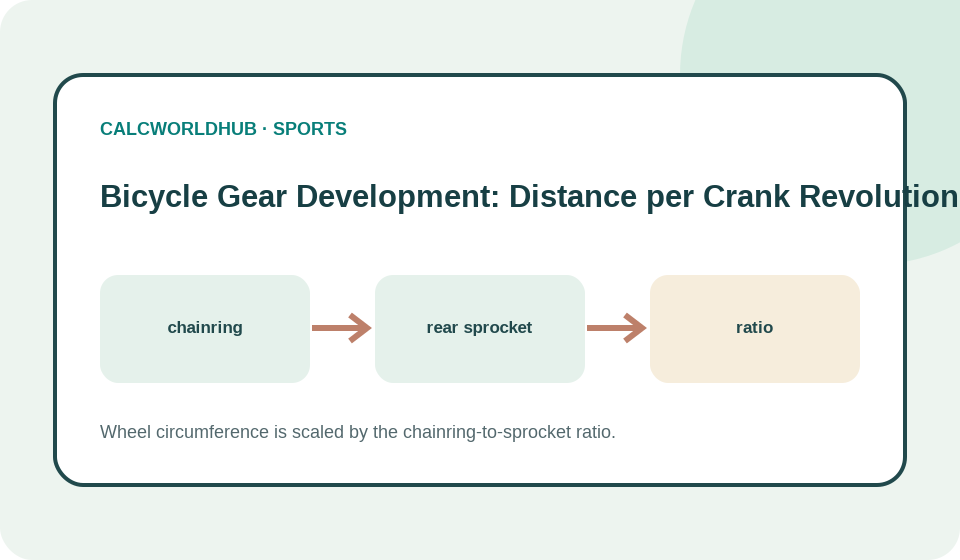
One crank revolution turns the chainring once. The chain moves a length proportional to the chainring teeth, which rotates the rear sprocket and wheel by the ratio front teeth ÷ rear teeth. Development = wheel circumference × front teeth ÷ rear teeth. The result is metres of wheel travel per crank revolution.
Use the measured rear-wheel circumference in metres so the result is also in metres. If you enter a circumference in centimetres or inches without converting it, the displayed numerical result will carry the wrong unit scale. Keep the tooth ratio dimensionless and do not multiply by cadence unless you are calculating a speed separately.
Compare gears without calling rollout speed
A larger chainring or a smaller rear sprocket increases the distance per crank turn. A smaller chainring or larger sprocket reduces it. This lets a rider compare selected gears on one bicycle, but the calculator does not choose a gear for terrain, rider strength, cadence, or mechanical limits.
Welsh Government’s bicycle-gears teaching resource gives the same metres-of-development relationship: wheel circumference multiplied by front chainring teeth and divided by rear sprocket teeth. Its example also highlights that circumference belongs to the driven wheel. Use a drivetrain-compatible gear combination rather than a ratio that cannot be shifted to on the installed bike.
Measure circumference rather than relying on a label
To measure rollout, mark the tire and ground, roll the loaded bicycle exactly one wheel revolution in a straight line, and measure the distance. Keep the tire pressure and load condition consistent if you compare measurements. A geometric circumference computed from nominal diameter can differ from the effective rolling distance under the rider.
Do not assume the calculated development is the exact distance over every ride. Tire deformation, wheel slip, surface irregularity, and measurement error can change travel. The calculator uses only one circumference number and does not model tire pressure, crank length, cadence, hub gearing, or a derailleur’s shift constraints.
Know the unit and output boundary
The result is metres per crank revolution. The tool does not convert it into kilometres per hour, gear inches, cadence, or a recommended gear. To estimate idealized speed, a separate model would need cadence and unit conversion; actual riding speed also depends on losses and external conditions.
Record the circumference method and exact tooth pair with the result. If a component is replaced, verify the number of teeth on the new chainring and sprocket rather than reusing an old ratio. Treat gear development as a comparison of mechanical rollout, and confirm compatibility and safe operation with the drivetrain manufacturer’s guidance.
Worked examples
A 50-tooth chainring with a 14-tooth sprocket
Inputs: Rear-wheel circumference = 2.105 m; front chainring = 50 teeth; rear sprocket = 14 teeth.
Calculation: Gear ratio = 50 ÷ 14 = 3.571428… . Development = 2.105 × 50 ÷ 14 = 7.517857… m/revolution ≈ 7.5179 m/revolution.
One crank turn corresponds to about 7.5179 m of ideal wheel travel with these inputs.
A smaller rollout combination
Inputs: Rear-wheel circumference = 2.196 m; front chainring = 34 teeth; rear sprocket = 17 teeth.
Calculation: Gear ratio = 34 ÷ 17 = 2. Development = 2.196 × 2 = 4.392 m/revolution.
The chosen gear gives a 4.392 m geometric rollout per crank turn, before real-world tire and surface effects.
