
Two percentages answer different questions
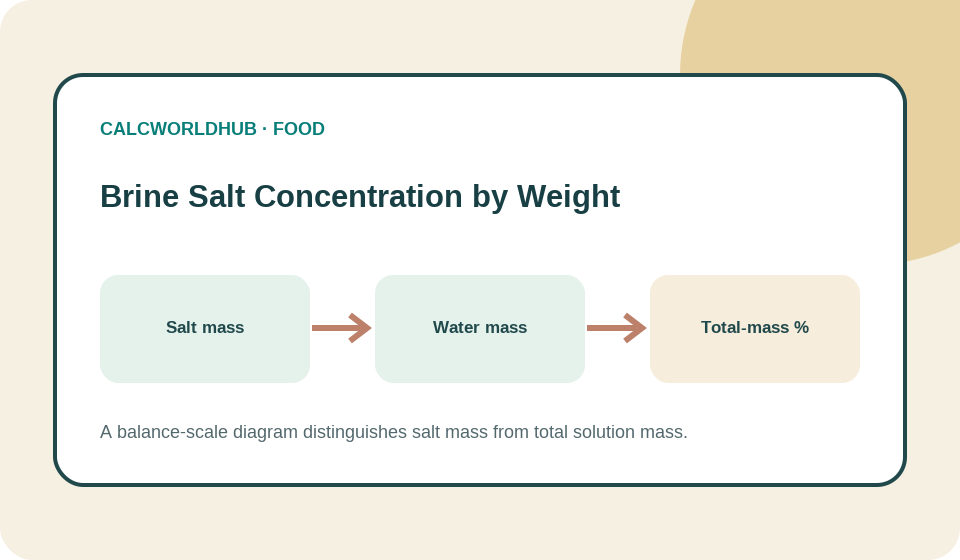
A cook may describe a brine as salt divided by water, or as salt divided by the total salt-and-water mixture. These are different ratios. This calculator reports the second one: salt mass ÷ (salt mass + water mass) × 100. Naming the denominator matters because a recipe ratio such as 60 g salt per 1,000 g water is not the same numeric percentage as salt’s share of the resulting solution.
The total-mass basis is useful when comparing a mixture’s composition by weight. It is not automatically the same as grams of salt per 100 g water, grams per litre, or a concentration measured after food is added. Always write the unit basis next to a percentage, especially when a recipe, lab note, or food process uses a different convention.
Weigh both ingredients
The fields are Salt mass (g) and Water mass (g). Use the mass of the salt you actually add and the mass of the water, not the vessel weight. Both quantities should be finite and nonnegative, and their sum must be greater than zero for the ratio to be defined. A scale avoids ambiguity from salt crystal size: a spoonful of fine table salt and a spoonful of coarse salt can have different masses.
For a recipe comparison, keep the salt type and ingredient scope in your notes. If a brine contains sugar or other dissolved material, this calculator still divides only salt by salt plus water; it does not include the other ingredients in the total. If a solid food is immersed, its mass is not added to the model denominator either. The output is a simplified salt-and-water basis rather than an analysis of a finished food.
Calculate salt share of the mixture
Add the salt and water masses to get the modeled brine mass, then divide the salt mass by that total and multiply by 100. Carry the unrounded weights through this calculation and round only the final percentage for display. The ratio is dimensionless because grams cancel, but the percent symbol is meaningful only with its stated total-solution denominator.
A recipe that says “6% salt” can be ambiguous unless it says 6% of what. On a total-mass basis, 60 g salt with 940 g water makes 1,000 g total and a 6.0% salt share. With 1,000 g water, the same 60 g salt makes 1,060 g total, so the calculator reports about 5.6604%. The water-only ratio remains 6 g per 100 g water in the latter example; it is simply another convention.
Worked examples
The examples use weighed ingredients and show why equal salt-to-water ratios can produce different percent-by-solution values.
A 60 g salt, 1,000 g water brine
Inputs: Salt mass = 60 g; Water mass = 1,000 g.
Calculation: Salt share = 60 ÷ (60 + 1,000) × 100 = 5.660377…% ≈ 5.6604%.
Salt is about 5.66% of the combined salt-and-water mass. The separate water-only ratio is 6 g per 100 g water.
A 4.5% total-mass brine
Inputs: Salt mass = 45 g; Water mass = 955 g.
Calculation: Salt share = 45 ÷ (45 + 955) × 100 = 4.5%.
The denominator is exactly 1,000 g, so salt is 4.5% of the modeled mixture by mass.

Use the result as a recipe measurement
The result helps reproduce a weighed mixture or compare recipes that use the same basis. It does not select the right strength, contact time, storage temperature, or salt type for a food. USDA FSIS describes brining as a salt-and-water treatment and gives recipe guidance for poultry; follow a tested recipe and safe handling instructions rather than treating this arithmetic as preservation advice.
If a target is expressed as a total-mixture percentage, you can solve for the needed salt from a known water mass: salt = target fraction × water ÷ (1 − target fraction). For a 5% total-mass target with 1,000 g water, salt is 0.05 × 1,000 ÷ 0.95 ≈ 52.63 g. The calculator itself takes the two masses and returns the resulting percentage, so verify any reverse-planned quantity by entering it back in.
Food-process limits
Mass concentration does not tell you how much salt enters a piece of meat or how salty it will taste. Diffusion, piece thickness, time, temperature, water movement, and rinsing all matter. The mixture may also change as food releases liquid or absorbs salt. This calculator measures its initial salt-and-water inputs; it does not model those later changes or validate a curing or fermentation process.
For poultry, USDA FSIS advises keeping raw poultry and its brine refrigerated and discarding used brine. That food-safety instruction is separate from the concentration calculation. Use a reliable kitchen scale, a food-safe vessel, and a tested method suited to the food. If a recipe’s percentage uses salt per water rather than salt per total mixture, convert carefully instead of comparing the displayed values as though their denominators matched.