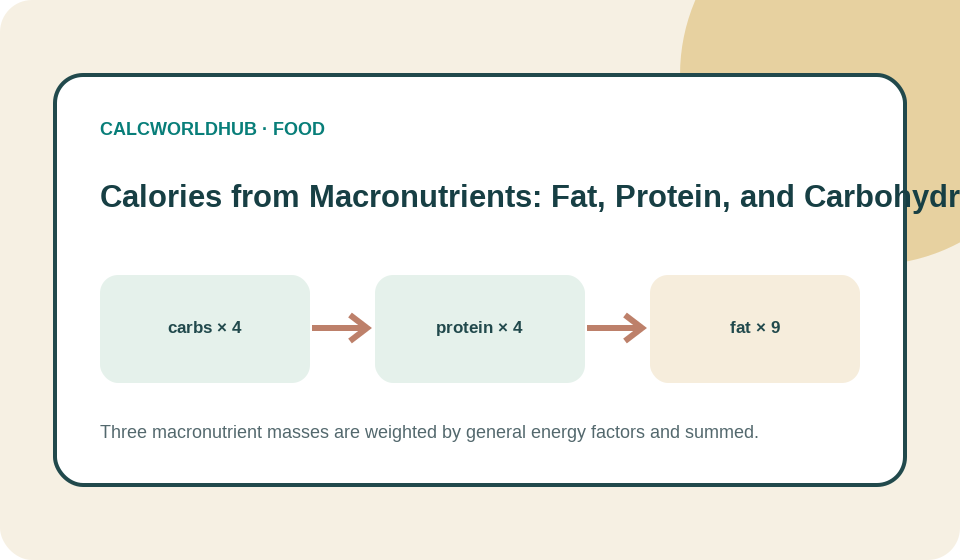

The 4-4-9 calculation
The model is kcal = 4C + 4P + 9F, where C is carbohydrate grams, P is protein grams, and F is fat grams. Each gram amount is multiplied by its factor and the three contributions are added. The calculator accepts finite nonnegative grams and displays a total in kilocalories (kcal), commonly called Calories on food labels.
The factors are general approximations. They are useful for a quick calculation when macronutrient grams are known, but they do not represent every food component with a separate energy value. The tool has no fields for alcohol, fiber subtypes, sugar alcohols, organic acids, or food-specific Atwater factors, so it cannot reconstruct every regulatory or laboratory method.
Enter grams for the same portion
Use carbohydrate, protein, and fat amounts for one consistent portion or batch. If the numbers are per serving, the result is per serving; if they describe a whole recipe, the result is for the whole recipe. Adding grams from different serving bases creates an answer with no useful interpretation. The calculator labels each entry in grams and requires nonnegative finite values.
If a label lists values per serving but the package contains several servings, multiply each macro amount by the number of portions only when you want a package total. Keep the same basis for all three values. The calculator does not infer serving size, divide a recipe into portions, convert grams from a food database, or adjust for the amount actually eaten.
Why the estimate can differ from a label
Nutrition labels may use more detailed calculation rules than a single 4-4-9 sum, and listed grams are rounded. Food-specific energy factors and separate treatment of dietary fiber or sugar alcohols can also affect the result. Therefore, a small difference between this estimate and a package declaration does not by itself show that either number is wrong.
The calculator returns a mathematical estimate from the values entered; it does not certify a product label or replace jurisdiction-specific labeling rules. If you need a label value, follow the applicable regulation or use the manufacturer’s verified data. The FDA explains that calories can come from carbohydrate, fat, protein, and alcohol, which is one reason a three-input macro total is not a complete analysis for every item.
Use the number for planning, not personal prescription
The output can help compare two portions using the same macro convention or check a simple recipe total. It does not tell whether a meal is balanced, suitable for a medical condition, or appropriate for an individual’s energy needs. Those questions depend on the person, full ingredient list, portion pattern, and relevant professional guidance.
Do not interpret the result as a target intake or as a recommended daily calorie amount. A macro estimate omits micronutrients, sodium, water, digestibility, preparation effects, and many other properties. For health decisions, use reliable nutrition information and qualified clinical advice rather than relying on a three-number arithmetic tool.
Understand rounding and input limits
The runtime rounds the final result to at most four decimal places, although most food-planning uses do not justify that many measured digits. If macro grams were rounded on a label, extra output decimals do not restore the hidden precision. Retain the original source values and state whether they came from a package, database, scale, or recipe calculation.
A zero for any macro is allowed; the calculation still adds the other contributions. Negative values and non-finite numbers are rejected. The result may be zero when all inputs are zero, but that only describes the entered vector. The tool does not validate the nutrient data, total serving mass, ingredient identity, or whether the chosen factors are appropriate for a particular regulatory purpose.
Worked examples
Use grams for one consistent portion. The displayed result is kcal under a general 4-4-9 estimate.
A moderate-carbohydrate portion
Inputs: Carbohydrate = 50 g; protein = 20 g; fat = 10 g.
Calculation: kcal = 4 × 50 + 4 × 20 + 9 × 10 = 200 + 80 + 90 = 370 kcal.
The general factors estimate 370 kcal for the entered portion.
A portion with more fat and less carbohydrate
Inputs: Carbohydrate = 30 g; protein = 15 g; fat = 18 g.
Calculation: kcal = 4 × 30 + 4 × 15 + 9 × 18 = 120 + 60 + 162 = 342 kcal.
The entered macros contribute an estimated 342 kcal under the same general factors.
