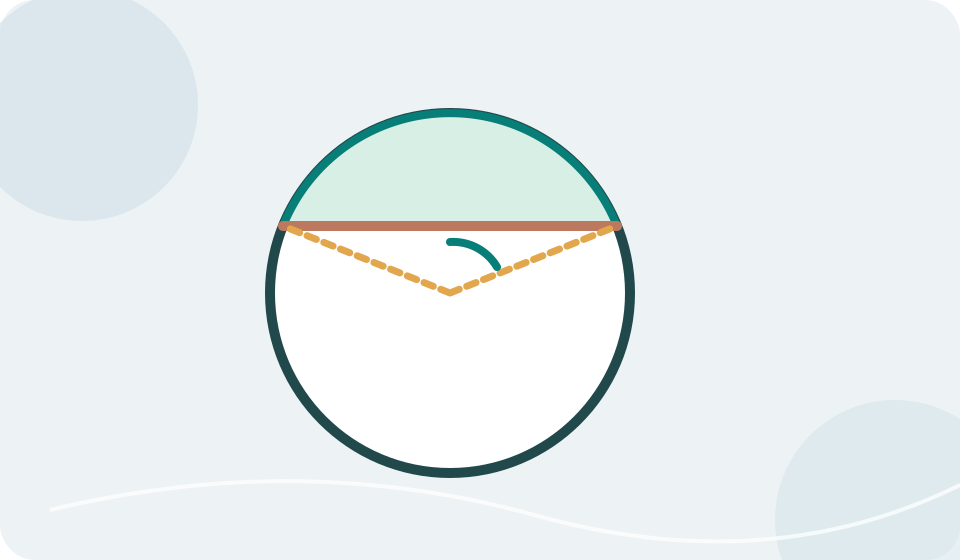

Segment, sector, and chord are different regions
A circular segment is the part of a disk cut off by a straight chord. Its boundary contains that chord and the corresponding arc. The sector with the same central angle includes two radii and the triangle between them, so its area is larger except at limiting cases. Confusing these regions can substantially overstate the area of a shallow cap.
The calculator reports the minor segment, the smaller region between the chord and arc. It does not find the major segment or the lens formed by two overlapping circles. Its angle is the central angle in degrees, measured by two radii ending at the chord endpoints. If a drawing gives the chord length or sagitta instead, use a matching relationship rather than treating either as the central angle.
Derive the minor-segment formula
Start with the sector area r²θ/2, where θ is measured in radians. The isosceles triangle between the radii has area r²sinθ/2. Subtracting the triangle leaves A = r²(θ − sinθ)/2. Because the input is degrees, convert using θ radians = θ degrees × π/180 before evaluating the sine and formula.
The degree expression used by the calculator is equivalent: it first converts the central angle to radians, then evaluates the subtraction. Sine in this equation takes radians, not degrees. A direct use of sin(60) in a programming language that expects radians would produce the wrong triangle area and therefore the wrong segment. Keep both the units and the angle convention explicit.
How radius and angle affect a shallow cap
At a fixed radius, the minor segment grows as the central angle increases from 0° to 180°. At 180°, the chord is a diameter and the segment is exactly a semicircle, with area πr²/2. Near zero degrees the cap becomes very small, so subtracting two nearly equal areas can be numerically sensitive in hand calculations; retain precision and do not round the sector and triangle separately too early.
At a fixed angle, segment area scales with r². Doubling radius therefore makes the area four times larger. A drawing with the same angle but a different scale preserves shape while changing area. This scaling check helps distinguish a unit conversion error: converting metres to centimetres multiplies the numerical area by 10,000, even though the physical region is unchanged.
Respect the minor-angle range
The runtime accepts finite nonnegative radius and a central angle from 0° to 180°. An angle above 180° describes the major arc and would need a different interpretation; this calculator intentionally restricts the input to the minor segment. A radius of zero or an angle of zero returns a zero-area limit in the current source logic, although a zero-radius circle is not a practical measured object.
Use a positive radius in an ordinary physical application and verify that the chosen angle identifies the smaller arc. If the two intersection points divide the circle into unequal arcs, there are two possible segments. Selecting the reflex angle by mistake can make the small cap seem much larger than the region shown. The calculator does not infer which arc is highlighted in a drawing.
Check by subtracting a triangle
For an independent calculation, compute sector area as r²θ/2 and the central triangle as r²sinθ/2, with θ converted to radians in both expressions. Subtract the triangle from the sector. For a right-angle sector, sinθ equals 1, so the triangle area is r²/2; this provides a quick check before comparing the difference with the calculator.
The output has squared length units. If the radius is in centimetres, the answer is in square centimetres. Round only after subtraction and keep enough digits for small angles, where the segment may be a small difference between two larger quantities. A perimeter, chord length, and segment area cannot be compared directly; each answers a different geometric question.

Worked examples
A 60-degree segment with a 5-unit radius
Inputs: r = 5 length units; θ = 60° = π/3 radians.
Calculation: A = 5²(π/3 − sin(π/3))/2 = 12.5(1.04719755 − 0.86602540) = 2.26465184 square units.
The minor segment area is about 2.26465 square units.
A quarter-circle angle with a 10-unit radius
Inputs: r = 10 length units; θ = 90° = π/2 radians.
Calculation: A = 10²(π/2 − sin(π/2))/2 = 50(1.57079633 − 1) = 28.53981634 square units.
The minor segment area is about 28.53982 square units; the full sector would be 50π ≈ 157.07963 square units.