
Keep each measurement on its stated basis
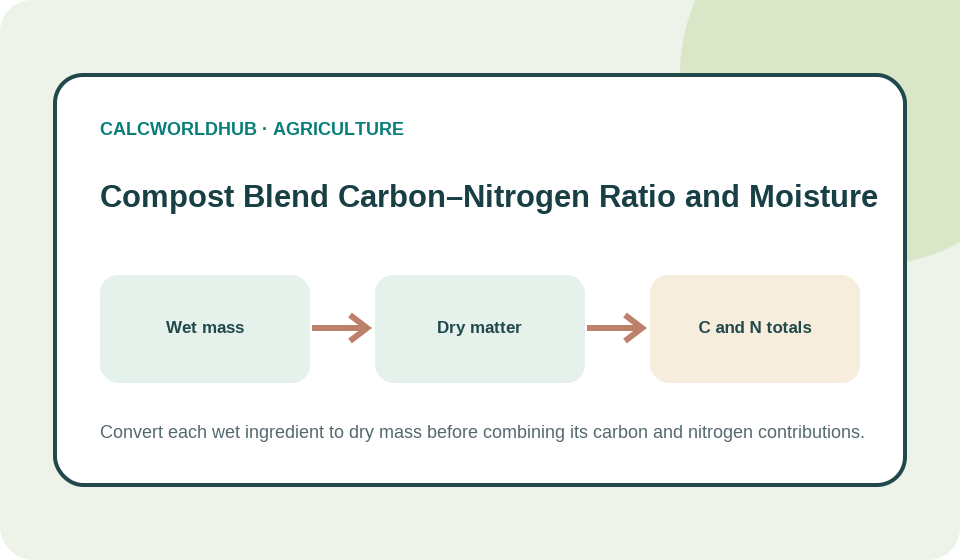
The mass list is the as-weighed, wet mass of each ingredient in kilograms. Moisture percentages are wet-basis values: water mass divided by total wet mass. Carbon and nitrogen percentages, by contrast, describe dry matter. Convert each wet mass to dry mass before applying nutrient percentages.
Use measurements from one batch and keep each list aligned. Each wet mass must pair with that ingredient’s moisture, carbon, and nitrogen values; if list lengths differ, the inputs cannot be paired unambiguously.
From wet mass to total carbon and nitrogen
For ingredient i, dry mass is wet mass × (1 − moisture fraction). Its carbon mass is dry mass × dry-matter carbon fraction; its nitrogen mass is dry mass × dry-matter nitrogen fraction. Add the ingredient carbon masses, add the nitrogen masses, then divide total carbon by total nitrogen. The resulting C:N ratio is a mass ratio, commonly written as a number followed by “:1.”
Blend moisture follows another path: add the water carried by every wet ingredient, then divide by total wet mass. That gives water / wet mass × 100. Do not average ingredient moisture percentages unless their wet masses happen to be equal; a 5 kg ingredient and a 100 kg ingredient do not contribute equally to the final mixture.
Worked examples
The examples use matching ingredient lists: one mass, moisture, carbon, and nitrogen value for every material.
A two-material mix with measured wet masses
Inputs: Wet masses = 100 kg and 50 kg; moisture = 60% and 20%; dry-matter carbon = 45% and 40%; dry-matter nitrogen = 2% and 1%.
Calculation: Dry masses = 100 × 0.40 = 40 kg and 50 × 0.80 = 40 kg. Carbon = 40 × 0.45 + 40 × 0.40 = 34 kg; nitrogen = 40 × 0.02 + 40 × 0.01 = 1.2 kg; C:N = 34 ÷ 1.2 = 28.3333:1. Water = 100 × 0.60 + 50 × 0.20 = 70 kg; moisture = 70 ÷ 150 × 100 = 46.6667%.
The blend has a calculated dry-matter C:N ratio of about 28.33:1 and wet-basis moisture of about 46.67%.
A three-ingredient batch with different moisture levels
Inputs: Wet masses = 80, 20, and 40 kg; moisture = 50%, 10%, and 25%; dry-matter carbon = 40%, 45%, and 42%; dry-matter nitrogen = 2%, 1.5%, and 1.2%.
Calculation: Dry masses = 40, 18, and 30 kg. Carbon = 40 × 0.40 + 18 × 0.45 + 30 × 0.42 = 36.7 kg; nitrogen = 40 × 0.02 + 18 × 0.015 + 30 × 0.012 = 1.43 kg; C:N = 36.7 ÷ 1.43 ≈ 25.6643:1. Water = 52 kg, so moisture = 52 ÷ 140 × 100 ≈ 37.1429%.
The first ingredient contributes the most dry matter at 40 kg because its starting mass is larger, even though its 50% moisture is the highest of the three; blend moisture is still weighted across all wet masses.

Read ratio and moisture as separate properties
A lower C:N means less carbon mass for each unit of nitrogen in the measured blend. It does not say how rapidly microbes will use either element. Particle size, oxygen movement, temperature, pH, chemical form, maturity, and the balance of easily degradable material can all influence decomposition. The calculator represents the supplied analysis, not the biological behavior of the pile.
Moisture can be sensible for a blend with a C:N ratio that looks suitable, or the reverse. A water percentage alone does not describe pore space or drainage. University extension guidance discusses moisture and carbon-to-nitrogen ratio as separate management factors; use the numerical outputs to compare recipes, not as a universal pass/fail score for every feedstock.
Check the inputs before adjusting a recipe
Moisture must be on a wet basis, not a dry basis. A lab report that states water relative to dry solids needs conversion before its percentage is entered. Likewise, carbon and nitrogen should be percentages of dry matter. Entering an as-received nutrient percentage as if it were dry-basis data can distort the ratio, especially for wet manure, food scraps, or slurries.
The list percentages are expected to be between zero and one hundred, while masses cannot be negative. Carbon and nitrogen do not both need to be nonzero in every individual ingredient, but a blend with zero total nitrogen cannot produce a finite C:N ratio. Keep units consistent: if a scale measures pounds, convert every mass to kilograms or use a separately checked unit conversion before entering the values.
Use the result as one part of compost planning
For a comparison, change one ingredient or measured property at a time and retain the recipe record. Laboratory samples vary, so displayed decimals do not mean a rough analysis is exact. This calculator does not recommend an ideal recipe, predict pile temperature or nitrogen loss, or assess aeration. Follow local compost guidance and reassess the pile after mixing.