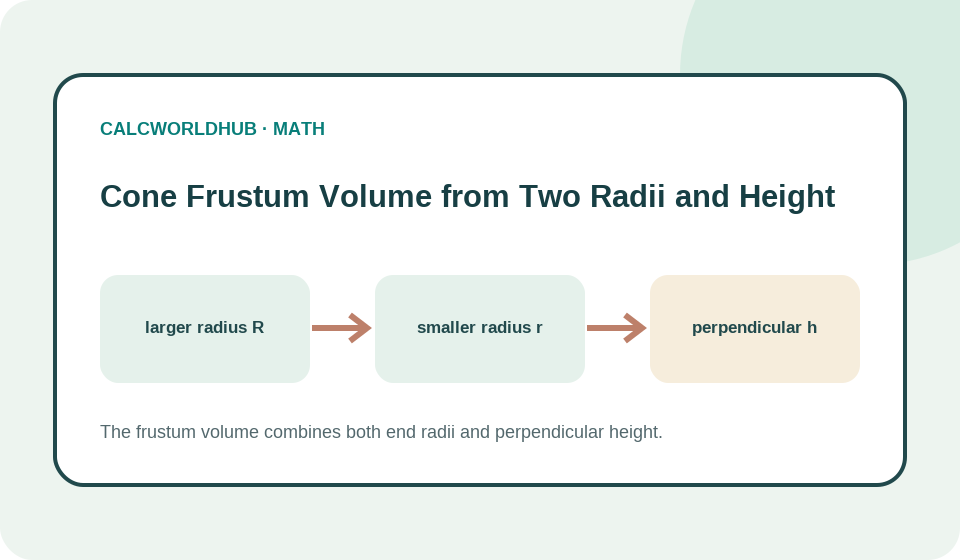

Identify both end radii and the height
Measure the radius from the center of each circular end to its edge. Label the larger radius R and the smaller radius r; the order is useful for describing the shape even though the symmetric formula gives the same volume if their positions are swapped. The height h is measured perpendicular to the parallel circular ends.
Use one length unit for both radii and height. If all three measurements are in centimetres, the volume is in cubic centimetres; if they are in metres, it is in cubic metres. A slant length measured along the side is not the height. The slant length and vertical height are different unless the sides are vertical.
Apply the frustum volume formula
Volume = (π × h ÷ 3) × (R² + Rr + r²). The expression in parentheses combines the squared end radii and their product. It comes from the volume geometry of a cone frustum; it is not the area of one circular face multiplied by height.
OpenStax presents the same relationship for the volume of a frustum of a cone. The formula assumes a right circular frustum with parallel circular ends and a straight center axis. A slanted cut, irregular cross-section, or vessel that changes shape in another way needs a different geometric model.
The relationship can also be seen by extending both sloping sides until they meet at the cone tip. The full cone and the smaller cone removed from its top are similar, so their radii scale with their heights. Subtracting the smaller cone volume from the full cone volume simplifies to the two-radius expression above. This derivation explains why the formula uses both circular ends rather than an average radius squared.
Use radius rather than diameter
If a drawing gives diameters D and d, convert them first: R = D ÷ 2 and r = d ÷ 2. Since the formula squares the radii, entering a diameter as though it were a radius can make the computed volume four times too large when both ends are affected by the same factor.
Keep extra precision through the squares, products, and multiplication by π. Round only the displayed volume to a precision that matches the measurements. A calculator may show a rounded decimal even though the formula result is an irrational multiple of π; report an approximation sign when you show a rounded value.
Interpret the geometric result
The output is the volume enclosed by the idealized solid. It does not subtract wall thickness, internal fittings, sediment, headspace, or inaccessible corners. For a container, usable capacity can therefore be lower than this geometric volume. If you need a fill quantity, measure the internal dimensions and account separately for the level or reserve.
Small measurement changes can affect the result because radius terms are squared. Recheck which end measurement is the radius, whether the height is vertical, and whether the two circular sections are parallel before using the volume in material or capacity planning.
Check units and geometric limits
When R and r are equal, the shape reduces to a cylinder and the expression becomes πR²h. When the smaller radius approaches zero, it approaches a cone. These limit checks are useful for spotting a swapped unit or a missed factor of three, but they do not replace checking the actual dimensions.
Use the result for geometric estimation, not as a direct mass or liquid quantity. To obtain mass, density and material assumptions are also needed. To estimate liquid volume in a tilted or nonuniform tank, the fill level and orientation matter; the calculator has no input for them.
Worked examples
A frustum with radii 6 cm and 3 cm
Inputs: Larger radius R = 6 cm; smaller radius r = 3 cm; perpendicular height h = 10 cm.
Calculation: Volume = (π × 10 ÷ 3) × (6² + 6 × 3 + 3²) = (10π ÷ 3) × 63 = 210π ≈ 659.7345 cm³.
The ideal frustum volume is about 659.73 cm³ before allowing for wall thickness or unused space.
A shorter frustum with a narrower top
Inputs: Larger radius R = 4 cm; smaller radius r = 2 cm; perpendicular height h = 9 cm.
Calculation: Volume = (π × 9 ÷ 3) × (4² + 4 × 2 + 2²) = 3π × 28 = 84π ≈ 263.8938 cm³.
The geometric volume is about 263.89 cm³ using the stated radii and perpendicular height.
