
Confirm that the object is a cube
A cube has six square faces and three equal edge dimensions. If the object is a rectangular prism with unequal length, width, and height, its volume does not determine one unique edge length. The cube-root calculation would still return a number, but it would describe an equal-sided cube with that volume rather than the original shape.
Use the volume of the geometric solid, not surface area or mass. If you only know mass, you would also need density to estimate volume. Check that the stated volume represents the same material boundary whose edge you want to recover.
Take the cube root
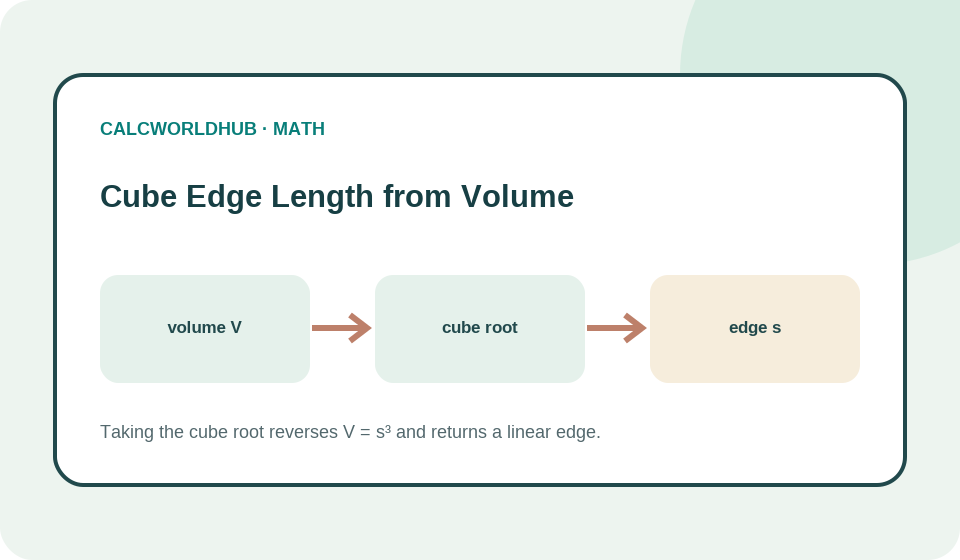
Let V be the volume and s the common edge length. The forward relation is V = s³; solving for s gives s = ∛V. The cube root is the number that, when multiplied by itself three times, returns the entered volume. It is not a square root and does not require taking a positive or negative sign from a quadratic equation.
OpenStax’s geometric formula reference lists cube volume as s³. The inverse calculation preserves dimensional units: the cube root of cubic centimetres is centimetres, and the cube root of cubic metres is metres. Keep the exponent visible when converting units because one cubic metre equals one million cubic centimetres.
Use cubic units consistently
Enter a nonnegative volume in the unit expected by the calculator. If a source gives litres, first decide whether the tool’s volume unit is cubic centimetres or another cubic unit and convert before taking the root. One litre equals one cubic decimetre, or 1,000 cubic centimetres; it is not one cubic centimetre.
Do not round a converted volume too early. The cube root softens relative error compared with a direct linear multiplication, but a unit conversion error can still change the result by a large factor. State both the volume unit and the resulting edge unit in any report.
Unit conversions must be cubed before you take the root. Since 1 m = 100 cm, 1 m³ = 100³ cm³ = 1,000,000 cm³. After converting a cubic volume, the cube root returns the corresponding linear unit. A mistaken linear conversion on a cubic value can shift the inferred edge by a factor of one hundred.
Understand precision and measurement limits
The returned edge is only as reliable as the volume estimate. If volume is rounded, inferred from a container label, or measured with uncertainty, the displayed root should not imply more precision than the source. Keep full calculation precision internally and round the final edge to the precision supported by the measurement.
A zero volume gives a zero edge, while a negative volume has no physical cube interpretation. The calculator can compute the geometric inversion but does not inspect a drawing, detect a hollow object, or correct for compressibility, porosity, or measurement uncertainty.
For a small relative uncertainty in the measured volume, the relative uncertainty in the inferred edge is approximately one third as large: differentiating s = V^(1/3) gives ds/s ≈ (1/3)(dV/V). This sensitivity rule assumes small changes and does not replace a formal uncertainty analysis when the measurement is critical.
Check the result by cubing it
A quick check is to cube the reported edge using unrounded values: s × s × s should return the input volume within display rounding. If the result seems inconsistent, verify that the value entered was volume rather than area and that the unit conversion used the third power.
Use the edge estimate for a cube-shaped object or a hypothetical equal-sided comparison. It does not reveal the original orientation, surface finish, corner rounding, or whether a real manufactured object meets a tolerance. Those questions require direct dimensions or a suitable measurement method.
Worked examples
A cube with a 729 cm³ volume
Inputs: Volume V = 729 cm³.
Calculation: Edge s = ∛729 cm³ = 9 cm, because 9³ = 729.
An ideal cube with volume 729 cm³ has an edge length of 9 cm.
A cube with a non-perfect-cube volume
Inputs: Volume V = 350 cm³.
Calculation: Edge s = ∛350 cm³ ≈ 7.0473 cm, because 7.0473³ ≈ 350.
The equal edge estimate is approximately 7.047 cm; the original object must still be cube-shaped for that to describe its edge.
