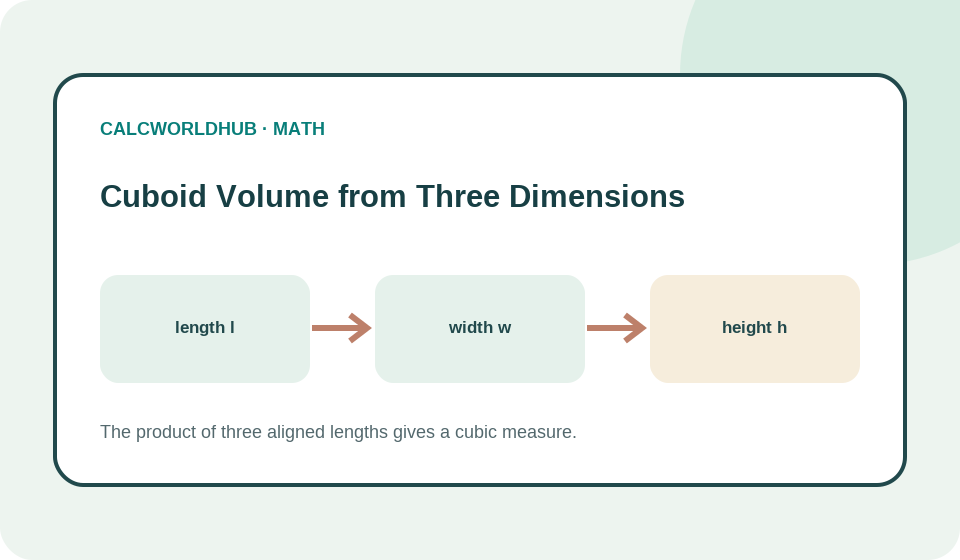

Measure the three perpendicular dimensions
Choose length, width, and height along the cuboid’s three perpendicular directions. The labels can be assigned to any of the three axes because multiplication is commutative, but each measurement must describe the same rectangular solid. For a package, internal dimensions are appropriate when estimating interior space; outside dimensions describe the object’s external bounding box.
A cuboid has straight edges and rectangular faces. A tapered carton, rounded container, or irregular load may not have one exact length-width-height volume. A bounding-box estimate can be useful for transport planning, but it may overstate usable or occupied space.
Multiply the dimensions
Volume = length × width × height. The product of three lengths has dimensions of length cubed. Thus metres multiplied by metres multiplied by metres produce cubic metres (m³), while centimetres produce cubic centimetres (cm³). It is not an area because all three independent dimensions are included.
OpenStax gives the same rectangular-prism rule as base area multiplied by height, which is equivalent to length × width × height when the base is a rectangle. The formula assumes the dimension lines are perpendicular and the solid does not change cross-section through its height.
Convert units before calculating
If one measurement is in centimetres and another in metres, convert them to a shared unit before multiplication. For example, converting a 75 cm side to 0.75 m is a linear conversion; the final product is then in m³. Do not convert the final cubic result using a linear factor, because cubic units scale by the conversion factor raised to the third power.
Keep measurement precision through the multiplication. A long decimal output does not make rough tape measurements exact. Round the final result to reflect the precision of the least reliable input and label the unit explicitly.
When comparing containers, use the same basis for each: internal dimensions for usable capacity or outside dimensions for a transport envelope. Keep that basis with the result; a larger outer box does not guarantee more interior space.
Interpret capacity and bounding volume
Geometric volume is the space inside the ideal cuboid boundary. It does not automatically equal how much a product can be packed, how much liquid a vessel can hold, or how much cargo space remains after padding and fittings. For usable capacity, use internal dimensions and account for rounded corners, wall thickness, dividers, or required clearance.
For irregular goods, a cuboid’s volume may be only the bounding volume. Orientation, gaps, compression, and stacking rules can dominate the packing result. This calculator uses three numbers and cannot model those details, so identify whether you mean solid volume, interior capacity, or a logistics envelope.
Check scale and shape before relying on the number
Estimate whether the result has a plausible order of magnitude by comparing it with a known object or a rough cube. If doubling one dimension while holding the others fixed doubles the volume; doubling all three multiplies volume by eight. These simple checks can catch a misplaced decimal or a forgotten conversion.
Use the output as a geometric calculation, not as a measurement certification. If an object has angled walls or changing thickness, divide it into simpler solids or use a measurement method designed for that shape. Preserve the source dimensions and units so the calculation can be repeated.
Worked examples
A storage box measured in metres
Inputs: Length = 2.4 m; width = 1.25 m; height = 0.8 m.
Calculation: Volume = 2.4 × 1.25 × 0.8 = 2.4 m³.
The rectangular box has a geometric volume of 2.4 m³ using these dimensions.
A compact container with smaller dimensions
Inputs: Length = 0.75 m; width = 0.4 m; height = 0.3 m.
Calculation: Volume = 0.75 × 0.4 × 0.3 = 0.09 m³, or 90 L.
The geometric volume is 0.09 m³; the equivalent is 90 litres before allowing for walls or clearance.
