
Define the percentage before comparing batches
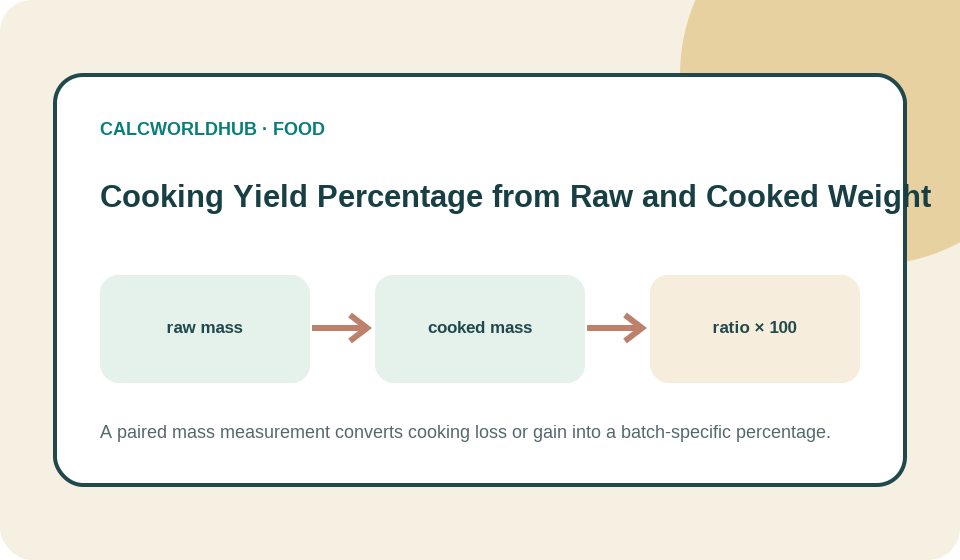
Cooking yield = cooked weight ÷ raw weight × 100. Both entries must use the same mass unit, so grams divided by grams cancel. The runtime requires finite values, positive raw weight, and nonnegative cooked weight. It can display a yield above 100% if cooked mass exceeds the starting mass.
That percentage describes the two measurements entered. It does not isolate water loss, fat loss, absorbed cooking liquid, discarded trim, or material left in a pan. Weigh the same defined batch before and after preparation, using consistent tare and a clear boundary for what counts as food. Otherwise, sound arithmetic may answer a different question.
Measure the batch at repeatable stages
Raw weight should represent the portion that actually enters cooking. Decide whether it includes skin, bones, marinade, packaging moisture, or seasoning, and use the same definition each time. After cooking, measure the edible batch you intend to compare. Resting or draining can change the measurement, so apply a consistent timing rule.
A scale introduces uncertainty. Keep it stable, check zero and tare, and use enough resolution for batch size. For a small sample, a one-gram difference can change the percentage more than for a large batch. Four displayed decimals describe software formatting; they do not imply that a kitchen scale measured the mass that precisely.
Why cooking methods produce different yields
Heating can drive off water and rendered fat, while simmering, brining, or other methods can add or retain liquid. Cut, thickness, initial composition, endpoint temperature, cooking time, and rest time also matter. USDA cooking-yield tables report values tied to specified foods and protocols; they are not universal percentages for every ingredient or kitchen.
For a useful comparison, hold food type and preparation method constant as practical. A yield measured for one cut and procedure is a reference for that procedure, not a guarantee for another cut, appliance, portion size, or endpoint. If recipes differ in seasoning or added liquid, record those separately rather than attributing every mass change to the ingredient.
Keep yield separate from quality and safety
A higher yield does not automatically mean better flavor, texture, or nutrition. It only means more measured mass remained relative to the chosen raw baseline. A lower yield does not itself show that food was overcooked. The percentage does not estimate moisture content, nutrient retention, edible portion, or material lost to trimming.
Food safety depends on handling, storage, and internal temperature for the particular food; a weight ratio cannot establish it. Follow current safety guidance for the product and method. Use yield for portion planning, recipe costing, and repeatable batch comparisons, while using suitable thermometers and handling procedures for safety decisions.
Use the percentage within its limits
The result is rounded to at most four decimal places. Small differences between runs may reflect scale resolution or process variation rather than a meaningful change. Keep context with the percentage: raw and cooked weights, food identity, trimming, cooking method, endpoint, rest period, and weighing conditions. This makes a later comparison interpretable.
If cooked mass is zero while raw mass is positive, the arithmetic output is zero, though that is not a useful edible-yield outcome. A zero or negative raw denominator is rejected. The calculator does not cap cooked weight at raw weight because some processes add mass; check whether such a result is plausible for the batch.
Worked examples
Examples use grams in both fields; the output is a percentage, not a safety or nutrition measure.
A batch with 76% retained mass
Inputs: Raw weight = 1,000 g; cooked weight = 760 g.
Calculation: Yield = 760 ÷ 1,000 × 100 = 76%.
The cooked batch retained 76% of the measured starting mass.
A smaller batch with a different yield
Inputs: Raw weight = 800 g; cooked weight = 540 g.
Calculation: Yield = 540 ÷ 800 × 100 = 67.5%.
This batch retained 67.5% of its raw measured mass; the percentage alone does not identify why.
