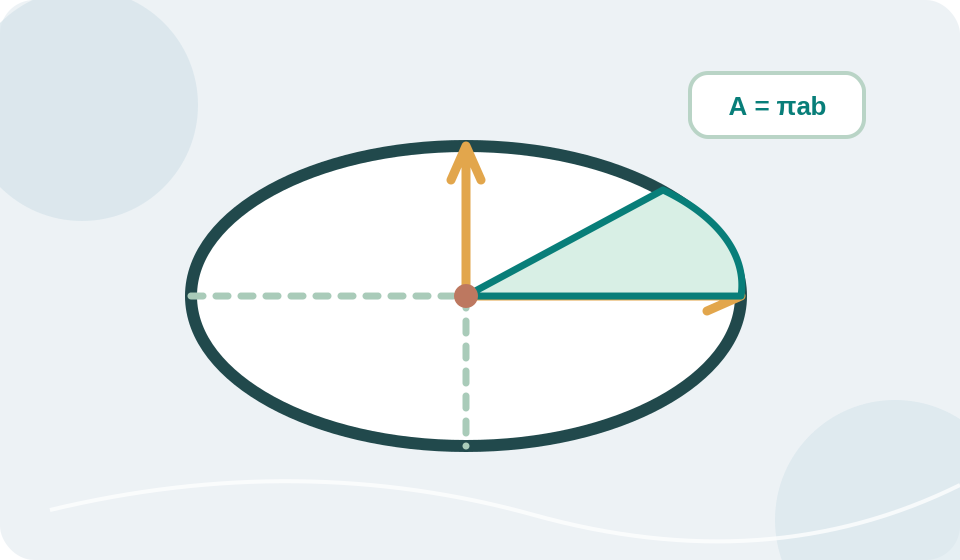

Identify the two semi-axes before calculating
An ellipse has a longer axis and a shorter axis that cross at its centre. The semi-major axis a runs from the centre to an endpoint of the longer axis; the semi-minor axis b runs from the centre to an endpoint of the shorter axis. Both inputs are lengths in the same unit. The labels “semi-major” and “semi-minor” describe their roles, so a should be the longer distance and b the shorter one.
The calculator asks for these two semi-axis lengths rather than the complete diameters. If a survey, drawing, or specification lists a major diameter of 16 cm and a minor diameter of 10 cm, the matching inputs are a = 8 cm and b = 5 cm. Treating the full diameters as semi-axes multiplies the calculated area by four because both factors in πab would be doubled.
Worked examples
Area of an ellipse with 8 m and 5 m semi-axes
Inputs: a = 8 m; b = 5 m.
Calculation: A = πab = π × 8 × 5 = 40π = 125.663706… m².
The ellipse area is about 125.664 m².
Area from two semi-axis measurements
Inputs: a = 10 cm; b = 6 cm.
Calculation: A = πab = π × 10 × 6 = 60π = 188.495559… cm².
The enclosed area is about 188.496 cm².

Why the area is πab
The ellipse area formula is A = πab. It reduces to the circle formula when the two semi-axes match: if a = b = r, then A = πr². One way to understand the relationship is to stretch a unit circle horizontally by a factor a and vertically by a factor b. Every small patch of the circle scales in area by the product ab, so its original area π becomes πab.
The dimensions provide a useful check. Multiplying one length by another produces square units, while π is a dimensionless constant. With axes measured in centimetres, the area is in cm²; with axes in metres, the area is in m². An output reported in a linear unit such as metres would signal a unit-label or interpretation error.
Read the result as a footprint
The result describes the two-dimensional region enclosed by the ellipse. It can help estimate a flat panel, opening, planting bed, graphic, or other planar footprint when its outline is well represented by an ellipse. It is not the perimeter, the length of the longer axis, or the surface area of a three-dimensional object. The calculator uses only a and b, so rotation of the ellipse on a plan does not change the result.
Area responds to both axes together. If a stays fixed and b grows by 10%, the computed area also grows by 10%. If both axes grow by 10%, the new area is 1.1 × 1.1 = 1.21 times the original, a 21% increase. This multiplicative behaviour is a useful planning check when comparing two outlines that look only slightly larger.
Measure from the centre and keep units aligned
On a measured object, first locate the centre and measure to the boundary along each principal direction. A ruler that measures edge-to-edge across the longest direction gives the full major diameter, not a. The shorter cross-section gives the full minor diameter, not b. Record whether measurements are inside, outside, or centreline dimensions; mixing an opening with an external outline changes both semi-axes and therefore the area.
The two inputs must share a unit before multiplication. Do not combine a = 8 cm with b = 0.05 m as if their numbers were comparable. Convert one first: 0.05 m equals 5 cm, so the area is 40π cm². Or convert both to metres and report 0.4π m². These are the same physical area expressed in different units.
Check precision and the limits of the model
For a transparent check, calculate π × a × b independently and keep the unrounded result until a reporting precision is chosen. If the measured axes are only known to the nearest millimetre, displaying many decimal places does not improve the measurement. A small relative error in either axis carries into the area; when both are uncertain, the combined effect depends on both measurement errors.
The model assumes a planar ellipse with positive semi-axis lengths. It does not infer the axes from an irregular outline, account for a tilted three-dimensional surface, or compensate for a shape that is close to an ellipse but not truly one. If the outline is irregular, use a traced plan or a method based on measured coordinates instead of treating two spans as a complete description.