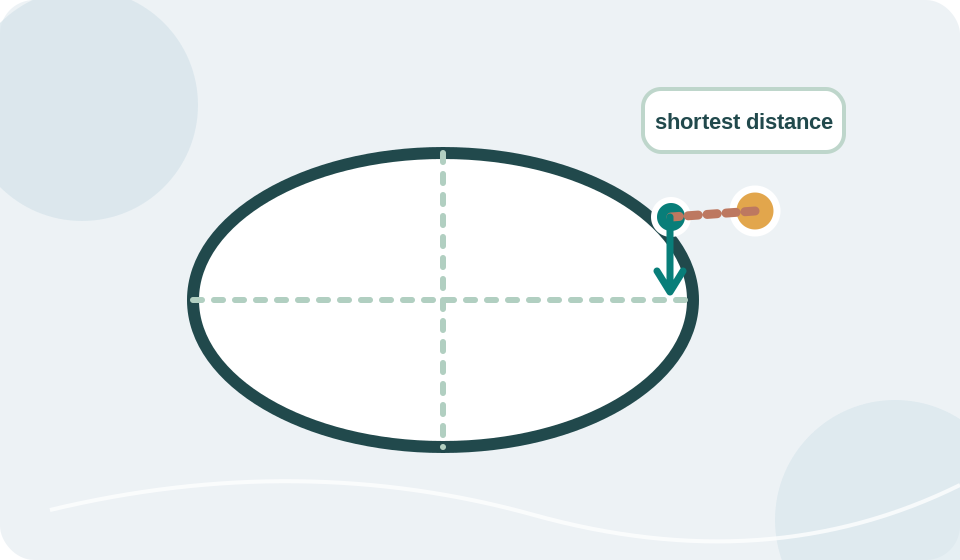

Confirm what the calculator measures
The calculator describes an ellipse centred at the origin with its axes aligned to the x and y coordinate directions. Enter the horizontal semi-axis a, vertical semi-axis b, and query coordinates x and y. Both axes must be positive, and the coordinates must use the same length unit. A query such as (8, 0) measured in metres cannot be paired with axes entered in centimetres without conversion.
The output gives a nearest boundary point and the distance to it. It measures to the outline, not to the filled ellipse. Therefore a point inside the ellipse can have a positive distance: that number is how far the point is from the edge. This differs from a distance-to-filled-region question, where an interior point would have distance zero.
Worked examples
An exterior point on the major-axis line
Inputs: a = 5 m; b = 3 m; query = (8, 0) m.
Calculation: The nearest boundary point is (5, 0) m. Distance = √((8 − 5)² + (0 − 0)²) = 3 m.
Nearest point: (5, 0) m; distance to the ellipse boundary: 3 m.
A query at the centre
Inputs: a = 5 cm; b = 3 cm; query = (0, 0) cm.
Calculation: The minor-axis endpoints (0, 3) and (0, −3) are each 3 cm from the centre. The runtime returns one nearest point, (0, 3) cm.
Nearest point shown: (0, 3) cm; minimum boundary distance: 3 cm. The symmetric point (0, −3) cm is tied.

Why a visual guess can miss the closest point
For a circle, the nearest point from an exterior query point lies along the line from the centre through that point. An ellipse is not rotationally symmetric, so the radial point on the same ray is generally not the nearest one. The perpendicular from the query to the ellipse normal is the relevant shortest segment, and the normal direction changes around the curve.
The runtime represents a boundary point by the parameterized coordinates (a cos θ, b sin θ). It searches over a bounded quarter of the ellipse after reflecting the query into the first quadrant, refines the candidate angle numerically, compares the ends, and restores the query point’s signs. The output is consequently a numerical nearest point, rounded for display, not a symbolic exact coordinate in every case.
Read the distance and coordinates together
A distance alone says how far away the boundary is but not where to reach it. The coordinates identify one nearest point on the axis-aligned ellipse. Check that the displayed point satisfies xₑ²/a² + yₑ²/b² ≈ 1, allowing for output rounding. Then calculate √((x − xₑ)² + (y − yₑ)²); it should match the reported distance.
There can be more than one equally near point because ellipses are symmetric. At the centre of an ellipse with a = 5 and b = 3, every boundary point has some distance, but the two minor-axis endpoints are both nearest at distance 3. The calculator returns one representative of that tie. Do not interpret a single displayed coordinate as proof that no symmetric solution exists.
Use coordinate units and orientation consistently
The input axes and query point are expressed in one coordinate system. If a map uses a translated centre or a rotated ellipse, convert the query into a local frame where the ellipse centre is (0, 0) and its axes are horizontal and vertical. This implementation does not take a centre or rotation angle, so entering global coordinates for an off-origin or tilted ellipse will answer a different geometric problem.
A practical approach is to translate the query by subtracting the ellipse centre, rotate it into the principal-axis frame if needed, calculate the nearest point there, and transform the point back afterward. The distance is unchanged by rigid translation or rotation, but the coordinate pair changes. Keep a note of the transformation so the returned local coordinates are not mistaken for the original drawing coordinates.
Understand the numerical boundary of the answer
The runtime uses a bounded angular search with numerical refinement, which works for this two-dimensional axis-aligned model but is not a substitute for a general geometry solver when strict tolerances or unusual scaling are required. Very large or tiny values can be sensitive to floating-point precision, and the displayed coordinates are limited to eight decimal places. If the answer is used for a tolerance-critical fit, validate it in the target CAD or numerical environment.
The model assumes both axes are positive and finite. It does not find the closest point on a segment, an ellipse arc, or a three-dimensional ellipsoid. It also does not return every tied nearest point. These distinctions matter in boundary clearance, collision checks, or layout work: state whether the target is the full boundary, a restricted arc, or the filled region before comparing results.