
Why use a weighted three-point estimate
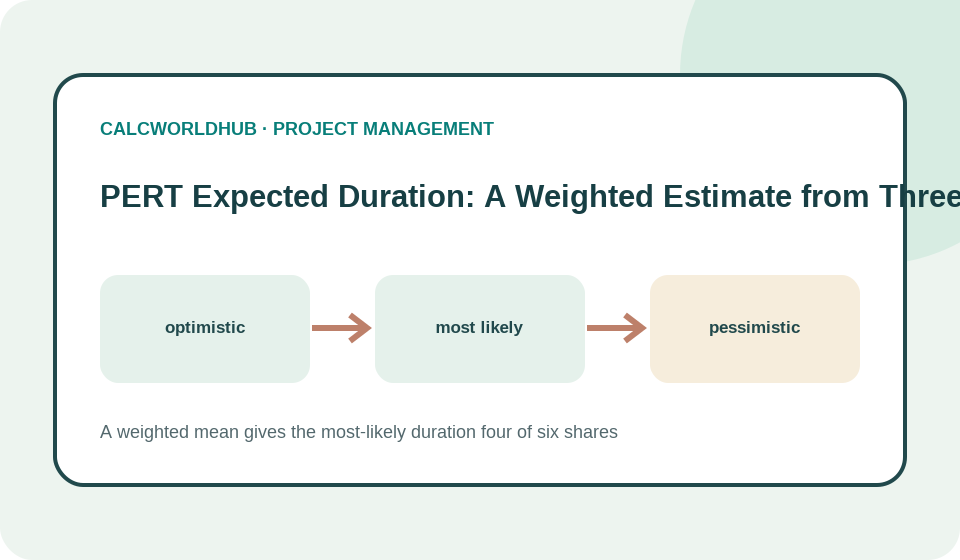
Three-point estimating is most useful when uncertainty is explicit. The optimistic value describes a favorable but credible duration, the most likely value describes the central scenario under current knowledge, and the pessimistic value describes an adverse but credible duration. They should refer to the same task scope, calendar convention, and resource assumptions; otherwise the weighted average blends different questions.
Keep optimistic, likely, and pessimistic aligned
The calculator’s three inputs must use one time unit and be ordered O ≤ M ≤ P. Optimistic, most likely, and pessimistic are not probability percentages; they are durations. If one estimate is in working days and another in calendar days, convert before calculation. Include the task’s actual work and agreed scope consistently, and state whether waiting time, reviews, or external approvals are represented.
How the PERT mean is weighted
The PERT expected duration is TE = (O + 4M + P) / 6. The central estimate receives four of the six weights, while each bound receives one. This is the conventional PERT weighted mean used to turn three points into one activity estimate. It should not be described as the simple midpoint unless the most-likely value happens to make the results equal.
Read the mean as a planning estimate
The weighted mean can be fractional even when the task is scheduled in whole days. Preserve the unrounded value in downstream math and round only for display or a calendar rule that explicitly requires whole units. If a project calendar excludes weekends or holidays, the duration estimate still needs to be translated into dates using that calendar; this calculator returns a duration, not a start or finish date.
Use one activity at a time
Use the estimate as one input to sequencing, resource planning, or a broader risk analysis. It says nothing by itself about whether the task lies on a critical path or how another task can run in parallel. Adding expected durations is appropriate only for a specified serial path; a project with branches and dependencies needs network analysis rather than a blind sum of all task averages.
A most-likely estimate should not automatically be treated as the expected value: skewed uncertainty can pull the average away from the most common outcome. The PERT weighting deliberately shifts the three-point average toward the middle input, while still incorporating both bounds. Review whether the optimistic and pessimistic cases are realistic rather than using them as arbitrary best and worst imaginable outcomes; extreme endpoints can dominate the uncertainty measures even though the central estimate receives more weight.
Worked examples
The estimates use the same duration unit; the weighted result is rounded only after evaluating the complete expression.
A short activity with a broader downside
Inputs: Optimistic O = 3 days; most likely M = 5 days; pessimistic P = 11 days.
Calculation: TE = (O + 4M + P) ÷ 6 = (3 + 4×5 + 11) ÷ 6 = 34 ÷ 6 ≈ 5.6667 days.
The PERT expected duration is approximately 5.67 days for this activity.
A task with evenly weighted endpoints
Inputs: Optimistic O = 4 days; most likely M = 7 days; pessimistic P = 16 days.
Calculation: TE = (4 + 4×7 + 16) ÷ 6 = 48 ÷ 6 = 8 days.
The weighted estimate is eight days; retain the original three estimates for context.

What the estimate leaves out
Keep a short note explaining how the three points were chosen and what evidence supports them. Historical task data, expert elicitation, and supplier quotes can yield different estimates. A single weighted result can make uncertainty less visible, so retain the original range for reviews and update the points when scope, staffing, technology, or external conditions change.
PERT is an approximation. The familiar weighting is associated with a beta-shaped activity-duration model, but three numbers do not prove that an actual task follows that distribution. Correlated risks, path convergence, resource conflicts, rework, and schedule constraints can all affect the project finish in ways this single-activity mean does not calculate.