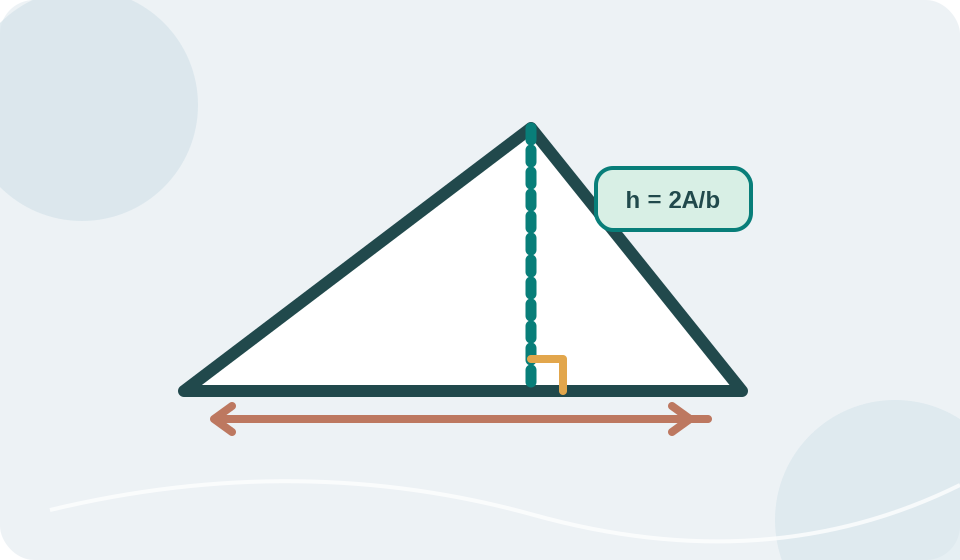

Use the base that corresponds to the known area
Starting from A = bh/2, multiply both sides by 2 and divide by b to get h = 2A/b. In the calculator, A is entered as a triangle area in square units and b as the corresponding base in length units. The result h is a length in that same base unit, provided the area unit is consistent.
The base is one side of the triangle, while the altitude is the perpendicular distance from the opposite vertex to the line containing that base. For an obtuse triangle the perpendicular may meet the extended base outside the segment. It still defines the altitude paired with that base and can be longer or shorter than a visible side.
The runtime accepts positive finite area and base values. It cannot confirm that they describe the same triangle or that their units match, so verify the pair from the drawing or measurement record.
Worked examples
Recover height from 42 cm² and a 12 cm base
Inputs: A = 42 cm²; b = 12 cm.
Calculation: h = 2A/b = 2 × 42/12 = 7 cm; checking 12 × 7/2 returns 42 cm².
The altitude corresponding to the 12 cm base is 7 cm.
Recover height from 84 m² and a 14 m base
Inputs: A = 84 m²; b = 14 m.
Calculation: h = 2 × 84/14 = 12 m; substitution gives 14 × 12/2 = 84 m².
The matching perpendicular altitude is 12 m.

Worked examples and unit conversion
With A = 42 cm² and b = 12 cm, h = 2 × 42/12 = 7 cm. Substituting back gives 12 × 7/2 = 42 cm². This substitution is the simplest independent check and should return the area supplied to the calculator.
For A = 84 m² and b = 14 m, h = 2 × 84/14 = 12 m. Square metres divided by metres leaves metres. Convert any mixed area and length units first; area conversion uses the square factor.
The result helps recover a missing perpendicular dimension from a known area and side length. It does not identify which side should be the base: if you switch to another side, use the matching altitude. Different base-altitude pairs for the same triangle can have very different lengths while producing the same area.
Read the relationship in both directions
At a fixed base, doubling the area doubles the inferred height. At a fixed area, doubling the base halves the inferred height. These inverse relationships are practical checks: if your entered base is larger but the area is unchanged, the returned altitude should become smaller rather than larger.
The algebra is exact for the stated triangle area identity, but the result inherits uncertainty from both inputs. A small base measured with a large percentage error can strongly affect h because b is in the denominator. When dimensions are approximate, compare the calculated height with a direct perpendicular measurement if one is available.
Record the area, chosen base, and inferred altitude together. The check A = bh/2 should recover the entered area; a height derived for one side must not be reused with a different base.
Common mistakes and limits
One common mistake is entering a perimeter or a side length in the area field. The numerator must be square units; putting a length there produces a result with the wrong dimension. Another is mixing square centimetres with a base in metres. Convert the area by the square factor: 1 m² equals 10,000 cm², not 100 cm².
This method assumes the area and base belong to a single planar triangle with straight edges. It does not infer a curved surface, handle a composite region without a suitable total area, or decide whether a measured shape is triangular. If area was assembled from multiple pieces, confirm that it is the triangle’s area before solving for h.
A very small positive base can produce a very large altitude. That may be mathematically consistent but should trigger a geometry and unit review. The tool reports the algebraic result for entered inputs; it does not cap the height based on a real object or warn that the selected base may be inappropriate.
A practical verification sequence
First check the area unit and base unit, then compute 2A/b without rounding intermediate values. Next substitute the displayed height back into bh/2 and compare with the original area at the calculator’s displayed precision. A small difference after rounding is expected; a large difference signals a conversion or transcription problem.
Second, inspect the geometry. Mark the chosen side and the perpendicular from the opposite vertex, including an extension line if the altitude falls outside the triangle. This makes clear why the result is not necessarily the length of any side. If the sketch uses a different base, calculate the corresponding altitude rather than reusing the first one.
This is a geometric conversion, not a tolerance, structural, or cutting-allowance check. Keep those project decisions separate from the area identity.