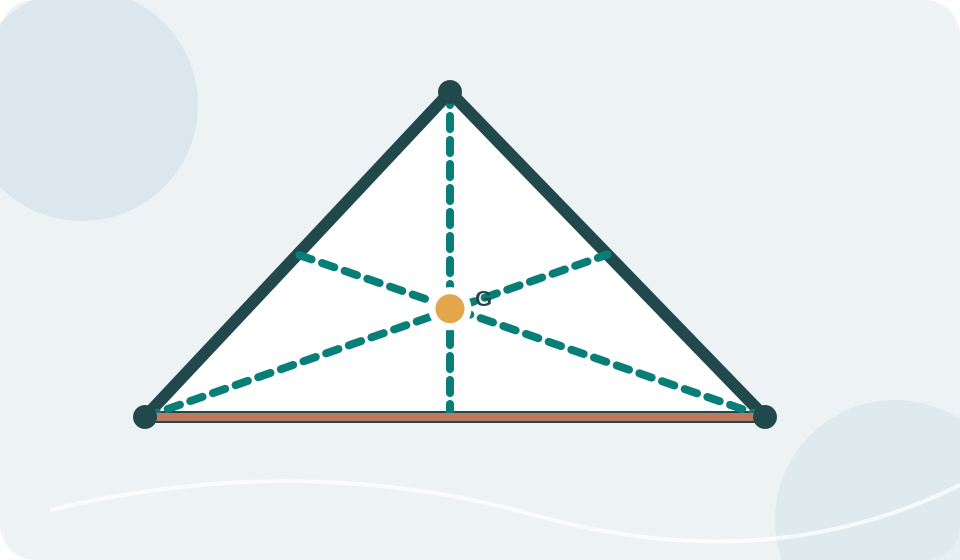

Average x and y coordinates separately
Write the vertices as A=(x₁,y₁), B=(x₂,y₂), and C=(x₃,y₃). The centroid G has coordinates G=((x₁+x₂+x₃)/3, (y₁+y₂+y₃)/3). The six calculator inputs are paired in vertex order: x and y for A, then x and y for B, then x and y for C. The result uses the same coordinate units as the inputs; it is not an area or a length measurement.
The equal weights matter. Each vertex contributes one third of the x-coordinate and one third of the y-coordinate, regardless of side lengths or angles. This is the geometric center of three equal point masses placed at the vertices. It is also the common intersection of the three medians, where a median joins a vertex to the midpoint of the opposite side.
Worked examples
A triangle translated above the x-axis
Inputs: A=(1, 2), B=(7, 2), C=(4, 8).
Calculation: xG=(1+7+4)/3=4; yG=(2+2+8)/3=4.
The centroid is G=(4, 4).
A triangle spanning negative and positive x-values
Inputs: A=(-3, 1), B=(3, 1), C=(0, 7).
Calculation: xG=(-3+3+0)/3=0; yG=(1+1+7)/3=3.
The centroid is G=(0, 3), on the y-axis.

Worked examples and a coordinate check
The examples below calculate both coordinates independently. Keep each x-value with the y-value from the same vertex; swapping one coordinate can still produce a plausible-looking point while describing a different triangle. A second check uses a median: the centroid divides each median in a 2:1 ratio measured from the vertex toward the opposite-side midpoint.
What the location tells you
The centroid always falls within the triangle, even when the shape is very narrow or obtuse. Draw the midpoint of any side, connect it to the opposite vertex, and locate the point two thirds of the way from that vertex. Repeating the construction with another side should land at the same location. If a plotted result falls outside the triangle, first inspect the input order and arithmetic rather than assuming an unusual triangle shape.
The point also balances a uniform, thin triangular lamina, provided mass is distributed evenly across the material. That physical interpretation is different from the coordinate calculation’s equal point-mass interpretation, but both identify the same centroid for a uniform triangle. A nonuniform sheet, cutout, or attached load changes the center of mass and cannot be modeled from the three vertices alone.
Coordinate systems and transformations
All six values must describe points in one Cartesian coordinate system. Eastings mixed with local offsets, or centimetres mixed with metres, do not form a coherent set until you convert them to a common origin and unit. Negative coordinates are valid: they indicate a position left of or below the chosen origin, not a negative physical distance.
Translations provide a strong check. If the origin shifts by a vector (p,q), every vertex and the centroid should shift by that same vector. Rotations and uniform scaling also carry the centroid with the triangle because the coordinate average is linear. A useful practical test is to translate every point by the same amount and confirm that the result changes by exactly that amount, while its position relative to the triangle remains unchanged.
How it differs from other triangle centers
The centroid is not generally the incenter, which is the meeting point of angle bisectors, or the circumcenter, which is equidistant from all three vertices. It is not the orthocenter, where altitudes meet. These four points coincide only in special symmetric cases. For an equilateral triangle they are the same point; for an ordinary scalene triangle they usually occupy different locations.
This distinction matters when a task says “center” without naming the construction. For balancing a uniform triangle or finding a median intersection, use the centroid. For an incircle, use the incenter; for the circle through all three vertices, use the circumcenter. Selecting the right center before entering values prevents a mathematically correct coordinate from answering the wrong geometric question.
Common input mistakes and limits
A frequent error is averaging three x-values but dividing by two, or averaging all six coordinates in one list. The centroid is a two-dimensional point, so it requires two separate means with denominator three. Another is entering an endpoint or side midpoint as if it were a vertex. Label A, B, and C on the drawing and enter the corresponding x,y pairs in that order before calculating.
The calculator accepts finite coordinates and computes the arithmetic result; it does not test whether the three points are distinct or form a positive-area triangle. Collinear vertices still have a coordinate average, but they describe a degenerate triangle with no interior. Coordinate magnitudes should also stay within ordinary numeric precision. Round only after checking the unrounded point, and report precision that the source measurements can support.