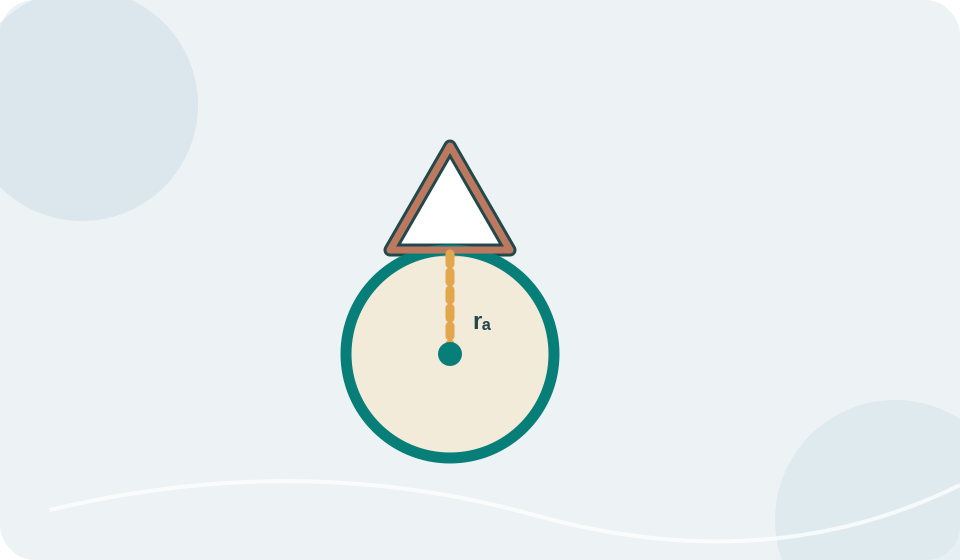

Identify the excircle and the opposite side
The calculator accepts three side lengths a, b, and c in one common unit and returns the exradius opposite side a. That circle lies outside the triangle; it touches side a and the extensions of the other two side lines. There are three excircles, one opposite each side, so the phrase “opposite side a” is part of the result’s meaning.
The side set must form a nondegenerate triangle: each pair of sides must sum to more than the third. The sides are positive lengths, not signed coordinate differences. If the inputs use millimetres and centimetres together, convert them before calculating or the side inequalities and radius will be meaningless.
Worked examples
Excircle opposite the 3-unit side of a 3-4-5 triangle
Inputs: a=3 units, b=4 units, c=5 units.
Calculation: s=6; A=6. The denominator is s−a=6−3=3, so rₐ=A/(s−a)=6/3=2.
The exradius opposite side a is 2 units.
Excircle opposite side a=5 in a 5-5-6 triangle
Inputs: a=5 units, b=5 units, c=6 units.
Calculation: s=8; A=12. Then rₐ=12/(8−5)=12/3=4.
The exradius opposite side a is 4 units. The exradius opposite side c would use a different denominator.

Relate the exradius to area and semiperimeter
Let s=(a+b+c)/2 and let A be the triangle area. The exradius opposite a is rₐ=A/(s−a). Heron’s formula supplies A=√[s(s−a)(s−b)(s−c)], so rₐ=√[s(s−b)(s−c)/(s−a)]. The result has length units because area is divided by a length.
The denominator is the difference between the semiperimeter and the selected opposite side. It is positive for every strict triangle, but it can become small when a approaches b+c in a nearly degenerate shape. In that case the exradius grows and becomes sensitive to small changes in the measurements.
An area decomposition explains the formula. The excenter is equally distant from all three side lines, so the external circle’s radius is the common perpendicular height used in signed-area triangles. Combining those signed areas gives A=rₐ(s−a). The other two exradii use s−b and s−c instead.
What “opposite side a” means
Side a is the side across from vertex A. The excenter opposite side a is the center of the excircle associated with that side; it does not mean a circle opposite angle A in an unrelated orientation. Label the triangle before assigning side lengths, especially when a diagram uses different letter conventions.
The three exradii generally differ. In a triangle with unequal sides, changing which side is designated a changes the denominator and therefore the radius. A side permutation can preserve the same geometric shape while selecting a different exradius, so retain the labels in notes and reports.
Worked examples and independent checks
Compute the semiperimeter and Heron area, then divide the area by s−a. A second check is to evaluate the equivalent square-root formula and compare the results before rounding. The two methods use the same geometry but expose different opportunities for an arithmetic or parenthesis error.
As a shape approaches degeneracy with a nearly equal to b+c, s−a becomes small and the exradius can become very large. That is a mathematical feature of the model, not necessarily a software defect. It also signals that the output may be highly sensitive to measurement uncertainty.
Avoid common mix-ups
Do not use A/s for an exradius; that gives the inradius. The exradius opposite a uses A/(s−a). Also avoid subtracting a side from the full perimeter instead of from the semiperimeter. Write s first and show the chosen opposite side explicitly so the denominator is auditable.
Another error is to treat all three exradii as one value. Only an equilateral triangle has all three equal. If the question names side b or c, change the denominator accordingly or use the corresponding calculator if available; this tool is specifically tied to side a.
The formula assumes straight sides on a plane and exact positive lengths. It does not account for rounded corners, manufacturing tolerances, a non-Euclidean surface, or a measured outline that is not truly triangular. Report enough input context for another person to identify which exradius was calculated.
Choose between an incircle and an excircle
Use the inradius when the circle must fit inside the triangle and touch all three sides. Use an exradius when the circle is outside and tangent to one side plus the other side extensions. The incenter and an excenter are different intersections of angle-bisector lines; their radii answer different placement questions.
The exradius can support a geometric construction or a comparison of tangent-circle configurations. It is not automatically a physical clearance or a design allowance: those interpretations depend on which side lines represent boundaries and whether the exterior region is usable.