
Measure the walls and read the roll label
Measure the wall perimeter in feet at the surfaces that will receive paper. Enter total wall height in feet, roll width and pattern repeat in inches, and roll length in feet. Keep the mixed units as the fields specify: the calculator converts perimeter and height to inches before dividing by the roll width and comparing cut length with roll length.
Enter the wallpaper’s stated dimensions, not a generic roll size. Product listings may give different widths, lengths, and pattern information. A repeat of zero tells the calculator to use the raw wall height as the cut length; a positive repeat is used to round each drop up to a whole repeat.
How drops and cuts are estimated
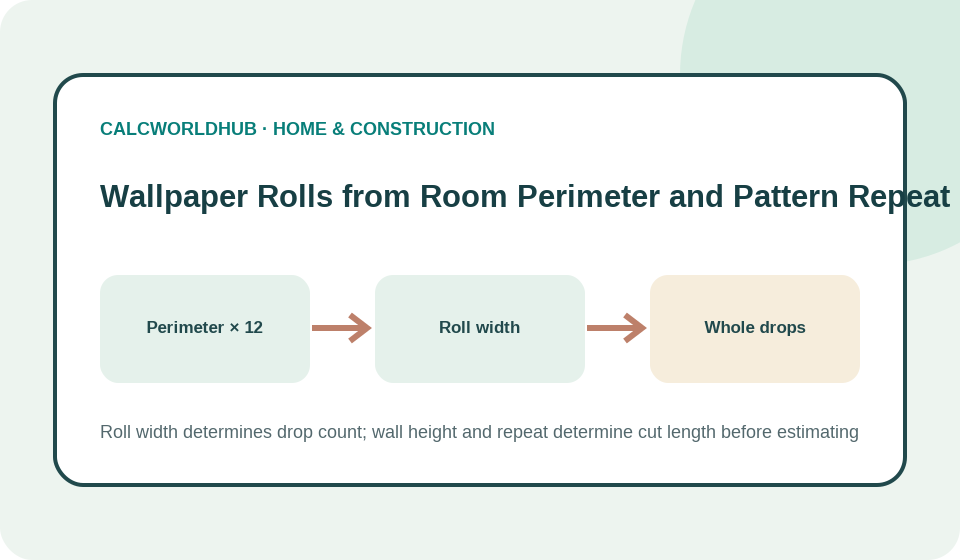
Drop count is ceil(perimeter × 12 ÷ roll width). It rounds upward because a partial drop still needs a strip. Raw cut length is wall height × 12 inches. When repeat is positive, the cut length becomes ceil(raw length ÷ repeat) × repeat; otherwise it remains the raw length.
Estimated rolls = ceil(drops × cut length ÷ (12 × roll length)). This is a continuous-length estimate, not a roll-by-roll cutting plan. With 52 ft of perimeter, 9 ft walls, a 21 in roll, a 33 ft roll, and no repeat, the calculator gets 30 drops at 108 in each and returns ceil(30 × 108 ÷ 396) = 9. Yet each 396 in roll holds only floor(396 ÷ 108) = 3 complete drops, so 30 drops require ceil(30 ÷ 3) = 10 whole rolls before trimming or spare stock. The estimate can understate an order because leftover lengths on separate rolls cannot necessarily combine into another full drop. Treat it as a continuous-length estimate and check the product’s cut plan; the tool does not reuse offcuts or model trimming.
Why pattern repeat changes the order
A pattern repeat is the vertical distance after which a printed motif begins again. Matching adjacent drops may require starting each cut at the next repeat boundary, so a drop can consume more paper than the wall height alone. A larger repeat can therefore increase cut length and push the estimate to another roll even when room dimensions have not changed.
Pattern matching can also depend on the design’s match type, including straight or half-drop alignment. The calculator uses only the repeat length entered; it does not interpret a manufacturer’s match diagram. Read the product label or installation guide, confirm how the motif should align, and use the stated repeat rather than estimating from a thumbnail.
Openings and room shape are not fully modeled
The calculator bases drops on total perimeter and does not subtract windows or doors. This is conservative for some rooms, but it may not match a real cutting plan: paper removed around an opening can create usable pieces, while narrow wall sections and awkward corners can increase waste. A large opening does not automatically eliminate a full drop.
For a room with a bay, chimney breast, many short returns, or changing wall heights, calculate sections separately or follow the wallpaper supplier’s measurement method. The simple estimate assumes one repeated wall height and a continuous perimeter. It also does not include a spare roll for future repair or damage.
Check the roll estimate against the actual product
Before ordering, compare the result with the manufacturer’s calculator or a decorator’s takeoff and verify the same roll dimensions and pattern repeat were used. Product coverage may be stated as a nominal area, but the number of usable drops depends on wall height and pattern alignment. The entered roll length is not an assurance that every inch can be used at a wall.
Keep dye lot and batch numbers consistent across the order. If a room uses different papers, calculate each design independently. The estimator is helpful for a first count and for comparing how a repeat affects consumption; it is not a substitute for product-specific instructions when the design or room is complex.
Worked examples
The first layout has no repeat; the second rounds each drop up to a full 21-inch repeat.
Forty feet of wall without a pattern repeat
Inputs: Perimeter = 40 ft; wall height = 8 ft; roll width = 20.5 in; roll length = 33 ft; repeat = 0 in.
Calculation: Drops = ceil(40 × 12 ÷ 20.5) = ceil(23.4146…) = 24; cut length = 8 × 12 = 96 in; rolls = ceil(24 × 96 ÷ (12 × 33)) = ceil(5.8182…) = 6.
The estimate is 24 drops and 6 rolls. It does not subtract openings or account for matching beyond the entered repeat.
Fifty-two feet with a 21-inch repeat
Inputs: Perimeter = 52 ft; wall height = 9 ft; roll width = 21 in; roll length = 33 ft; repeat = 21 in.
Calculation: Drops = ceil(52 × 12 ÷ 21) = ceil(29.7143…) = 30; raw cut = 9 × 12 = 108 in; aligned cut = ceil(108 ÷ 21) × 21 = 126 in; rolls = ceil(30 × 126 ÷ 396) = ceil(9.5455…) = 10.
The repeat increases each cut from 108 to 126 inches, producing an estimate of 10 rolls. Matching type and trimming still need product-specific review.
