Wallpaper rolls estimator
Estimate whole wallpaper rolls from wall dimensions and product coverage.
inputs.
Calculator
How to use this calculator
Estimate wallpaper rolls from wall perimeter, height, roll dimensions, and a pattern-repeat allowance.
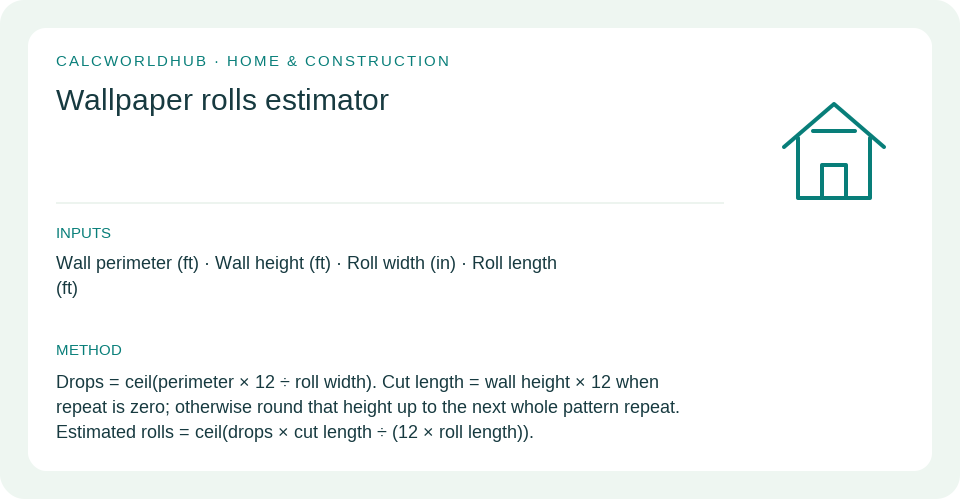
- Enter Wall perimeter (ft), Wall height (ft), Roll width (in), Roll length (ft), then complete the remaining labeled fields. Match the units shown beside each field and review the result together with the assumptions below.
- Read the worked example below to check the expected input format and result.
- Compare another scenario by changing one input at a time. Use Reset to return to the starting values.
Estimate rolls from full-height wall drops
Estimate wallpaper rolls from the perimeter you will cover and the usable dimensions of one roll. The result rounds up to whole rolls.
Inputs and units
- Wall perimeter (ft): Add only the wall lengths being papered; exclude openings only if you have measured them separately.
- Wall height (ft): Use the finished floor-to-ceiling height for the area to cover.
- Roll width (in): Use the product width printed on the roll, not a label width from a different product.
- Roll length (ft): Use the usable roll length.
- Pattern repeat (in, 0 if none): Enter the vertical repeat length for a pattern that must be matched; enter zero for plain or random-match paper.
Formula and method
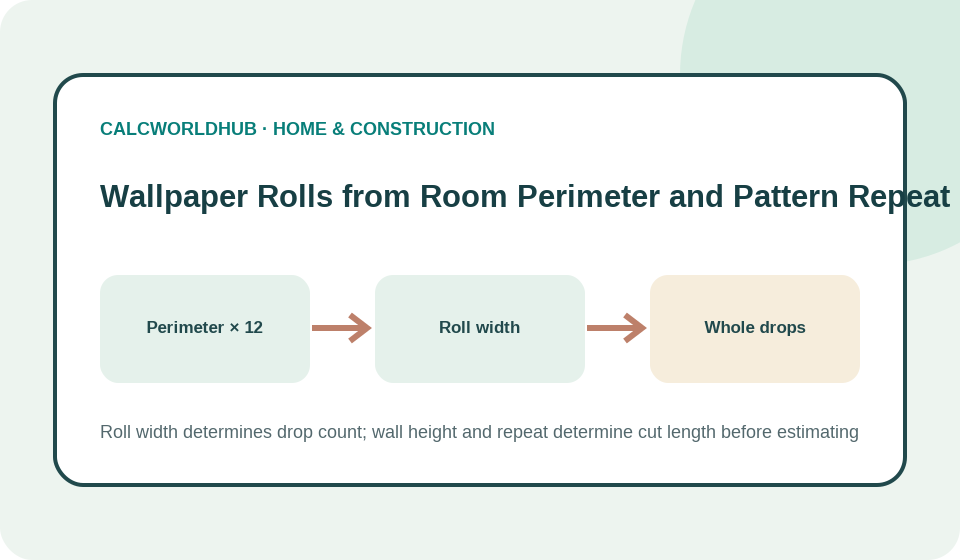
Drops = ceil(perimeter × 12 ÷ roll width). Cut length = wall height × 12 when repeat is zero; otherwise round that height up to the next whole pattern repeat. Estimated rolls = ceil(drops × cut length ÷ (12 × roll length)).
Worked example
For 40 ft of wall perimeter, 8 ft height, 20.5 in roll width, and a 33 ft roll with no repeat: 24 drops × 96 in = 2,304 in; one roll covers 396 in, so ceil(2,304 ÷ 396) = 6 rolls.
Interpreting the result
The estimate counts full-height drops and pattern allowance, then rounds the purchase quantity upward. A pattern repeat can increase each cut even when the wall dimensions stay the same.
Assumptions and limits
This assumes the full printed roll length is usable and every drop is the same height. It does not deduct doors or windows, add corner/ceiling waste, account for matching across multiple rolls, or replace the manufacturer’s coverage guidance. Measure the actual walls and product.
Frequently asked questions
Why can a pattern repeat add more than one repeat?
The cut must reach at least the wall height, so its length is rounded up to a whole repeat interval.
Should I subtract doors and windows?
Only if you can also account for the extra seams and short pieces they create. This simple drop model does not optimize offcuts.
How do I use the Wallpaper rolls estimator?
Enter Wall perimeter (ft), Wall height (ft), Roll width (in), Roll length (ft), then complete the remaining labeled fields. Match the units shown beside each field and review the result together with the assumptions below.
What is a worked example of Wallpaper rolls estimator?
For 40 ft of wall perimeter, 8 ft height, 20.5 in roll width, and a 33 ft roll with no repeat: 24 drops × 96 in = 2,304 in; one roll covers 396 in, so ceil(2,304 ÷ 396) = 6 rolls.
What does the Wallpaper rolls estimator calculate?
Estimate wallpaper rolls from wall perimeter, height, roll dimensions, and a pattern-repeat allowance.
Good calculators show their work.
CalcWorldHub is built around clear inputs and visible assumptions. Results are estimates for planning; check official sources or your provider’s terms when exact figures matter.