2D vector cross product calculator
The signed scalar is the z-component of the 3D cross product when both vectors lie in the xy-plane.
inputs.
Calculator
How to use this calculator
Calculate the signed 2D cross product x₁y₂ − y₁x₂ to compare vector orientation and parallelogram area.
- Complete the labeled inputs for 2D vector cross product. Use the units requested by each field, then read the displayed result alongside the method and limits below.
- Read the worked example below to check the expected input format and result.
- Compare another scenario by changing one input at a time. Use Reset to return to the starting values.
The sign records orientation
Formula and method
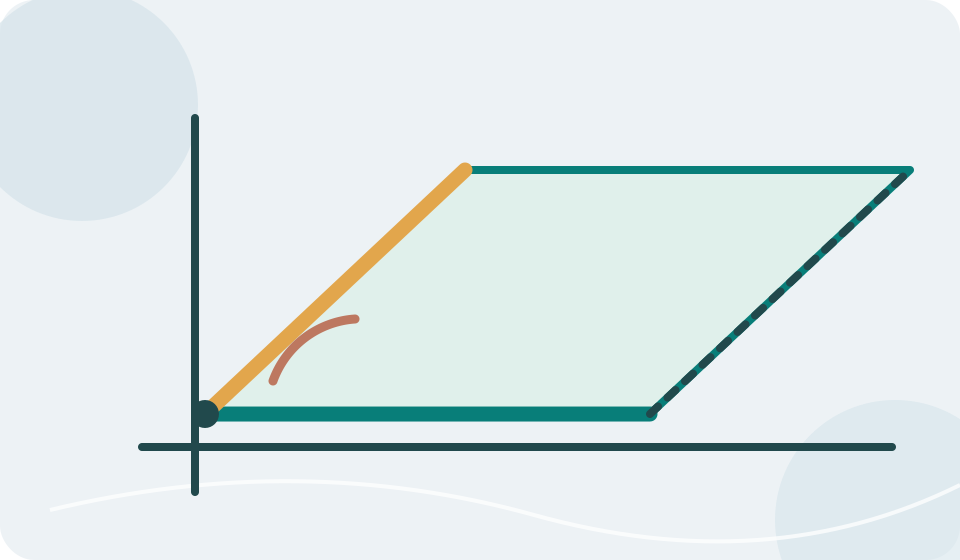
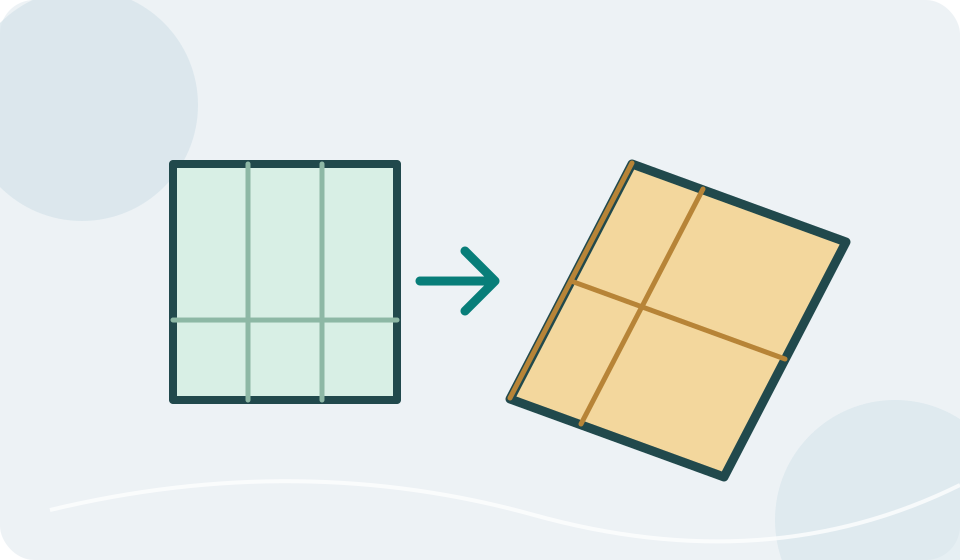
For u = (x₁,y₁) and v = (x₂,y₂), u × v = x₁y₂ − y₁x₂. Its magnitude is the area of the parallelogram spanned by the vectors; its sign records clockwise or counterclockwise orientation under the usual x-right, y-up axes.
Worked example
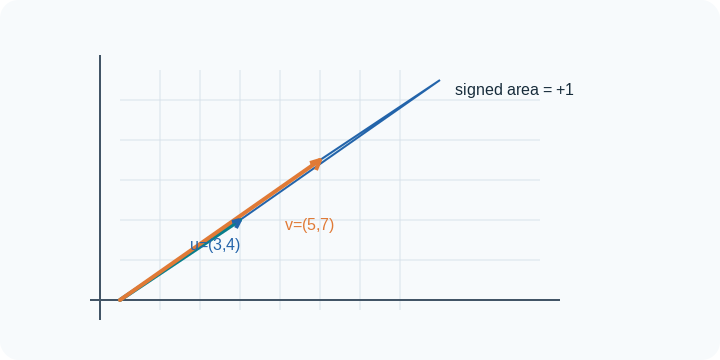
For u=(3,4) and v=(5,7), 3×7 − 4×5 = 1. The signed scalar is +1 square coordinate unit, so the turn from u to v is counterclockwise under standard axes.
Interpreting the result
A result of zero means the vectors are collinear or one vector is zero. The result’s units are the product of the coordinate units.
Assumptions and limits
The orientation statement assumes standard Cartesian axes and the entered vector order. Reversing u and v flips the sign while preserving magnitude.
Read our calculation methodology.
Frequently asked questions
How do I use the 2D vector cross product calculator?
Complete the labeled inputs for 2D vector cross product. Use the units requested by each field, then read the displayed result alongside the method and limits below.
What is a worked example of 2D vector cross product?
For u=(3,4) and v=(5,7), 3×7 − 4×5 = 1. The signed scalar is +1 square coordinate unit, so the turn from u to v is counterclockwise under standard axes.
What does the 2D vector cross product calculator calculate?
Calculate the signed 2D cross product x₁y₂ − y₁x₂ to compare vector orientation and parallelogram area.
What assumptions apply to 2D vector cross product?
The orientation statement assumes standard Cartesian axes and the entered vector order. Reversing u and v flips the sign while preserving magnitude.
Which method does the 2D vector cross product calculator use?
For u = (x₁,y₁) and v = (x₂,y₂), u × v = x₁y₂ − y₁x₂. Its magnitude is the area of the parallelogram spanned by the vectors; its sign records clockwise or counterclockwise orientation under the usual x-right, y-up axes. The determinant gives signed area in the plane.
Good calculators show their work.
CalcWorldHub is built around clear inputs and visible assumptions. Results are estimates for planning; check official sources or your provider’s terms when exact figures matter.