How to use this calculator
Check transmitter voltage margin at 20 mA and find the remaining receiver-resistance budget in a two-wire loop.
- Enter Loop supply voltage (V), Transmitter minimum terminal voltage (V), Receiver resistance (Ω), Round-trip wire resistance (Ω), then complete the remaining labeled fields. Match the units shown beside each field and review the result together with the assumptions below.
- Read the worked example below to check the expected input format and result.
- Compare another scenario by changing one input at a time. Use Reset to return to the starting values.
How this calculation works
At full-scale 20 mA, each series resistance consumes voltage from the loop supply. The transmitter must retain at least its specified minimum terminal voltage. Add the receiver shunt, total two-conductor cable resistance, and any other series burdens to check the compliance margin.
Inputs and units
supplyVoltage— Loop supply voltage (V)- DC voltage available at the source terminals.
transmitterMinVoltage— Transmitter minimum terminal voltage (V)- Minimum voltage the selected two-wire transmitter needs at its terminals.
receiverResistance— Receiver resistance (Ω)- Shunt or input resistance in series with the 4–20 mA loop.
loopWireResistance— Round-trip wire resistance (Ω)- Total resistance of both outgoing and return conductors.
otherSeriesResistance— Other series burden (Ω)- Combined resistance of barriers, meters, and other series devices.
Formula
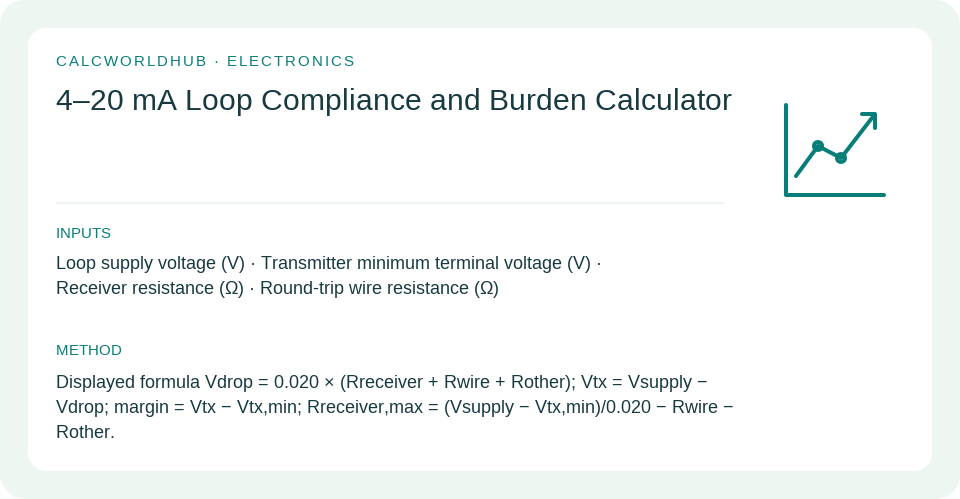
Vdrop = 0.020 × (Rreceiver + Rwire + Rother); Vtx = Vsupply − Vdrop; margin = Vtx − Vtx,min; Rreceiver,max = (Vsupply − Vtx,min)/0.020 − Rwire − Rother.
Method
Enter the DC loop supply, the transmitter's minimum operating terminal voltage, receiver resistance, total round-trip wire resistance, and any other series resistance. The model checks the limiting 20 mA full-scale current.
Worked example
For a 24 V loop with a 12 V transmitter minimum, a 250 Ω receiver, 20 Ω round-trip cable, and 35 Ω of other burden, the 20 mA loop drop is 6.100 V. The transmitter retains 17.900 V, giving 5.900 V of compliance margin; up to 545.00 Ω of receiver resistance is available.
Assumptions and limits
Assumes one two-wire transmitter on a fixed DC supply, a 20 mA full-scale current, and lumped series resistances. Use the specific transmitter minimum terminal voltage from its datasheet and include the complete two-conductor cable resistance. This does not check maximum supply voltage, power-supply current capacity, component tolerances, HART impedance, protection ratings, or hazardous-area requirements.
Frequently asked questions
Why check the loop at 20 mA?
At the specified 20 mA full-scale current, every fixed series resistance creates its largest voltage drop.
What counts as wire resistance?
Use the total resistance around the outgoing and return conductors, not only the one-way cable resistance.
What does a negative compliance margin mean?
The source and listed series burdens leave less than the transmitter's minimum terminal voltage at 20 mA, so the loop may not reach full scale.
How do I use the 4–20 mA Loop Compliance and Burden Calculator?
Enter Loop supply voltage (V), Transmitter minimum terminal voltage (V), Receiver resistance (Ω), Round-trip wire resistance (Ω), then complete the remaining labeled fields. Match the units shown beside each field and review the result together with the assumptions below.
What is a worked example of 4–20 mA Loop Compliance and Burden?
For a 24 V loop with a 12 V transmitter minimum, a 250 Ω receiver, 20 Ω round-trip cable, and 35 Ω of other burden, the 20 mA loop drop is 6.100 V. The transmitter retains 17.900 V, giving 5.900 V of compliance margin; up to 545.00 Ω of receiver resistance is available.
Reference: National Instruments sampling theorem and anti-alias filter guidance. See our calculation methodology.