How to use this calculator
Estimate voltage lost and cable heating in a two-conductor DC run from current, one-way distance, conductor area, and resistivity.
- Enter Source voltage (V), Load current (A), One-way cable length (m), Conductor cross-sectional area (mm²), then complete the remaining labeled fields. Match the units shown beside each field and review the result together with the assumptions below.
- Read the worked example below to check the expected input format and result.
- Compare another scenario by changing one input at a time. Use Reset to return to the starting values.
How this calculation works
A DC load current travels to the device and returns to the source, so both conductors contribute resistance. This calculator doubles the entered one-way run length, estimates loop resistance, then reports load voltage and resistive loss.
Inputs and units
supplyV— Source voltage (V)- Voltage at the source before the cable drop.
currentA— Load current (A)- Steady current through both conductors.
oneWayLengthM— One-way cable length (m)- Distance from source to load; the formula includes the return conductor.
areaMm2— Conductor cross-sectional area (mm²)- Area of each conductor, not the combined area of the pair.
resistivity— Conductor resistivity (Ω·mm²/m)- Copper is about 0.01724 at 20°C; change this value if your conductor or temperature basis differs.
Formula
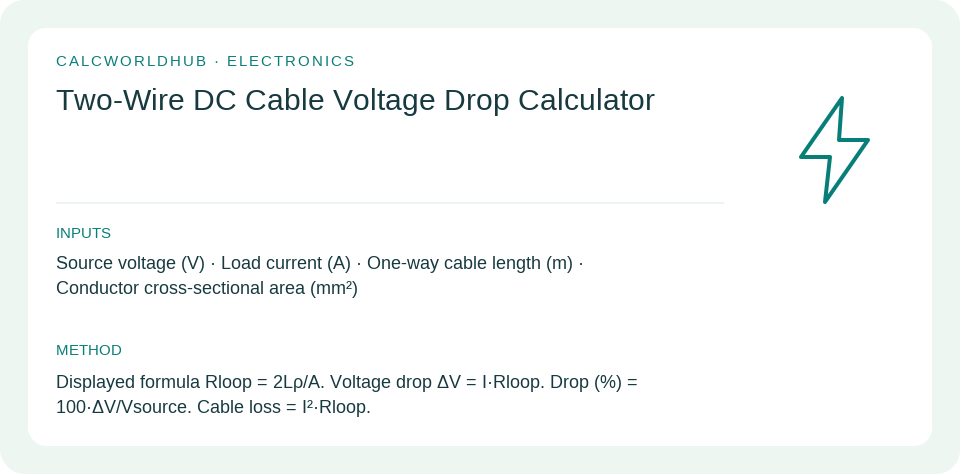
Rloop = 2Lρ/A. Voltage drop ΔV = I·Rloop. Drop (%) = 100·ΔV/Vsource. Cable loss = I²·Rloop.
Method
Enter one-way length, the cross-sectional area of each conductor, and resistivity on a consistent SI basis. The default resistivity is a copper reference near 20°C; connectors, temperature rise, and AC effects are not modeled.
Worked example
For a 12 V, 10 A DC load 5 m one-way from the source on 2.5 mm² copper, Rloop = 2×5×0.01724/2.5 = 0.06896 Ω. The drop is 10×0.06896 = 0.6896 V, about 5.75% of source voltage.
Assumptions and limits
This steady-state estimate uses the entered resistivity for both conductors and a round-trip length of twice the one-way distance. It does not model conductor heating, terminal/contact resistance, transient current, AC effects, voltage-regulation requirements, or allowable ampacity; check wire protection and local electrical requirements separately.
Frequently asked questions
Does cable length mean one-way or round-trip?
Enter the one-way route length. The calculator doubles it for the outgoing and return conductors.
How can I reduce voltage drop?
Shorter runs, larger conductor area, or lower current reduce the resistive drop; check the load’s allowable voltage range.
Does the estimate include connector or fuse losses?
No. Add those resistances separately or measure the installed circuit under load.
How do I use the Two-Wire DC Cable Voltage Drop Calculator?
Enter Source voltage (V), Load current (A), One-way cable length (m), Conductor cross-sectional area (mm²), then complete the remaining labeled fields. Match the units shown beside each field and review the result together with the assumptions below.
What is a worked example of Two-Wire DC Cable Voltage Drop?
For a 12 V, 10 A DC load 5 m one-way from the source on 2.5 mm² copper, Rloop = 2×5×0.01724/2.5 = 0.06896 Ω. The drop is 10×0.06896 = 0.6896 V, about 5.75% of source voltage.
Reference: Blue Sea Systems voltage-drop reference for DC conductor circuits. See our calculation methodology.