How to use this calculator
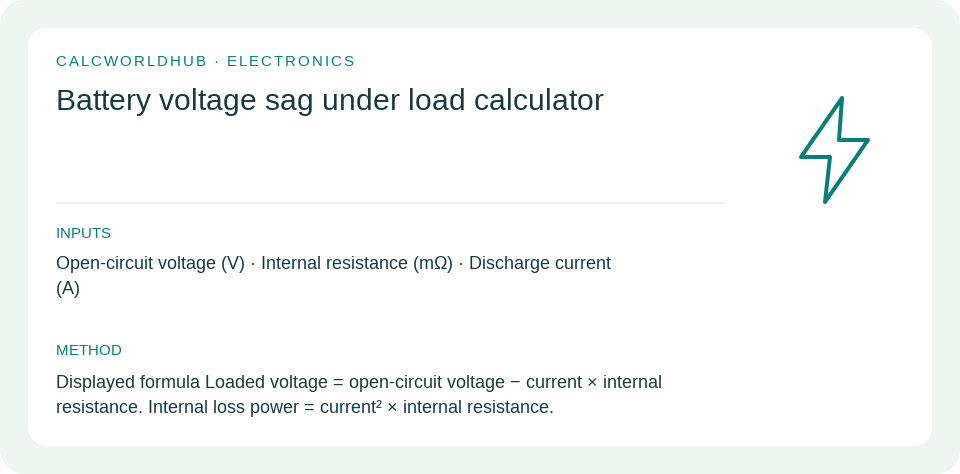
Estimate loaded terminal voltage and internal-resistance loss from open-circuit voltage and load current.
- Enter Open-circuit voltage (V), Internal resistance (mΩ), Discharge current (A). Match the units shown beside each field and review the result together with the assumptions below.
- Read the worked example below to check the expected input format and result.
- Compare another scenario by changing one input at a time. Use Reset to return to the starting values.
How this calculation works
A simple Thevenin model treats a battery as an ideal voltage source in series with internal resistance. Enter open-circuit voltage, estimated internal resistance, and a fixed load current to estimate terminal voltage and internal dissipation.
Inputs and units
voc— Open-circuit voltage (V)- Battery terminal voltage before the modeled load is applied.
resistance— Internal resistance (mΩ)- Equivalent series resistance in milliohms.
current— Discharge current (A)- Positive load current drawn from the battery.
Formula
Loaded voltage = open-circuit voltage − current × internal resistance. Internal loss power = current² × internal resistance.
Worked example
At 12.6 V open-circuit, 40 mΩ internal resistance, and 10 A, sag is 10 × 0.040 = 0.40 V; estimated loaded voltage is 12.20 V and internal loss is 4 W.
Assumptions and limits
Real battery resistance changes with state of charge, temperature, age, and pulse duration. This does not model chemistry, protection circuits, wiring, or constant-power loads.
Frequently asked questions
What does internal resistance represent?
It is an equivalent series resistance that approximates the voltage drop and heat loss under a specified load.
Is battery resistance constant?
No. It varies with battery condition, temperature, state of charge, and measurement method.
Can I use this for a constant-power device?
This fixed-current model does not solve a constant-power load; use a load-line model for that case.
How do I use the Battery voltage sag under load calculator?
Enter Open-circuit voltage (V), Internal resistance (mΩ), Discharge current (A). Match the units shown beside each field and review the result together with the assumptions below.
What is a worked example of Battery voltage sag under load?
At 12.6 V open-circuit, 40 mΩ internal resistance, and 10 A, sag is 10 × 0.040 = 0.40 V; estimated loaded voltage is 12.20 V and internal loss is 4 W.
Read our calculation methodology.