How to use this calculator
Estimate average items inspected per lot for a single-sample plan with full screening of rejected lots.
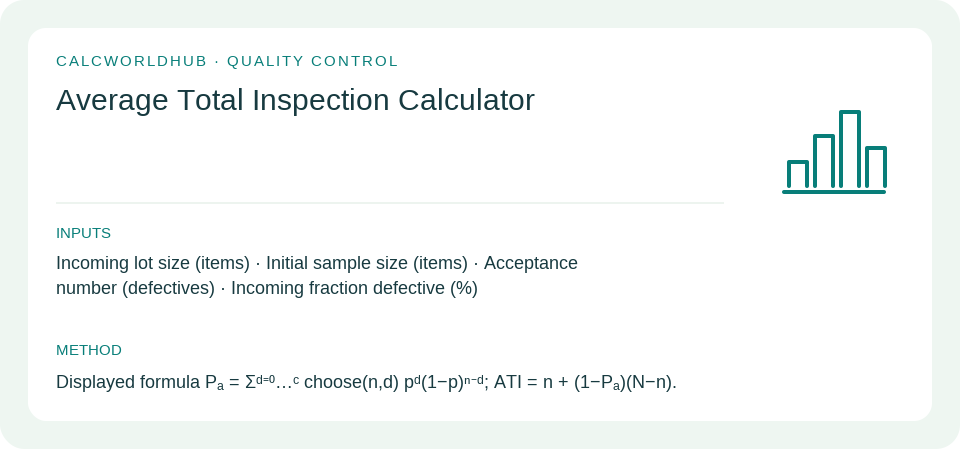
- Enter Incoming lot size (items), Initial sample size (items), Acceptance number (defectives), Incoming fraction defective (%). Match the units shown beside each field and review the result together with the assumptions below.
- Read the worked example below to check the expected input format and result.
- Compare another scenario by changing one input at a time. Use Reset to return to the starting values.
How this calculation works
The average total inspection (ATI) estimates the number of items that will be checked per incoming lot when an accepted lot receives only the initial sample and a rejected lot is screened in full. The acceptance chance is calculated from a binomial model using the sample size, acceptance number, and incoming defective fraction.
Inputs and units
lotSize— Incoming lot size (items)- Number of items in each incoming lot.
sampleSize— Initial sample size (items)- Items randomly inspected before the lot decision.
acceptanceNumber— Acceptance number (defectives)- Accept the lot when the initial sample has no more than this many defectives.
defectRatePct— Incoming fraction defective (%)- Assumed long-run fraction of defective items in incoming lots.
Formula
Pₐ = Σᵈ⁼⁰…ᶜ choose(n,d) pᵈ(1−p)ⁿ⁻ᵈ; ATI = n + (1−Pₐ)(N−n).
Method
First calculate the binomial probability that the number of defectives in the sample is at most the acceptance number. Then weight the initial sample by every lot and the additional inspection of rejected lots by the rejection probability. ATI is an expected count, so it can be fractional even though each actual inspection count is whole.
Worked example
For N = 10,000, n = 52, acceptance number 3, and 3% incoming defectives, the binomial acceptance probability is 92.95% and ATI is 752.96 inspected items per lot.
Assumptions and limits
Assumes independent item outcomes with a constant defective fraction, so the binomial model is a good approximation for large lots. A rejected lot is assumed to receive 100% screening after the sample, and no finite-lot correction or replacement inspection cost is included.
Frequently asked questions
What does ATI measure?
It estimates the average number of items inspected per incoming lot under the stated rectifying inspection plan.
Why can ATI be fractional?
ATI is a long-run expected value across many lots, not the exact count for one lot.
What happens when every lot is accepted?
If the assumed defect rate is zero, the lot acceptance probability is one and ATI equals the initial sample size.
How do I use the Average Total Inspection Calculator?
Enter Incoming lot size (items), Initial sample size (items), Acceptance number (defectives), Incoming fraction defective (%). Match the units shown beside each field and review the result together with the assumptions below.
What is a worked example of Average Total Inspection?
For N = 10,000, n = 52, acceptance number 3, and 3% incoming defectives, the binomial acceptance probability is 92.95% and ATI is 752.96 inspected items per lot.
Reference: NIST/SEMATECH e-Handbook binomial acceptance probability and average total inspection formula. See our calculation methodology.