How to use this calculator
Estimate a battery’s DC internal resistance from its open-circuit voltage, loaded voltage, and measured discharge current.
- Enter Open-circuit voltage (V), Loaded terminal voltage (V), Discharge current (A). Match the units shown beside each field and review the result together with the assumptions below.
- Read the worked example below to check the expected input format and result.
- Compare another scenario by changing one input at a time. Use Reset to return to the starting values.
How this calculation works
A short DC load test compares a battery voltage at rest with a second voltage while current is flowing. Under a simple Thevenin model, the voltage drop divided by the load current estimates the effective series resistance for that test condition.
Inputs and units
openCircuitV— Open-circuit voltage (V)- Measure before applying the test load.
loadedV— Loaded terminal voltage (V)- Measure while the stated discharge current is flowing.
loadCurrentA— Discharge current (A)- Use the measured current at the loaded-voltage reading.
Formula
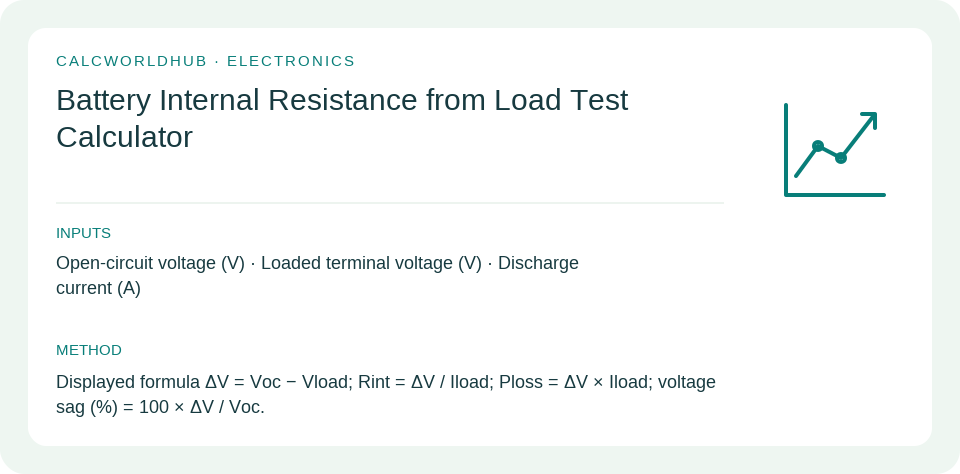
ΔV = Voc − Vload; Rint = ΔV / Iload; Ploss = ΔV × Iload; voltage sag (%) = 100 × ΔV / Voc.
Method
The calculator subtracts the measured loaded voltage from the open-circuit voltage, divides by the entered load current, and estimates resistive loss at that operating point.
Worked example
A 12.6 V open-circuit reading that falls to 12.2 V at 10 A gives ΔV = 0.4 V and an estimated DC internal resistance of 0.04 Ω (40 mΩ).
Assumptions and limits
This is a DC pulse estimate, not a universal cell constant or a direct capacity test. Results vary with chemistry, state of charge, temperature, pulse duration, connection resistance, and measurement timing. Use safe, chemistry-appropriate test equipment.
Frequently asked questions
What is the voltage-drop method?
Measure open-circuit voltage, apply a known load, measure the loaded voltage and current, then estimate resistance as voltage drop divided by current.
Does this value prove a battery is healthy or bad?
No. Internal resistance is one test metric and depends on test conditions; it does not by itself measure usable capacity.
Why does pulse duration matter?
Battery voltage also changes through electrochemical and state-of-charge effects. Short, repeatable pulses help make comparisons, but methods differ.
Should test-lead resistance be considered?
Yes. At low battery resistance, lead and contact drops can materially affect the estimate; accurate measurement setups minimize them.
How do I use the Battery Internal Resistance from Load Test Calculator?
Enter Open-circuit voltage (V), Loaded terminal voltage (V), Discharge current (A). Match the units shown beside each field and review the result together with the assumptions below.
Reference: Tektronix battery DC internal-resistance measurement application note. See our calculation methodology.