How to use this calculator
Estimate convective cloud-base height above the surface from air temperature and dew-point spread.
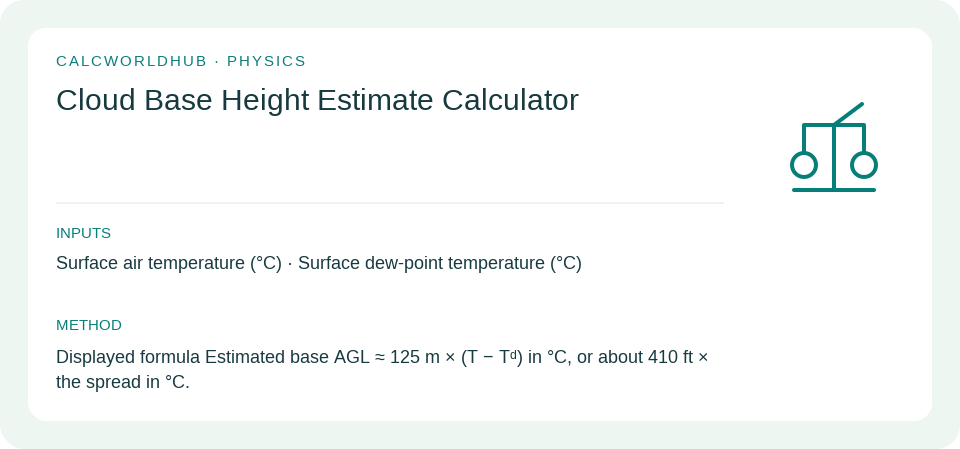
- Enter Surface air temperature (°C), Surface dew-point temperature (°C). Match the units shown beside each field and review the result together with the assumptions below.
- Read the worked example below to check the expected input format and result.
- Compare another scenario by changing one input at a time. Use Reset to return to the starting values.
How this calculation works
A rising unsaturated air parcel cools faster than its dew point falls, so the two temperatures approach each other at the lifting condensation level. A quick estimate is about 125 metres of cloud-base height for each degree Celsius between surface temperature and dew point. The result is an approximate height above the observation surface, not a reported ceiling or aviation forecast.
Inputs and units
temperature— Surface air temperature (°C)- Enter the measured or forecast surface air temperature.
dewPoint— Surface dew-point temperature (°C)- Enter dew point at the same place and time as the air temperature.
Formula
Estimated base AGL ≈ 125 m × (T − Tᵈ) in °C, or about 410 ft × the spread in °C.
Method
Enter surface temperature and dew point in degrees Celsius. The dew point cannot exceed the air temperature; equal values produce a zero-height estimate at saturation.
Worked example
At 25°C with a dew point of 17°C, the 8°C spread gives an estimated convective cloud base of 1,000 m AGL (about 3,281 ft AGL).
Assumptions and limits
This rule of thumb assumes a representative rising air parcel and a well-mixed lower atmosphere. Actual cloud base depends on atmospheric structure and lift; check current weather observations for aviation decisions.
Frequently asked questions
What does AGL mean?
AGL means above ground level or, more generally here, above the observation surface.
Why use the temperature-dew point spread?
As a surface air parcel rises, it cools toward saturation while its dew point changes more slowly; their spread gives a rough estimate of the lifting condensation level.
Can this replace an aviation ceiling report?
No. It is an approximate rule of thumb and does not report a cloud layer or ceiling; use official aviation weather observations and forecasts for flight decisions.
How do I use the Cloud Base Height Estimate Calculator?
Enter Surface air temperature (°C), Surface dew-point temperature (°C). Match the units shown beside each field and review the result together with the assumptions below.
What is a worked example of Cloud Base Height Estimate?
At 25°C with a dew point of 17°C, the 8°C spread gives an estimated convective cloud base of 1,000 m AGL (about 3,281 ft AGL).
Reference: technical reference. See our calculation methodology.