How to use this calculator
Estimate wet-bulb temperature from dry-bulb air temperature and relative humidity using Stull’s sea-level approximation.
- Enter Dry-bulb air temperature (°C), Relative humidity (%). Match the units shown beside each field and review the result together with the assumptions below.
- Read the worked example below to check the expected input format and result.
- Compare another scenario by changing one input at a time. Use Reset to return to the starting values.
How this calculation works
Wet-bulb temperature combines air temperature and humidity into an approximate temperature associated with evaporative cooling. This page uses the compact Stull empirical equation, which is convenient when pressure is not supplied but is less exact than a full psychrometric calculation.
Inputs and units
temperatureC— Dry-bulb air temperature (°C)- Measured ambient air temperature in degrees Celsius; supported range is −20 to 50 °C.
humidityPct— Relative humidity (%)- Relative humidity from 5% to 99%; use a measurement for the same air conditions.
Formula
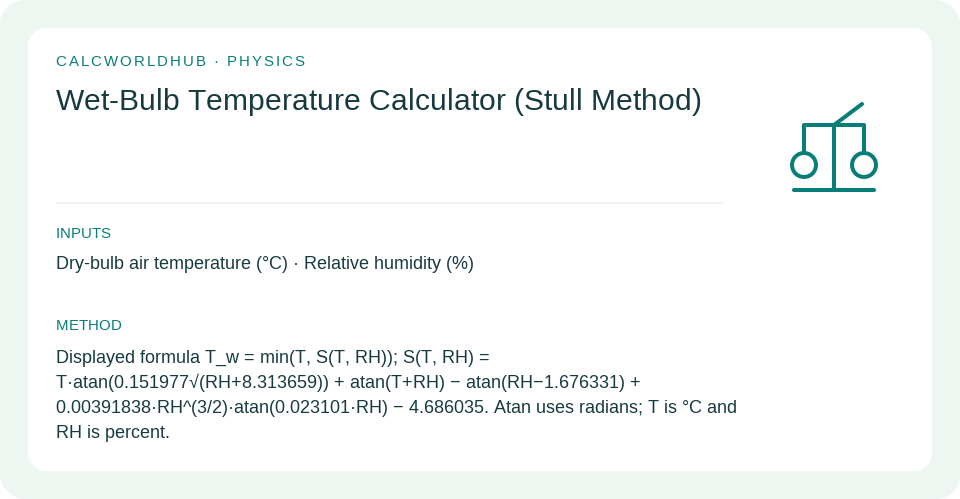
T_w = min(T, S(T, RH)); S(T, RH) = T·atan(0.151977√(RH+8.313659)) + atan(T+RH) − atan(RH−1.676331) + 0.00391838·RH^(3/2)·atan(0.023101·RH) − 4.686035. Atan uses radians; T is °C and RH is percent.
Method
Enter dry-bulb temperature in degrees Celsius and relative humidity in percent. Evaluate the Stull approximation using inverse tangents in radians. The estimate is capped at the entered dry-bulb temperature if the empirical fit overshoots it near a domain edge; convert the bounded result to Fahrenheit with °F = 1.8 × °C + 32. The approximation assumes standard sea-level pressure.
Worked example
At 30 °C and 70% relative humidity, the Stull equation estimates a wet-bulb temperature of approximately 25.6 °C (78.1 °F).
Assumptions and limits
The Stull equation is an empirical approximation with a stated domain of about −20 to 50 °C and 5% to 99% relative humidity; accuracy can worsen in cold, dry combinations. At edge combinations, this tool caps an impossible estimate above dry-bulb temperature, which does not make the approximation precise. It is not wet-bulb globe temperature (WBGT), a heat-stress assessment, or a substitute for pressure-aware psychrometrics or local safety guidance.
Frequently asked questions
Is wet-bulb temperature the same as dew point?
No. Dew point is the temperature at which air becomes saturated by cooling; wet-bulb temperature is an evaporative-cooling measure and is generally different.
Is this the same as WBGT?
No. WBGT is a heat-stress index that uses additional environmental measurements such as radiant heat and, in some formulations, natural wet-bulb conditions.
Why does the formula not ask for air pressure?
The Stull approximation is fitted for standard sea-level pressure. A full psychrometric calculation can account for pressure explicitly.
When should I avoid this estimate?
Do not extrapolate beyond the entered range, especially in cold and dry conditions; use a validated psychrometric method for precision work.
How do I use the Wet-Bulb Temperature Calculator (Stull Method)?
Enter Dry-bulb air temperature (°C), Relative humidity (%). Match the units shown beside each field and review the result together with the assumptions below.
Reference: Stull’s original paper on wet-bulb temperature estimation from temperature and relative humidity. See our calculation methodology.