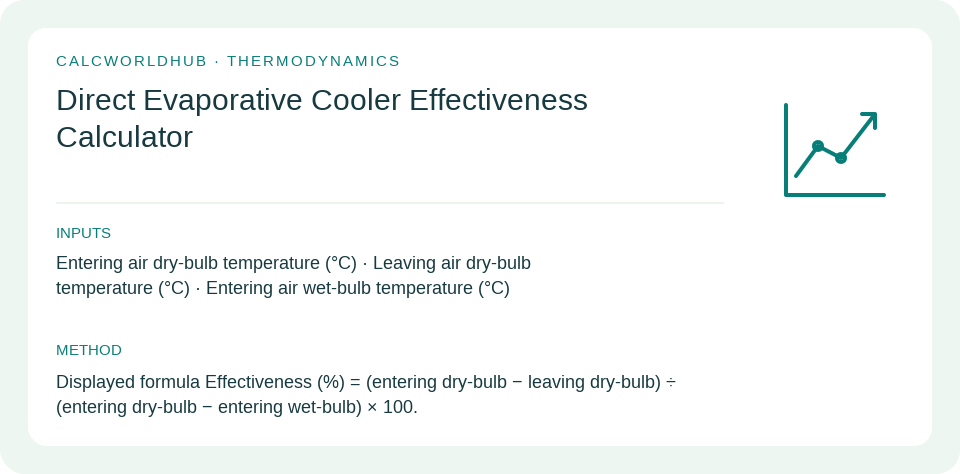
How to use this calculator
Estimate direct evaporative cooler saturation effectiveness from entering dry-bulb, entering wet-bulb, and leaving dry-bulb temperatures.
- Enter Entering air dry-bulb temperature (°C), Leaving air dry-bulb temperature (°C), Entering air wet-bulb temperature (°C). Match the units shown beside each field and review the result together with the assumptions below.
- Read the worked example below to check the expected input format and result.
- Compare another scenario by changing one input at a time. Use Reset to return to the starting values.
How this calculation works
Direct evaporative cooling lowers the air's dry-bulb temperature as water evaporates into the airstream. Saturation effectiveness compares the measured dry-bulb decrease with the maximum decrease available between the inlet dry-bulb and inlet wet-bulb temperatures.
Inputs and units
enteringDryBulb— Entering air dry-bulb temperature (°C)- Air dry-bulb temperature immediately before the direct evaporative cooler.
leavingDryBulb— Leaving air dry-bulb temperature (°C)- Air dry-bulb temperature at the cooler outlet after evaporation.
enteringWetBulb— Entering air wet-bulb temperature (°C)- Inlet wet-bulb temperature measured for the same airstream and operating condition.
Formula
Effectiveness (%) = (entering dry-bulb − leaving dry-bulb) ÷ (entering dry-bulb − entering wet-bulb) × 100.
Method
Use all three temperatures on the same scale and measured at the cooler inlet or outlet as labeled. The formula estimates how closely the leaving dry-bulb approaches the inlet wet-bulb temperature.
Worked example
With entering air at 35°C dry-bulb and 20°C wet-bulb, and leaving air at 22°C dry-bulb, the cooler achieves 86.67% saturation effectiveness.
Assumptions and limits
This direct-cooling metric assumes leaving air is between the entering wet-bulb and dry-bulb temperatures. It is not a cooling-capacity estimate and does not describe indirect or staged equipment.
Frequently asked questions
What does 100% effectiveness mean?
The leaving dry-bulb equals the entering wet-bulb temperature under this idealized metric.
Can I use Fahrenheit?
Yes. Use the same temperature scale for all three readings; temperature differences have the same numeric size in Celsius and Fahrenheit.
Does this equal cooling capacity?
No. Capacity also depends on airflow and air properties; this metric only compares temperature depression.
How do I use the Direct Evaporative Cooler Effectiveness Calculator?
Enter Entering air dry-bulb temperature (°C), Leaving air dry-bulb temperature (°C), Entering air wet-bulb temperature (°C). Match the units shown beside each field and review the result together with the assumptions below.
What is a worked example of Direct Evaporative Cooler Effectiveness?
With entering air at 35°C dry-bulb and 20°C wet-bulb, and leaving air at 22°C dry-bulb, the cooler achieves 86.67% saturation effectiveness.
Reference: ASHRAE Handbook direct evaporative-cooling saturation-effectiveness definition. See our calculation methodology.