How to use this calculator
Estimate a steady radial unconfined water-table shape where declining saturated thickness changes the available flow area.
- Enter Steady pumping rate (m³/day), Hydraulic conductivity (m/day), Outer fixed-head radius (m), Evaluation radius (m), then complete the remaining labeled fields. Match the units shown beside each field and review the result together with the assumptions below.
- Read the worked example below to check the expected input format and result.
- Compare another scenario by changing one input at a time. Use Reset to return to the starting values.
Dupuit unconfined well water table profile explained
Use Steady pumping rate (m³/day) with Hydraulic conductivity (m/day) to reproduce the sample calculation, then review the stated limits before carrying the result into another scenario.
A numerical walkthrough
Steady pumping rate (m³/day) = 100; Hydraulic conductivity (m/day) = 5; Outer fixed-head radius (m) = 500; Evaluation radius (m) = 20; Outer saturated thickness (m) = 12.
- Local saturated thickness: 11.113415 m
- Drawdown from outer head: 0.886585 m
- Local water-table slope magnitude: 0.014321
A well extracts 100 m³/day from K=5 m/day material. With 12 m saturated thickness fixed at radius 500 m, the profile is evaluated 20 m from the well.
The model behind the numbers
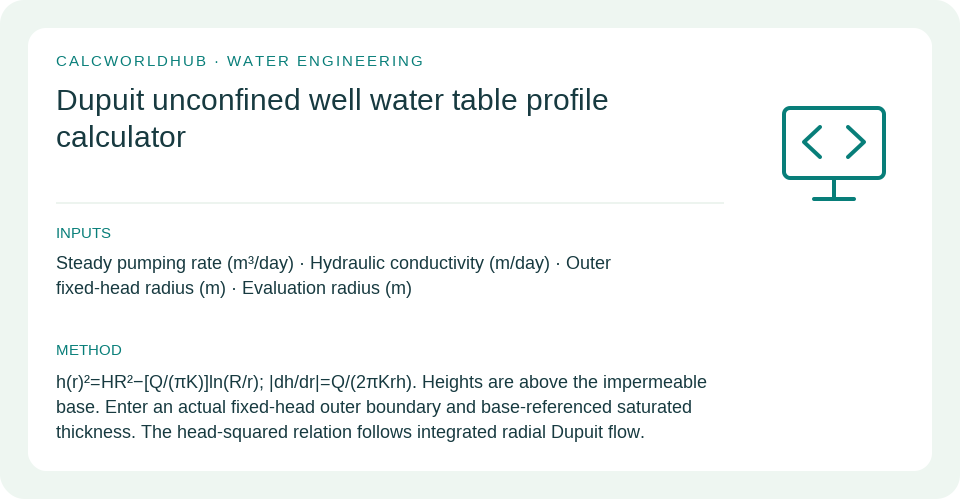
h(r)²=HR²−[Q/(πK)]ln(R/r); |dh/dr|=Q/(2πKrh). Heights are above the impermeable base.
Enter an actual fixed-head outer boundary and base-referenced saturated thickness. The head-squared relation follows integrated radial Dupuit flow.
What to enter
Q— Steady pumping rate (m³/day)- Extraction balanced by the maintained outer boundary.
K— Hydraulic conductivity (m/day)- Uniform horizontal conductivity of the unconfined aquifer.
R— Outer fixed-head radius (m)- Radius where saturated thickness HR is prescribed; not automatically an observed radius of influence.
r— Evaluation radius (m)- Radius from well axis, positive and smaller than R.
HR— Outer saturated thickness (m)- Water-table elevation above the horizontal impermeable base at radius R.
Interpreting the result
Steady unconfined, horizontal impermeable base, homogeneous isotropic conductivity and small water-table slope. Near-well vertical flow and a seepage face are excluded. Educational model; this is not a code-compliant design check.
Reading the outputs
Local thickness and drawdown are m, while the local radial slope is dimensionless.
Frequently asked questions
Is R calculated from pumping time?
No. It is an independently justified fixed-head boundary in this steady model.
Why can a requested rate be rejected?
It can imply zero or imaginary saturated thickness, beyond the Dupuit profile domain.
Does drawdown equal HR minus well depth?
No. HR and h are water heights above the same aquifer base, not construction depths.
How do I use the Dupuit unconfined well water table profile calculator?
Enter Steady pumping rate (m³/day), Hydraulic conductivity (m/day), Outer fixed-head radius (m), Evaluation radius (m), then complete the remaining labeled fields. Match the units shown beside each field and review the result together with the assumptions below.
What is a worked example of Dupuit unconfined well water table profile?
Steady pumping rate (m³/day) = 100; Hydraulic conductivity (m/day) = 5; Outer fixed-head radius (m) = 500; Evaluation radius (m) = 20; Outer saturated thickness (m) = 12. Local saturated thickness: 11.113415 m Drawdown from outer head: 0.886585 m Local water-table slope magnitude: 0.014321 A well extracts 100 m³/day from K=5 m/day material. With 12 m saturated thickness fixed at radius 500 m, the profile is evaluated 20 m from the well.
Background or definition reference: USGS Documentation of Spreadsheets for Analysis of Aquifer Tests.
Reference access note: The linked USGS aquifer-test reference could not be retrieved. The stated model equation and example were checked independently; consult the primary document before applying to a field test.
Read our calculation methodology.