How to use this calculator
Sequence single-machine jobs by due date and calculate completion times and lateness.
- Enter Processing times pⱼ, Due dates dⱼ. Match the units shown beside each field and review the result together with the assumptions below.
- Read the worked example below to check the expected input format and result.
- Compare another scenario by changing one input at a time. Use Reset to return to the starting values.
How this calculation works
The earliest-due-date rule sorts available independent jobs from the earliest due date to the latest. It is a practical way to evaluate a one-machine schedule when the objective is to reduce the worst lateness, not to optimize every possible cost or resource constraint.
Inputs and units
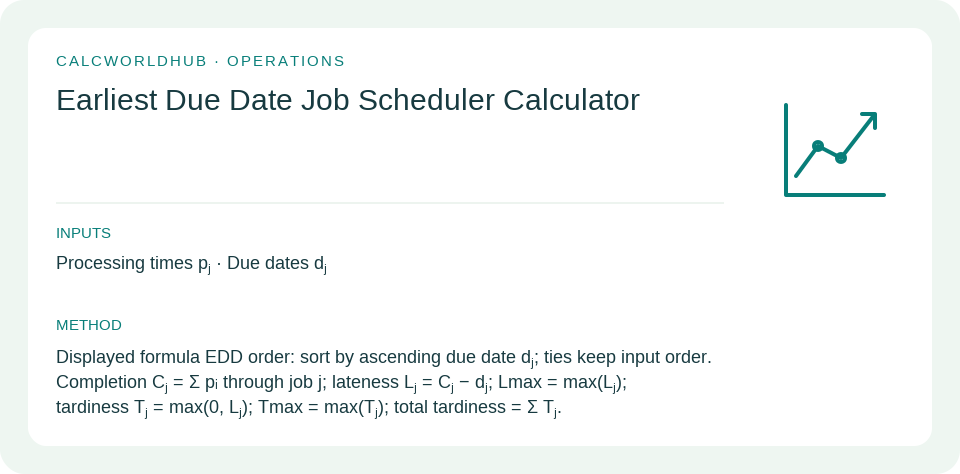
processingTimes— Processing times pⱼ- Enter each job duration in the same time unit, separated by commas. Jobs are identified by their input positions J1, J2, and so on.
dueDates— Due dates dⱼ- Enter one due date for each processing time in matching order, using the same time unit.
Formula
EDD order: sort by ascending due date dⱼ; ties keep input order. Completion Cⱼ = Σ pᵢ through job j; lateness Lⱼ = Cⱼ − dⱼ; Lmax = max(Lⱼ); tardiness Tⱼ = max(0, Lⱼ); Tmax = max(Tⱼ); total tardiness = Σ Tⱼ.
Method
Jobs are ranked by due date; the entered order breaks ties. Processing times are accumulated in that order to obtain completion times. Lateness can be negative for an early job, while tardiness is never negative. Under the standard single-machine assumptions, EDD minimizes maximum lateness.
Worked example
For processing times J1=4, J2=3, J3=2 and due dates 6, 7, 3, EDD orders J3 → J1 → J2. Completion times are 2, 6, and 9; lateness values are −1, 0, and 2, so maximum lateness and total tardiness are both 2 time units.
Assumptions and limits
Assumes one machine, all jobs available at time zero, no preemption, no sequence-dependent setup time, and independent processing. It does not model release dates, precedence constraints, parallel machines, or different job priorities. Use a consistent time unit for processing times and due dates.
Frequently asked questions
What does EDD optimize?
For independent jobs on one machine that are all available at the start, sorting by due date minimizes the maximum lateness.
Is lateness the same as tardiness?
Lateness is completion time minus due date and may be negative. Tardiness is the positive part of lateness, so an early job has zero tardiness.
How are equal due dates handled?
Jobs with the same due date retain the order in which their processing times were entered.
How do I use the Earliest Due Date Job Scheduler Calculator?
Enter Processing times pⱼ, Due dates dⱼ. Match the units shown beside each field and review the result together with the assumptions below.
What is a worked example of Earliest Due Date Job Scheduler?
For processing times J1=4, J2=3, J3=2 and due dates 6, 7, 3, EDD orders J3 → J1 → J2. Completion times are 2, 6, and 9; lateness values are −1, 0, and 2, so maximum lateness and total tardiness are both 2 time units.
Reference: University operations-management lecture notes on single-machine EDD scheduling. See our calculation methodology.