How to use this calculator
Compare annual purchase, ordering, and holding costs to see whether a supplier quantity discount lowers total inventory cost.
- Enter Annual demand (units/year), Ordering cost per order, Annual holding rate (%), Regular unit price, then complete the remaining labeled fields. Match the units shown beside each field and review the result together with the assumptions below.
- Read the worked example below to check the expected input format and result.
- Compare another scenario by changing one input at a time. Use Reset to return to the starting values.
How this calculation works
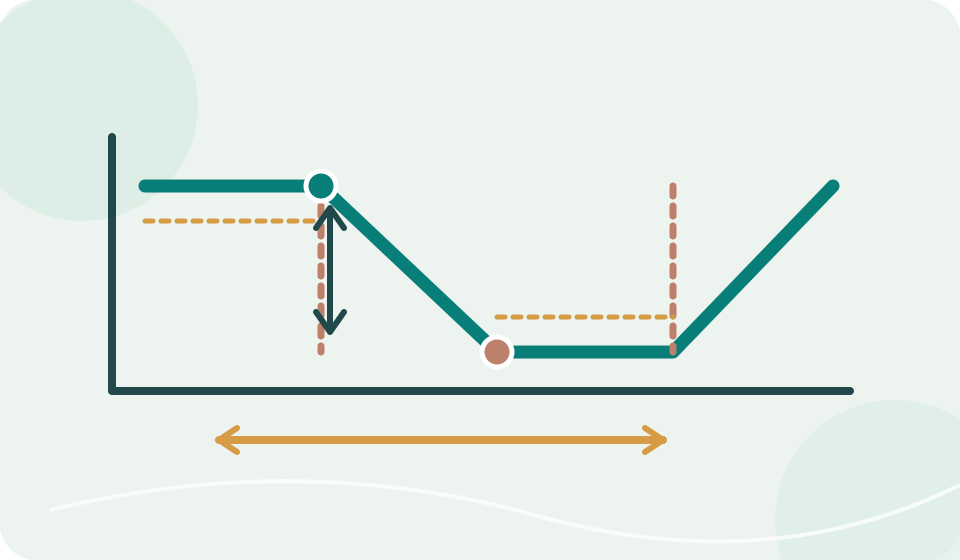
A lower unit price can be offset by the extra stock held when the order must meet a price-break quantity. This calculator compares feasible integer order quantities around each tier's EOQ and at the discount threshold, using annual purchasing, ordering, and cycle-stock holding costs.
Inputs and units
annualDemand— Annual demand (units/year)- Expected annual units purchased and consumed.
orderCost— Ordering cost per order- Fixed administrative and receiving cost per replenishment order, in your currency.
holdingRatePercent— Annual holding rate (%)- Annual carrying cost as a percentage of unit price; enter 24 for 24% per year.
regularUnitPrice— Regular unit price- Price per unit below the supplier's quantity-discount threshold.
discountUnitPrice— Discounted unit price- All-units price per unit once the order reaches the entered threshold.
discountBreak— Minimum quantity for discount (units)- Smallest integer order quantity that qualifies for the discounted price.
Formula
For each price tier P: H = rP; Q* = √(2DS/H); TC(Q) = DP + (D/Q)S + (Q/2)H. Evaluate feasible integer quantities near Q* and at the discount break; choose the Q with the lowest TC. D is annual demand, S is order cost, and r is annual holding-cost rate.
Method
Enter annual unit demand, fixed cost per order, annual holding rate, regular unit price, discounted unit price, and the minimum integer quantity for the discount. The calculation checks each tier's feasible EOQ-neighbour quantities and the price-break quantity, then selects the lowest annual total cost.
Worked example
For demand 12,000 units/year, order cost $50, 24% annual holding rate, regular price $10, and a $9.50 price at 1,000 units, the 1,000-unit discounted order costs $115,740/year. The regular-tier EOQ is about 707 units and costs about $121,697/year.
Assumptions and limits
This is an all-units price-break model with deterministic demand, immediate replenishment, no shortages, no tier-specific fees, and cycle-stock holding cost Q/2. It omits taxes, freight, storage limits, quantity-specific supplier rules, and uncertainty; confirm the quote's discount terms before ordering.
Frequently asked questions
Does the lower unit price always make the discount worthwhile?
No. A larger order raises cycle-stock holding cost, so compare purchase, ordering, and holding costs together.
What does all-units discount mean?
Once the order meets the break, the discounted price applies to every unit in that order. Incremental discounts use a different price schedule.
Why are order quantities whole numbers?
This model assumes indivisible units and evaluates integer order quantities at the EOQ neighbourhood and the price break.
How do I use the EOQ with quantity discount calculator?
Enter Annual demand (units/year), Ordering cost per order, Annual holding rate (%), Regular unit price, then complete the remaining labeled fields. Match the units shown beside each field and review the result together with the assumptions below.
What is a worked example of EOQ with quantity discount?
For demand 12,000 units/year, order cost $50, 24% annual holding rate, regular price $10, and a $9.50 price at 1,000 units, the 1,000-unit discounted order costs $115,740/year. The regular-tier EOQ is about 707 units and costs about $121,697/year.
Reference: ACCA stock control and bulk-discount cost method. See our calculation methodology.