How to use this calculator
Estimate photovoltaic module temperature from ambient temperature, plane-of-array irradiance, and wind speed.
- Enter Ambient air temperature (°C), Plane-of-array irradiance, EPOA (W/m²), Wind speed (m/s), Faiman coefficient U₀ (W/m²·K), then complete the remaining labeled fields. Match the units shown beside each field and review the result together with the assumptions below.
- Read the worked example below to check the expected input format and result.
- Compare another scenario by changing one input at a time. Use Reset to return to the starting values.
How this calculation works
The Faiman empirical model estimates module operating temperature by balancing incoming plane-of-array irradiance with convective and radiative heat-loss behavior captured by fitted coefficients.
Inputs and units
ambientC— Ambient air temperature (°C)- Ambient air temperature near the module.
irradiance— Plane-of-array irradiance, EPOA (W/m²)- Solar irradiance in the module plane.
windSpeed— Wind speed (m/s)- Wind speed used by the empirical heat-loss model.
u0— Faiman coefficient U₀ (W/m²·K)- Fitted baseline heat-loss coefficient.
u1— Faiman coefficient U₁ (W·s/m³·K)- Fitted wind-dependent heat-loss coefficient.
Formula
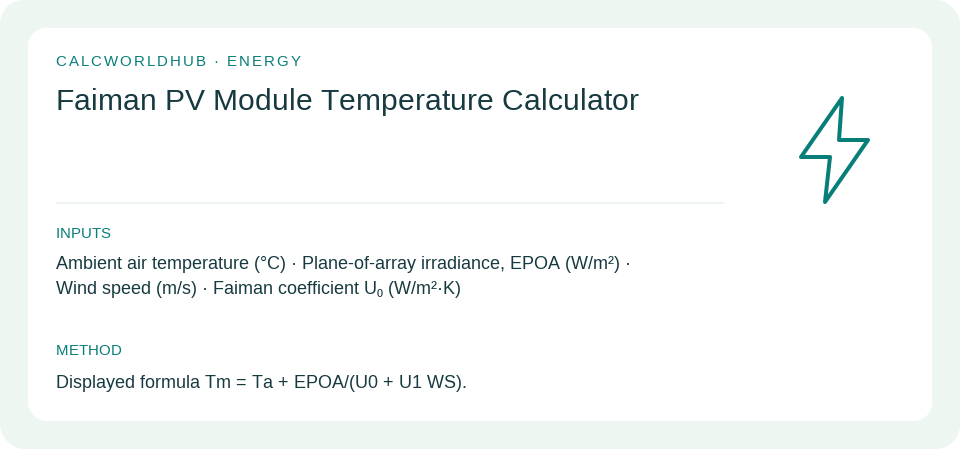
Tm = Ta + EPOA/(U0 + U1 WS).
Method
Enter ambient temperature in °C, plane-of-array irradiance in W/m², wind speed in m/s, and fitted Faiman coefficients U₀ and U₁. The model returns an estimated module temperature in °C.
Worked example
At 25 °C ambient, 800 W/m² irradiance, 2 m/s wind, U₀ = 25 and U₁ = 6.84, the Faiman estimate is 45.68 °C, 20.68 K above ambient.
Assumptions and limits
U₀ and U₁ depend on module construction, mounting, and exposure and should be fitted or selected for the relevant configuration. This steady-state empirical estimate does not model transient thermal response, irradiance nonuniformity, or all site-specific airflow effects.
Frequently asked questions
What irradiance does EPOA represent?
It is irradiance on the plane of the module rather than horizontal global irradiance.
Where do U₀ and U₁ come from?
They are empirical coefficients fitted for a module and mounting configuration; published defaults are not universal.
Does the estimate include thermal transients?
No. This form is a steady-state temperature estimate.
How do I use the Faiman PV Module Temperature Calculator?
Enter Ambient air temperature (°C), Plane-of-array irradiance, EPOA (W/m²), Wind speed (m/s), Faiman coefficient U₀ (W/m²·K), then complete the remaining labeled fields. Match the units shown beside each field and review the result together with the assumptions below.
What is a worked example of Faiman PV Module Temperature?
At 25 °C ambient, 800 W/m² irradiance, 2 m/s wind, U₀ = 25 and U₁ = 6.84, the Faiman estimate is 45.68 °C, 20.68 K above ambient.
Reference: Sandia PV Performance Modeling Collaborative Faiman module-temperature model. See our calculation methodology.