How to use this calculator
Estimate a solar module string's open-circuit voltage at a cold module temperature using its datasheet coefficient.
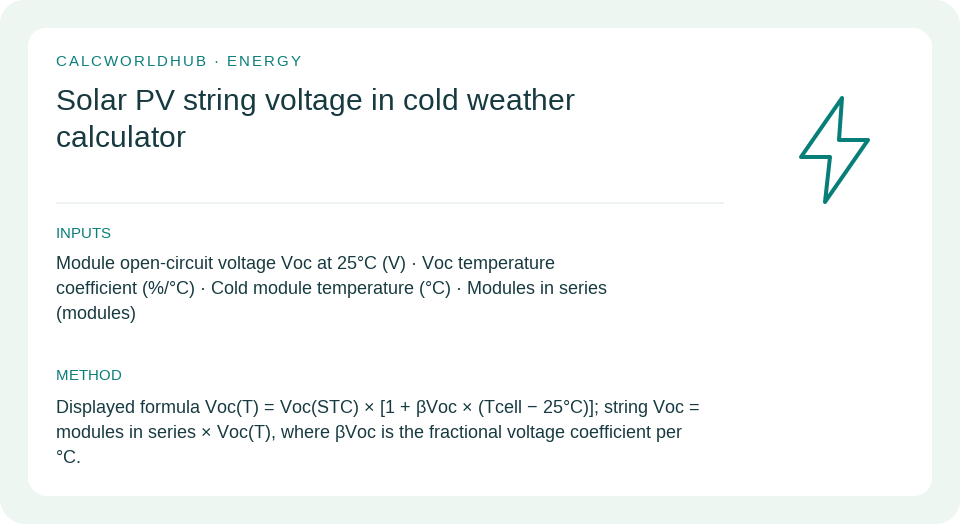
- Enter Module open-circuit voltage Voc at 25°C (V), Voc temperature coefficient (%/°C), Cold module temperature (°C), Modules in series (modules). Match the units shown beside each field and review the result together with the assumptions below.
- Read the worked example below to check the expected input format and result.
- Compare another scenario by changing one input at a time. Use Reset to return to the starting values.
How this calculation works
Photovoltaic module open-circuit voltage changes with cell temperature. This estimate applies the module's specified Voc temperature coefficient to a reference Voc at 25°C, then multiplies by the number of modules in series to help check a cold-weather string voltage against equipment limits.
Inputs and units
voc— Module open-circuit voltage Voc at 25°C (V)- Use the module datasheet value at standard test conditions.
coefficient— Voc temperature coefficient (%/°C)- Enter the signed coefficient from the module datasheet; it is commonly negative.
cellTempC— Cold module temperature (°C)- Use the design minimum cell or module temperature required by the applicable design method.
seriesCount— Modules in series (modules)- Enter the number of identical modules connected in one series string.
Formula
Voc(T) = Voc(STC) × [1 + βVoc × (Tcell − 25°C)]; string Voc = modules in series × Voc(T), where βVoc is the fractional voltage coefficient per °C.
Method
Enter the module's Voc at standard test conditions, its negative Voc temperature coefficient in percent per °C, the coldest expected module temperature, and series module count. Convert the percentage coefficient to a fraction before applying it.
Worked example
For a 50 V module with βVoc = −0.28%/°C at −10°C, estimated module Voc is 50 × [1 + (−0.0028)(−35)] = 54.9 V; ten in series give 549 V.
Assumptions and limits
This is a simplified linear estimate based on the module's own datasheet coefficient. It does not replace maximum system-voltage calculations, inverter limits, wiring checks, code requirements, or a qualified electrical design review.
Frequently asked questions
Why does Voc rise in cold weather?
For common PV modules, the datasheet's negative Voc temperature coefficient means voltage rises as cell temperature falls below the reference temperature.
Which temperature coefficient should I use?
Use the signed Voc coefficient for the exact module model, not the Pmax coefficient.
Does this confirm an inverter string is safe?
No. Compare the estimate with all applicable equipment limits and design rules; a qualified PV designer must verify the system.
How do I use the Solar PV string voltage in cold weather calculator?
Enter Module open-circuit voltage Voc at 25°C (V), Voc temperature coefficient (%/°C), Cold module temperature (°C), Modules in series (modules). Match the units shown beside each field and review the result together with the assumptions below.
What is a worked example of Solar PV string voltage in cold weather?
For a 50 V module with βVoc = −0.28%/°C at −10°C, estimated module Voc is 50 × [1 + (−0.0028)(−35)] = 54.9 V; ten in series give 549 V.
Reference: technical reference. See our calculation methodology.