How to use this calculator
Distinguish fluorescence lifetime from photon yield when radiative, intrinsic nonradiative and added dynamic-quenching pathways compete.
- Enter Radiative decay rate (per ns), Intrinsic nonradiative decay rate (per ns), Added dynamic quenching rate (per ns). Match the units shown beside each field and review the result together with the assumptions below.
- Read the worked example below to check the expected input format and result.
- Compare another scenario by changing one input at a time. Use Reset to return to the starting values.
Fluorescence lifetime yield and dynamic quenching explained
How the calculation works
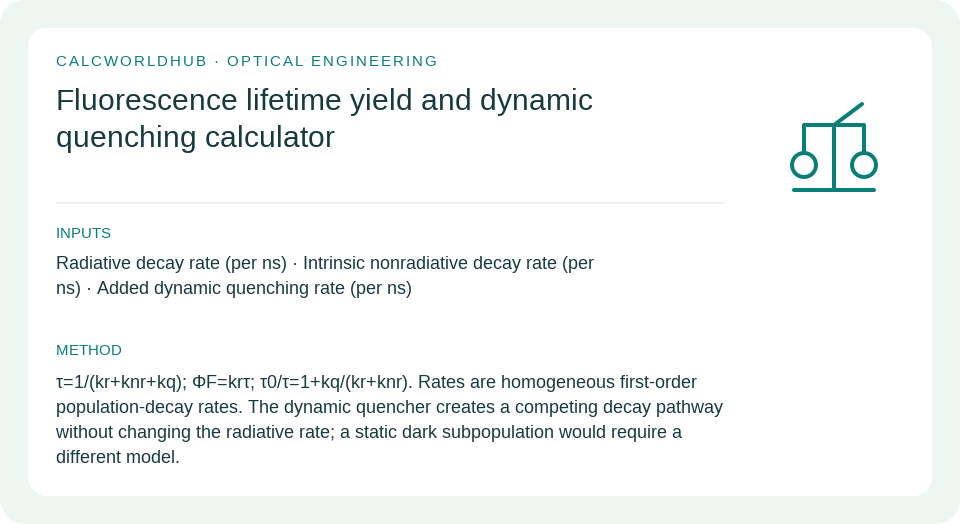
τ=1/(kr+knr+kq); ΦF=krτ; τ0/τ=1+kq/(kr+knr).
Rates are homogeneous first-order population-decay rates. The dynamic quencher creates a competing decay pathway without changing the radiative rate; a static dark subpopulation would require a different model.
Set up the calculation
radiative— Radiative decay rate (per ns)- Rate of photon-emitting decay from the excited state.
nonradiative— Intrinsic nonradiative decay rate (per ns)- Competing decay rate that does not emit a fluorescence photon.
quenching— Added dynamic quenching rate (per ns)- Additional homogeneous collisional or dynamic decay rate.
Limits of this model
Single excited-state population with time-independent rates. Multiexponential mixtures, energy transfer networks, re-excitation and photobleaching are excluded.
Check this example
Radiative decay rate (per ns) = 0.2; Intrinsic nonradiative decay rate (per ns) = 0.05; Added dynamic quenching rate (per ns) = 0.1.
- Quenched fluorescence lifetime: 2.857143 ns
- Quenched fluorescence quantum yield: 0.571429
- Unquenched lifetime: 4 ns
- Dynamic lifetime quenching ratio: 1.4
Rates 0.2, 0.05 and 0.1 per ns produce a 2.857 ns quenched lifetime and a fluorescence quantum yield of about 0.571.
Reading the outputs
Lifetimes are ns; quantum yield and lifetime-quenching ratio are dimensionless. A zero radiative rate gives zero fluorescence yield even when population lifetime is finite.
Frequently asked questions
Does a shorter lifetime always mean lower quantum yield?
No. Increasing radiative rate shortens lifetime while potentially increasing yield; this page separates the pathways.
Can static quenching be entered as an added rate?
Not generally. Static dark populations can reduce intensity without the same lifetime change.
Why is quantum yield below one?
Nonradiative pathways remove part of the excited population without emitting a fluorescence photon.
How do I use the Fluorescence lifetime yield and dynamic quenching calculator?
Enter Radiative decay rate (per ns), Intrinsic nonradiative decay rate (per ns), Added dynamic quenching rate (per ns). Match the units shown beside each field and review the result together with the assumptions below.
What is a worked example of Fluorescence lifetime yield and dynamic quenching?
Radiative decay rate (per ns) = 0.2; Intrinsic nonradiative decay rate (per ns) = 0.05; Added dynamic quenching rate (per ns) = 0.1. Quenched fluorescence lifetime: 2.857143 ns Quenched fluorescence quantum yield: 0.571429 Unquenched lifetime: 4 ns Dynamic lifetime quenching ratio: 1.4 Rates 0.2, 0.05 and 0.1 per ns produce a 2.857 ns quenched lifetime and a fluorescence quantum yield of about 0.571.
Background or definition reference: Radiative decay engineering: measured fluorescence rates and yields.
Read our calculation methodology.