How to use this calculator
Estimate a signed standardized mean difference using the control group’s standard deviation as the scale.
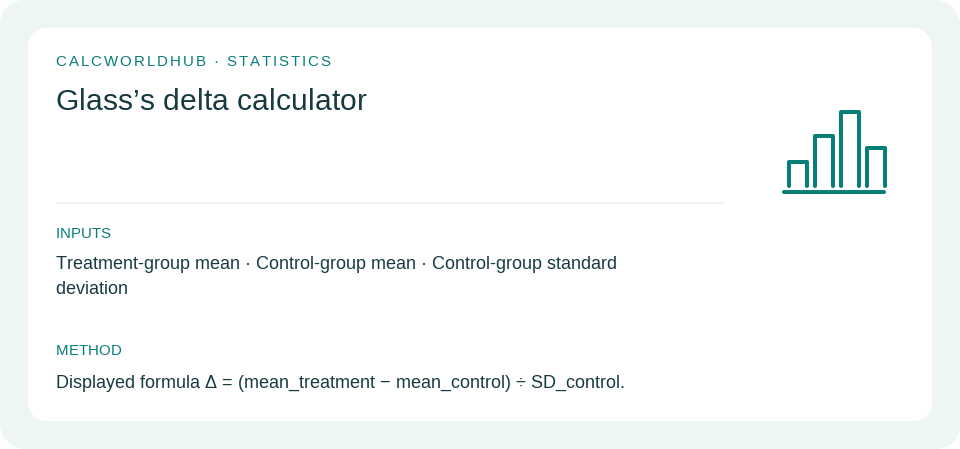
- Enter Treatment-group mean, Control-group mean, Control-group standard deviation. Match the units shown beside each field and review the result together with the assumptions below.
- Read the worked example below to check the expected input format and result.
- Compare another scenario by changing one input at a time. Use Reset to return to the starting values.
How this measure is calculated
The mean difference is divided by the standard deviation of the designated control group. The sign preserves which group has the larger mean.
Inputs and units
treatMean— Treatment-group mean- Enter the treatment mean in the measured outcome units.
controlMean— Control-group mean- Enter the reference control mean using the same scale.
controlSd— Control-group standard deviation- Use the sample SD for the designated control group; it must be positive.
Formula
Δ = (mean_treatment − mean_control) ÷ SD_control.
Worked example
Treatment mean 100, control mean 90, and control SD 15 give Δ=(100−90)/15=0.667 control-group standard deviations.
Assumptions and limits
Use independent groups with the same outcome scale. The control group is the reference distribution; this result is not the pooled-SD Cohen’s d.
Frequently asked questions
Why use only the control SD?
Glass’s delta uses the reference group’s spread, which can be useful when treatment may change variance.
Can delta be negative?
Yes. A negative value means the treatment mean is below the control mean under the entered group order.
Is this the same as Cohen’s d?
No. Cohen’s d commonly uses a pooled within-group SD; Glass’s delta scales by the selected control SD.
How do I use the Glass’s delta calculator?
Enter Treatment-group mean, Control-group mean, Control-group standard deviation. Match the units shown beside each field and review the result together with the assumptions below.
What is a worked example of Glass’s delta?
Treatment mean 100, control mean 90, and control SD 15 give Δ=(100−90)/15=0.667 control-group standard deviations.
Read our calculation methodology.