How to use this calculator
Estimate how leakage through a confining bed limits transient drawdown compared with an isolated confined aquifer.
- Enter Constant pumping rate (m³/day), Aquifer transmissivity (m²/day), Aquifer storativity, Observation radius (m), then complete the remaining labeled fields. Match the units shown beside each field and review the result together with the assumptions below.
- Read the worked example below to check the expected input format and result.
- Compare another scenario by changing one input at a time. Use Reset to return to the starting values.
Hantush Jacob leaky aquifer transient drawdown explained
How the calculation works
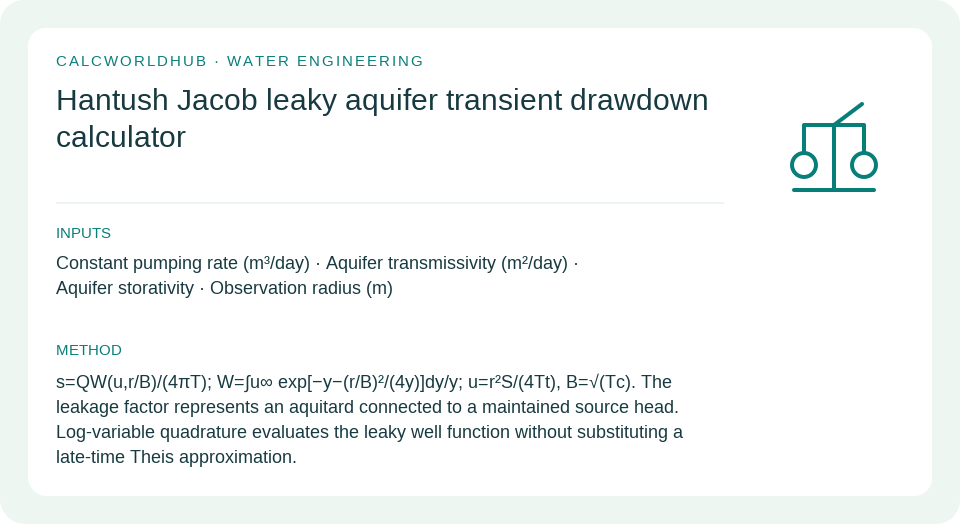
s=QW(u,r/B)/(4πT); W=∫u∞ exp[−y−(r/B)²/(4y)]dy/y; u=r²S/(4Tt), B=√(Tc).
The leakage factor represents an aquitard connected to a maintained source head. Log-variable quadrature evaluates the leaky well function without substituting a late-time Theis approximation.
Set up the calculation
Q— Constant pumping rate (m³/day)- Extraction from the pumped confined aquifer.
T— Aquifer transmissivity (m²/day)- Horizontal transmissivity of the pumped aquifer.
S— Aquifer storativity- Confined storage coefficient of the pumped layer.
r— Observation radius (m)- Distance from the fully penetrating well.
B— Leakage factor (m)- B=√(Tc), with aquitard hydraulic resistance c in days.
t— Elapsed pumping time (days)- Positive time since constant-rate extraction began.
Limits of this model
Hantush–Jacob model with no aquitard storage, fixed source head and horizontal flow in the pumped layer. Delayed aquitard release and partial penetration require other solutions. Educational model; this is not a code-compliant design check.
Check this example
Constant pumping rate (m³/day) = 500; Aquifer transmissivity (m²/day) = 250; Aquifer storativity = 0.0005; Observation radius (m) = 100; Leakage factor (m) = 300; Elapsed pumping time (days) = 2.
- Leaky-aquifer drawdown: 0.406349 m
- Theis time parameter u: 0.0025
- Leakage storage time scale: 0.18 days
A 500 m³/day well operates for two days with T=250 m²/day, S=0.0005 and leakage factor 300 m, observed 100 m away.
Reading the outputs
Drawdown is m, u is dimensionless and B²S/T is a characteristic leakage-storage time in days.
Frequently asked questions
Is B the aquifer thickness?
No. It is a leakage length combining transmissivity and aquitard resistance.
Can aquitard storage be included?
Not by changing B alone; the current well function neglects storage within the confining bed.
Why does leakage reduce long-time drawdown?
The maintained source supplies part of pumping through the aquitard rather than drawing solely on aquifer storage.
How do I use the Hantush Jacob leaky aquifer transient drawdown calculator?
Enter Constant pumping rate (m³/day), Aquifer transmissivity (m²/day), Aquifer storativity, Observation radius (m), then complete the remaining labeled fields. Match the units shown beside each field and review the result together with the assumptions below.
What is a worked example of Hantush Jacob leaky aquifer transient drawdown?
Constant pumping rate (m³/day) = 500; Aquifer transmissivity (m²/day) = 250; Aquifer storativity = 0.0005; Observation radius (m) = 100; Leakage factor (m) = 300; Elapsed pumping time (days) = 2. Leaky-aquifer drawdown: 0.406349 m Theis time parameter u: 0.0025 Leakage storage time scale: 0.18 days A 500 m³/day well operates for two days with T=250 m²/day, S=0.0005 and leakage factor 300 m, observed 100 m away.
Method reference: Hantush & Jacob (1955), non-steady radial flow in an infinite leaky aquifer. The original solution treats constant-rate pumping with leakage proportional to drawdown and neglects storage in the confining bed, matching this model’s stated limits.
Background or definition reference: USGS Documentation of Spreadsheets for Analysis of Aquifer Tests.
Reference access note: The linked USGS aquifer-test reference could not be retrieved. The stated model equation and example were checked independently; consult the primary document before applying to a field test.
Read our calculation methodology.