How to use this calculator
Estimate duct cross-section and sample round or rectangular dimensions from airflow.
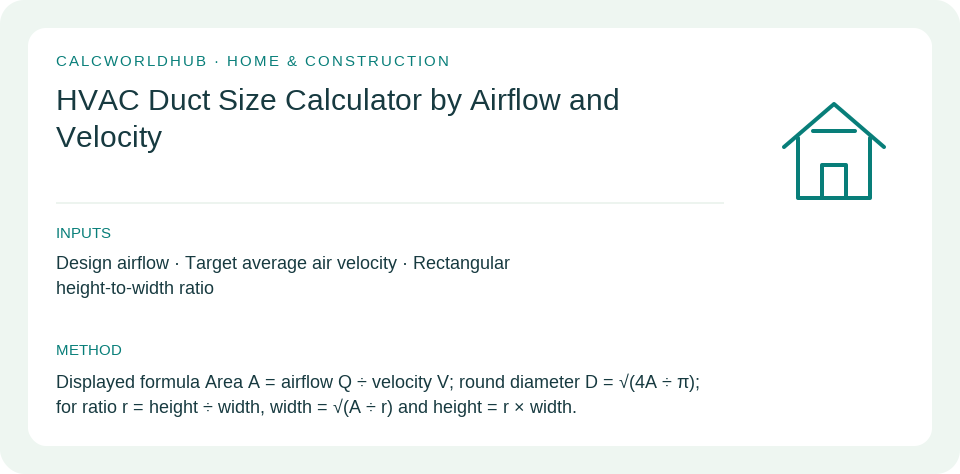
- Enter Design airflow, Target average air velocity, Rectangular height-to-width ratio. Match the units shown beside each field and review the result together with the assumptions below.
- Read the worked example below to check the expected input format and result.
- Compare another scenario by changing one input at a time. Use Reset to return to the starting values.
How this calculation works
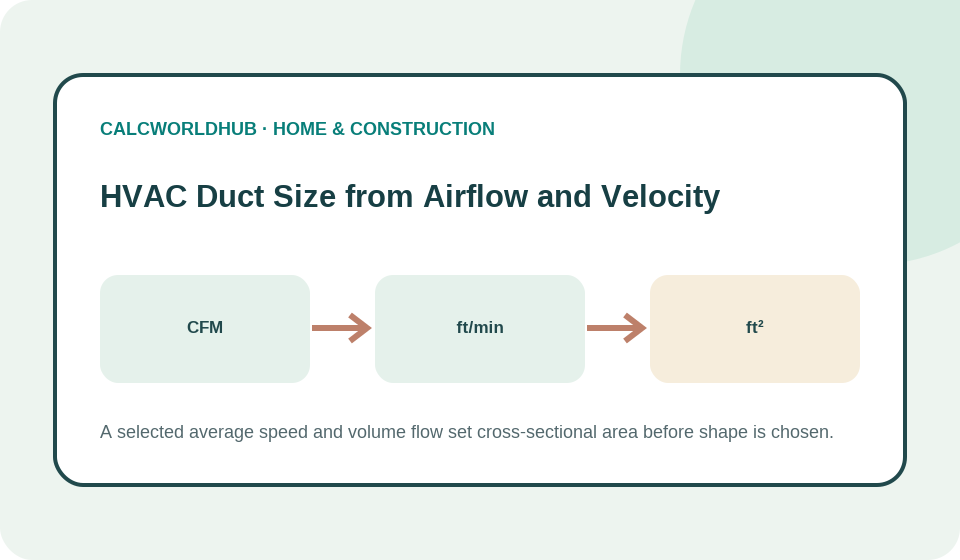
A duct must provide enough cross-sectional area for the selected airflow at the target average velocity. This estimator converts that relationship into an equivalent round diameter and rectangular dimensions for an entered height-to-width ratio.
Inputs and units
airflow— Design airflow- Airflow through this duct section, in cubic feet per minute (CFM).
velocity— Target average air velocity- Selected cross-section average velocity, in feet per minute (ft/min).
ratio— Rectangular height-to-width ratio- Enter height divided by width; 0.5 represents a rectangle twice as wide as it is tall.
Formula
Area A = airflow Q ÷ velocity V; round diameter D = √(4A ÷ π); for ratio r = height ÷ width, width = √(A ÷ r) and height = r × width.
Method
Airflow is entered in cubic feet per minute and velocity in feet per minute, giving area in square feet. The equivalent round diameter and rectangular sides are geometric estimates; they are not selected from a pressure-loss or acoustics design method.
Worked example
For 1,200 CFM at 900 ft/min, area is 1.333 ft². At a 0.5 height-to-width ratio, the equivalent round diameter is about 15.64 in and the rectangular size is about 19.6 × 9.8 in.
Assumptions and limits
This sizing estimate does not calculate friction loss, fitting resistance, leakage, noise, fan curve, or system pressure. A qualified HVAC design should verify duct dimensions and delivered airflow for the actual installation.
Frequently asked questions
How does airflow determine duct area?
Area equals volumetric airflow divided by average velocity when units are consistent.
Does the suggested diameter guarantee the right duct?
No. Pressure drop, fittings, length, noise, fan performance, and applicable design guidance also matter.
What does the rectangular ratio mean?
It is height divided by width. A ratio below one produces a wider-than-tall rectangle.
How do I use the HVAC Duct Size Calculator by Airflow and Velocity?
Enter Design airflow, Target average air velocity, Rectangular height-to-width ratio. Match the units shown beside each field and review the result together with the assumptions below.
What is a worked example of HVAC Duct Size Calculator by Airflow and Velocity?
For 1,200 CFM at 900 ft/min, area is 1.333 ft². At a 0.5 height-to-width ratio, the equivalent round diameter is about 15.64 in and the rectangular size is about 19.6 × 9.8 in.
Reference: ASHRAE Handbook chapter on duct design, airflow, area, and velocity. See our calculation methodology.