Log mean temperature difference calculator
Calculate the log-mean of two positive terminal temperature differences for a heat exchanger.
Calculator
How to use this calculator
Calculate the log-mean of two positive terminal temperature differences for a heat exchanger.
- Enter Terminal temperature difference ΔT₁ (K), Terminal temperature difference ΔT₂ (K). Match the units shown beside each field and review the result together with the assumptions below.
- Read the worked example below to check the expected input format and result.
- Compare another scenario by changing one input at a time. Use Reset to return to the starting values.
Log mean temperature difference calculator
Calculate the log-mean of two positive terminal temperature differences for a heat exchanger.
Inputs and units
- Terminal temperature difference ΔT₁ (K): Positive hot-to-cold terminal difference in kelvins for the selected exchanger flow arrangement.
- Terminal temperature difference ΔT₂ (K): Positive hot-to-cold terminal difference in kelvins for the selected exchanger flow arrangement.
Formula and method
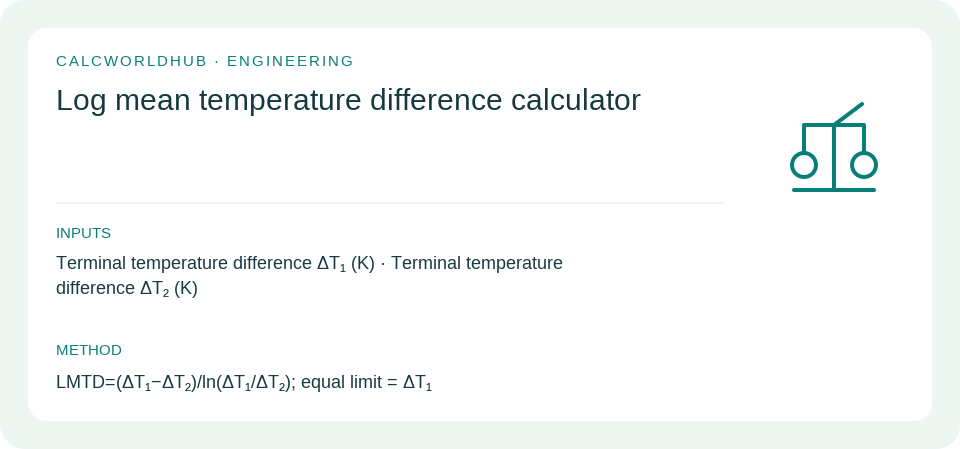
LMTD=(ΔT₁−ΔT₂)/ln(ΔT₁/ΔT₂); equal limit = ΔT₁
Worked example
For 50 K and 30 K, LMTD=20/ln(50/30)≈39.15 K. Equal 40 K endpoints give the continuous limit 40 K.
Interpreting the result
LMTD is the effective temperature-driving difference in the standard heat-exchanger relation; it is not the arithmetic average except as a limiting approximation.
Assumptions and limits
Both terminal differences must be positive for a single-direction temperature profile. The equal case is valid and uses the limit; temperature cross or changing flow arrangement needs separate analysis.
Sources and method
- Relates steady conduction through a slab to thickness, area, and conductivity; resistance form is the reciprocal proportionality. OpenStax University Physics Volume 2: mechanisms of heat transfer
Frequently asked questions
Which inputs determine this result?
The visible inputs are Terminal temperature difference ΔT₁ (K), Terminal temperature difference ΔT₂ (K). Each is used by the displayed formula; the calculator does not use any other hidden measurement.
When does this method apply?
Both terminal differences must be positive for a single-direction temperature profile. The equal case is valid and uses the limit; temperature cross or changing flow arrangement needs separate analysis.
How do I use the Log mean temperature difference calculator?
Enter Terminal temperature difference ΔT₁ (K), Terminal temperature difference ΔT₂ (K). Match the units shown beside each field and review the result together with the assumptions below.
What is a worked example of Log mean temperature difference?
For 50 K and 30 K, LMTD=20/ln(50/30)≈39.15 K. Equal 40 K endpoints give the continuous limit 40 K.
What does the Log mean temperature difference calculator calculate?
Calculate the log-mean of two positive terminal temperature differences for a heat exchanger.
See the calculation methodology.
Good calculators show their work.
CalcWorldHub is built around clear inputs and visible assumptions. Results are estimates for planning; check official sources or your provider’s terms when exact figures matter.