How to use this calculator
Compare entered less-than-truckload and full-truckload quotes and estimate the shipment-weight crossover.
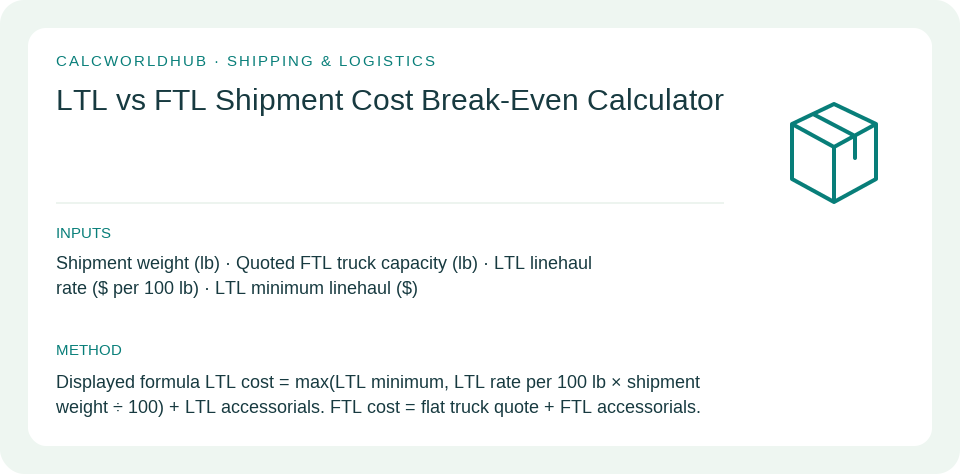
- Enter Shipment weight (lb), Quoted FTL truck capacity (lb), LTL linehaul rate ($ per 100 lb), LTL minimum linehaul ($), then complete the remaining labeled fields. Match the units shown beside each field and review the result together with the assumptions below.
- Read the worked example below to check the expected input format and result.
- Compare another scenario by changing one input at a time. Use Reset to return to the starting values.
How this calculation works
LTL and FTL quotes use different pricing structures. This model compares a user-entered LTL rate per hundredweight with a minimum linehaul charge against a flat FTL quote, then adds the accessorial charges entered for each option.
Inputs and units
weight— Shipment weight (lb)- Actual chargeable shipment weight in pounds for this quote comparison.
capacity— Quoted FTL truck capacity (lb)- Maximum shipment weight covered by the entered flat FTL quote.
ltlRate— LTL linehaul rate ($ per 100 lb)- Entered linear LTL rate per hundredweight before the minimum and accessorials.
ltlMinimum— LTL minimum linehaul ($)- Minimum base linehaul charge before the entered LTL accessorials.
ltlAccessorial— LTL accessorial charges ($)- Additional LTL charges for the compared quote.
ftlQuote— Flat FTL truck quote ($)- Entered flat quote for the whole truck before entered FTL accessorials.
ftlAccessorial— FTL accessorial charges ($)- Additional FTL charges for the compared quote.
Formula
LTL cost = max(LTL minimum, LTL rate per 100 lb × shipment weight ÷ 100) + LTL accessorials. FTL cost = flat truck quote + FTL accessorials.
Method
At the entered shipment weight, calculate each quote model and compare totals. When the LTL linehaul is above its minimum, the crossover weight is 100 × (FTL total − LTL accessorials) ÷ LTL rate per 100 lb.
Worked example
At 8,500 lb, a $15 per 100 lb LTL linehaul rate with a $250 minimum and $80 accessorials gives an estimated LTL total of $1,355. A $1,600 FTL quote plus $120 accessorials totals $1,720; LTL is lower by $365 and the modeled crossover is about 10,933 lb.
Assumptions and limits
This is a simplified quote comparison, not a carrier rate engine. It assumes one linear LTL rate with a minimum and a flat FTL quote; real tariffs may include freight class, density, lane pricing, weight breaks, fuel surcharges, and other terms. Confirm comparable quotes for the actual shipment.
Frequently asked questions
Does this model an actual carrier tariff?
No. It compares the quote terms you enter with a simplified linear LTL model.
What is the LTL minimum used for?
The modeled linehaul charge is the greater of the minimum and the rate multiplied by hundredweight.
Why do real break-even weights vary?
Freight class, density, lane, accessorials, minimums, and weight-break discounts can change the quoted costs.
How do I use the LTL vs FTL Shipment Cost Break-Even Calculator?
Enter Shipment weight (lb), Quoted FTL truck capacity (lb), LTL linehaul rate ($ per 100 lb), LTL minimum linehaul ($), then complete the remaining labeled fields. Match the units shown beside each field and review the result together with the assumptions below.
What is a worked example of LTL vs FTL Shipment Cost Break-Even?
At 8,500 lb, a $15 per 100 lb LTL linehaul rate with a $250 minimum and $80 accessorials gives an estimated LTL total of $1,355. A $1,600 FTL quote plus $120 accessorials totals $1,720; LTL is lower by $365 and the modeled crossover is about 10,933 lb.
Reference: Freightquote guide to LTL and FTL quote structures, minimum charges, and accessorials. See our calculation methodology.