How to use this calculator
Estimate the microbial decimal reduction time at one fixed treatment condition from exposure time and positive initial and final survivor counts.
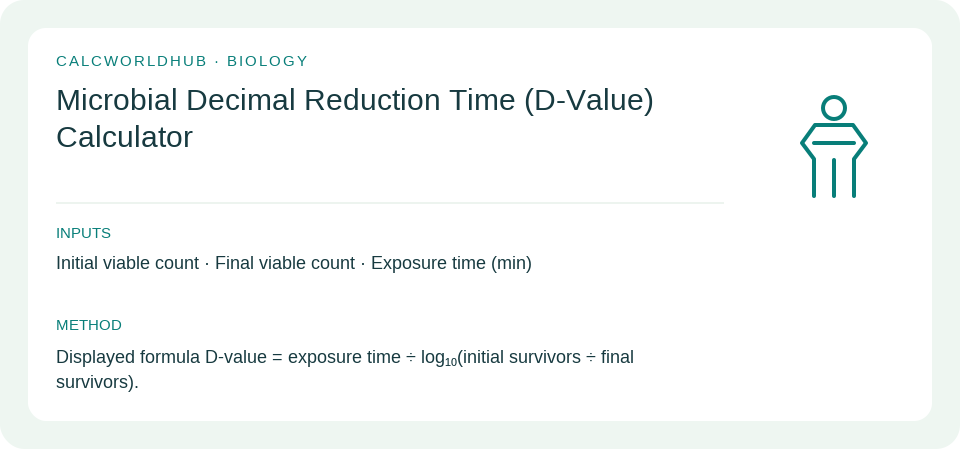
- Enter Initial viable count, Final viable count, Exposure time (min). Match the units shown beside each field and review the result together with the assumptions below.
- Read the worked example below to check the expected input format and result.
- Compare another scenario by changing one input at a time. Use Reset to return to the starting values.
How this calculation works
A D-value is the time at a specified treatment condition needed for one base-10 reduction in a microbial population. This two-point estimate uses the log-linear survivor relationship between the initial and final counts. D-values depend on the organism, medium, temperature, and other exposure conditions.
Inputs and units
initialSurvivors— Initial viable count- Positive count before the defined treatment interval, using the same sample basis as the final count.
finalSurvivors— Final viable count- Positive count after treatment; zero or below-detection values cannot be logged directly.
exposureMinutes— Exposure time (min)- Elapsed treatment duration at the stated constant condition.
Formula
D-value = exposure time ÷ log₁₀(initial survivors ÷ final survivors).
Method
Enter counts measured at the start and end of one treatment interval at the same fixed condition, along with the elapsed time. The ratio of log survivor counts gives the number of decimal reductions during that interval.
Worked example
A decline from 1,000,000 to 1,000 viable organisms in 6 minutes is three decimal reductions, giving a D-value of 2 minutes per log reduction at that condition.
Assumptions and limits
This estimate requires positive detectable counts and log-linear inactivation over the interval. Shoulders, tailing, recovery, detection-limit censoring, and changing conditions require a more suitable model and process-specific validation.
Frequently asked questions
What does one D-value mean?
Under the stated condition and log-linear model, one D-value reduces the surviving population by 90%.
Can a zero final count be entered?
No. A zero or below-detection count is censored data and cannot be logged as an exact survivor count.
Can this predict food safety by itself?
No. Use process-specific microbial studies and validation by qualified food-safety professionals.
How do I use the Microbial Decimal Reduction Time (D-Value) Calculator?
Enter Initial viable count, Final viable count, Exposure time (min). Match the units shown beside each field and review the result together with the assumptions below.
What is a worked example of Microbial Decimal Reduction Time (D-Value)?
A decline from 1,000,000 to 1,000 viable organisms in 6 minutes is three decimal reductions, giving a D-value of 2 minutes per log reduction at that condition.
Reference: U.S. FDA microbial inactivation kinetics guidance for D-values. See our calculation methodology.