How to use this calculator
Estimate the microbial thermal resistance z-value from decimal reduction times measured at two temperatures.
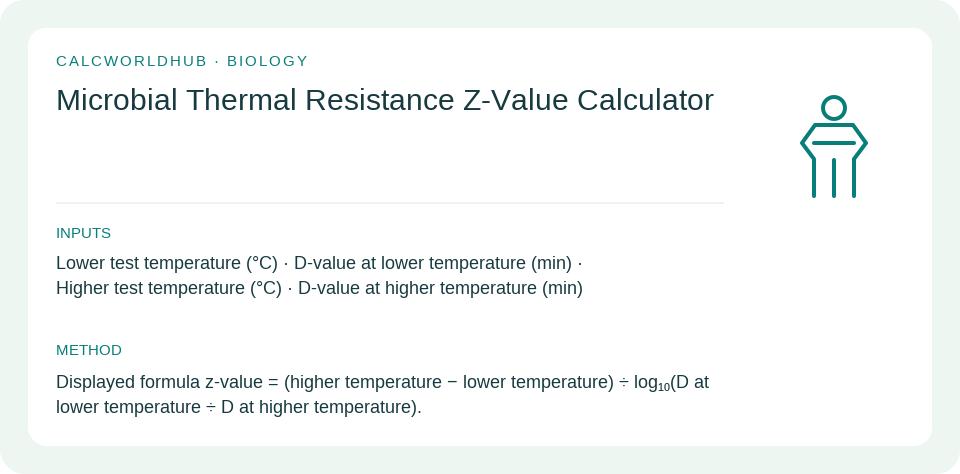
- Enter Lower test temperature (°C), D-value at lower temperature (min), Higher test temperature (°C), D-value at higher temperature (min). Match the units shown beside each field and review the result together with the assumptions below.
- Read the worked example below to check the expected input format and result.
- Compare another scenario by changing one input at a time. Use Reset to return to the starting values.
How this calculation works
The microbial z-value is the temperature increase associated with a tenfold decrease in decimal reduction time. This two-point estimate uses a linear relationship between log₁₀(D) and temperature over the entered interval; it is a characterization of thermal resistance, not a process schedule.
Inputs and units
lowerTemperature— Lower test temperature (°C)- Temperature associated with the longer decimal reduction time.
lowerDValue— D-value at lower temperature (min)- Positive decimal reduction time measured at the lower temperature.
higherTemperature— Higher test temperature (°C)- Higher temperature measured under the same test method and sample conditions.
higherDValue— D-value at higher temperature (min)- Positive decimal reduction time measured at the higher temperature.
Formula
z-value = (higher temperature − lower temperature) ÷ log₁₀(D at lower temperature ÷ D at higher temperature).
Method
Enter two temperatures on the same scale and the matching positive D-values. The higher-temperature observation must have the smaller D-value for a positive z-value under this model.
Worked example
If D is 10 minutes at 110°C and 1 minute at 120°C, the estimated z-value is 10°C per tenfold D-value reduction.
Assumptions and limits
Use data from the same organism, medium, and method over a temperature interval where log₁₀(D) is approximately linear. A two-point estimate is sensitive to measurement uncertainty and is not process validation.
Frequently asked questions
What does a z-value represent?
It is the temperature increase associated with a tenfold decrease in D-value under a log-linear thermal-resistance model.
Can I use Fahrenheit?
Yes. Use one temperature scale consistently; the reported interval is then in degrees of that scale.
Can this define a safe process?
No. Process design requires validated, condition-specific microbial data and qualified review.
How do I use the Microbial Thermal Resistance Z-Value Calculator?
Enter Lower test temperature (°C), D-value at lower temperature (min), Higher test temperature (°C), D-value at higher temperature (min). Match the units shown beside each field and review the result together with the assumptions below.
What is a worked example of Microbial Thermal Resistance Z-Value?
If D is 10 minutes at 110°C and 1 minute at 120°C, the estimated z-value is 10°C per tenfold D-value reduction.
Reference: U.S. FDA microbial inactivation kinetics guidance for z-values. See our calculation methodology.